Mobile County Schools Defends Hiring Process After Background Check Gap Surfaces
State officials say a delayed database update, not a broken hiring process, let a Denton Middle School teacher's earlier arrest slip past screening.
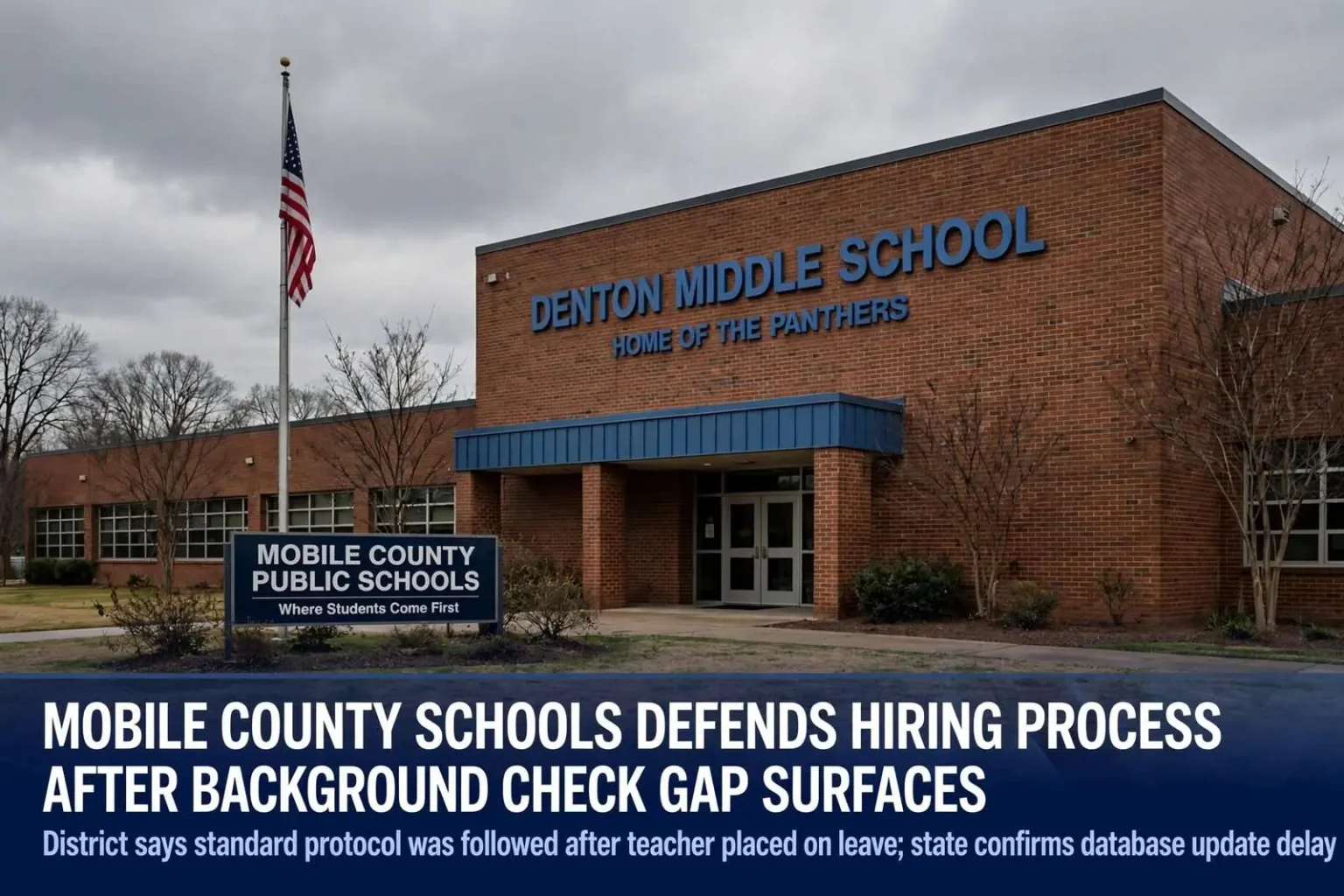
The Mobile County Public Schools System followed its standard hiring protocol when it brought on a Denton Middle School language arts teacher last year, according to a spokesman for the Alabama State Department of Education, even though the teacher had previously faced a criminal charge that was not reflected in the state’s screening database at the time.
The teacher, who taught seventh and eighth grade, was placed on administrative leave from Denton Middle School in early March after a student reported that he had made inappropriate sexual comments to her in the classroom. Mobile police later arrested him on a charge of being a school employee who had sexual contact with a student under 19.
Superintendent Martha Peek said the district removed him from the school immediately after learning of the complaint. “When we realized we had an issue we immediately took action,” Peek said, adding that student safety ranks just behind education among the district’s top priorities.
An earlier arrest, a missed flag
The case drew scrutiny after it emerged that the teacher had been arrested roughly a year earlier while working at a different Alabama middle school, on a charge of indecent exposure. State education officials said they began the process of moving to revoke his teaching certificate soon after that earlier arrest and updated an internal tracking system accordingly. However, the external database that school districts use to check a prospective hire’s certification status was not updated to reflect the pending action when Mobile County schools ran a background check on him in August.
Michael Sibley, the state education department’s director of communications, said the delay was a mistake rather than evidence of a broken process, noting that the department’s certificate portal was updated during one of its busiest stretches of the year, when tens of thousands of renewal requests come in over a matter of weeks. He said the department has since assigned a staff member specifically to keep its various online systems synced in a timely way.
How districts check new hires
In Alabama, the hiring paperwork for a public school teacher runs through the state education department’s certification office. A district verifies that an applicant holds a valid teaching certificate in the relevant subject and grade levels, and it consults the department’s external certificate portal as part of its background review. Separately, most districts conduct criminal background checks through state and federal fingerprint databases before an educator ever stands in front of a classroom. What those checks do not capture, however, is a pending professional disciplinary action — a charge that has not yet produced a conviction appears in no criminal database, and a certificate that has not yet been formally revoked still looks valid to an outside district.
That gap is precisely what opened in this case. The earlier arrest had triggered action inside the state department, but the public-facing portal a hiring district consults still showed a clean certificate. Mobile County schools, checking in August as they would for any applicant, saw what the system told them.
What the district found in its own review
Peek said the district’s own review of the teacher’s file at the time turned up nothing alarming. His references from the prior district were strong, she said, and the certification portal showed no outstanding issues. Sibley confirmed that Mobile County schools did not deviate from normal procedure. “They didn’t break protocol,” he said. “It’s not unusual for school districts to check our external portal for background checks.”
Those assurances matter for the district’s standing, but they also underline the uncomfortable truth of the episode: a district can do everything right and still miss a problem that lives only inside another agency’s files. Strong references and a clean portal are the ordinary signals a hiring office relies on, and both pointed the same direction here.
The earlier record
State records also show the teacher had prior guilty pleas for driving under the influence and for breaking into a vehicle, a Class C felony under Alabama law, before he received his teaching certificate in 2012. A department attorney said a breaking-and-entering conviction alone would not automatically disqualify someone from certification, and it was unclear whether school officials at the time were aware of the DUI charge.
That detail raises a question familiar to every district personnel office in the state: where the line should fall between an applicant’s past mistakes and a career in the classroom. Alabama, like most states, does not bar every conviction from certification; decisions rest with the state department, which weighs the nature of the offense, how long ago it occurred and the type of license sought. A Class C felony property offense, in the department’s view, did not foreclose a certificate — a judgment that looked defensible in 2012 and considerably harder to defend in hindsight.
What happens to his certificate
The teacher was expected to face a certification hearing before the state in mid-June, a proceeding that typically determines whether an educator keeps the credential needed to teach in Alabama public schools. State officials said the revocation process, once triggered, can take up to a year to conclude.
Those timelines help explain why the earlier case produced no visible flag for Mobile County. An administrative process measured in months — notice, hearing, decision, any appeal — moves slowly against a hiring cycle measured in days. A teacher can leave one district under a cloud, apply in another, and be hired and settled into a classroom well before the first district’s paperwork ripens into formal action.
Denton Middle and the district’s response
Denton Middle School serves students in the western part of Mobile, one of the district’s longtime neighborhood middle schools. Parents there learned of the arrest in March, and the district’s decision to place the teacher on leave the same day the complaint surfaced became the first point of reassurance Peek offered. The superintendent’s message — that the complaint was acted on immediately, that the teacher never returned to the classroom, and that police were involved — was aimed at calming exactly the concerns a report of this kind raises among families.
The episode has prompted closer attention to how quickly state and local systems share information about educators facing discipline, particularly during seasonal surges when certificate renewals and staffing changes are heaviest across Alabama’s school districts.
Where the system goes from here
The state department’s response so far has been administrative: a staff member assigned specifically to keep the internal tracking system and the external certificate portal in sync, so that a pending revocation becomes visible to any district that checks. That is a modest fix, but it addresses the exact failure mode this case exposed — two databases inside the same agency telling different stories about the same teacher.
The larger lesson is one that school systems across Alabama have been absorbing for years: no single check is sufficient. A certificate verification, a reference call and a criminal background check each cover a different corner of an applicant’s history, and the corners do not always overlap. Districts that hire in the spring and summer rush, when resignations and new budgets compress the calendar, have the least time to reconcile the differences.
The scale of the hiring challenge
Any hiring lapse lands differently in a system the size of Mobile County’s, the largest public school system in Alabama. The district hires hundreds of teachers in a typical year, drawing from education schools across the state and from neighboring systems, and its personnel office processes those files against the same spring-to-summer deadline every district faces. Each hire requires the same sequence: application review, interview, reference checks, certificate verification through the state portal, and the state and federal background check that accompanies a fingerprint submission.
At that volume, a hiring office depends on the systems behind each check being current. When one of them lags — as the state’s external certificate portal did here during the renewal rush — the error does not announce itself. It looks like a routine clearance, and the file moves on. That is why the state’s admission that the delay was a mistake, rather than a protocol failure, cuts both ways: it clears the district of blame while confirming that the flaw sat in the shared infrastructure every county system leans on.
For Mobile County, the immediate matter is resolved: the teacher is gone from Denton Middle, the criminal case is in the courts, and the state will decide his certification at the June hearing. The harder question — how to make sure the next teacher with a pending disciplinary file in one county does not surface with a clean portal in another — now sits with the state department, where officials say the syncing problem has been recognized and assigned. Parents, for their part, are left to weigh a familiar set of reassurances against an uncomfortable gap, and to hope the assignment keeps the next one from slipping through.