University of South Alabama Foley
Baldwin County Baby Born Without a Nose Becomes Global Story of Hope
A Baldwin County baby born without a nose due to an extremely rare condition has drawn worldwide attention and support from his local community.
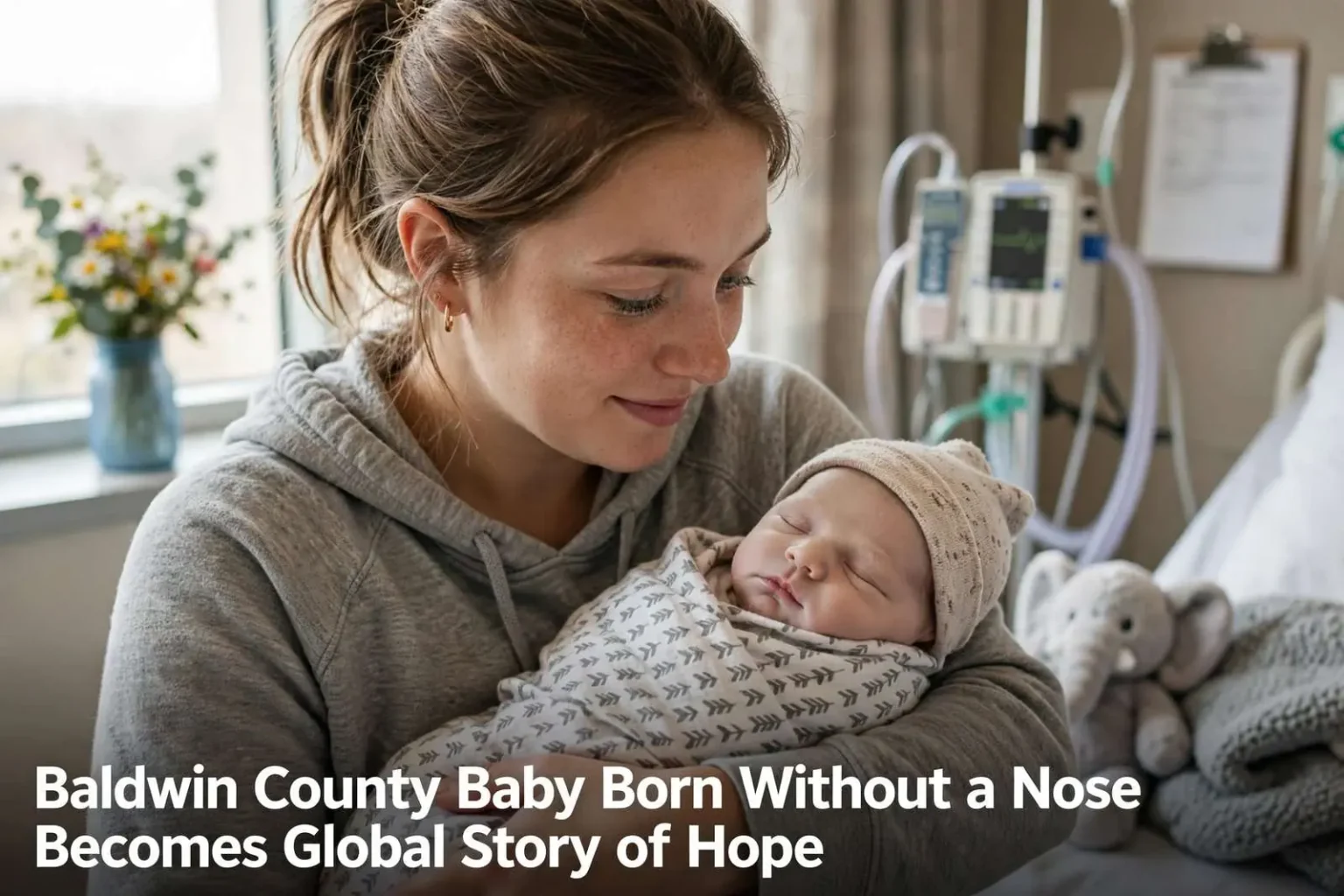
A Baldwin County family found itself thrust into the international spotlight this spring after a baby born without a nose at South Baldwin Hospital in Foley became an unlikely internet sensation and a source of hope for families around the world facing the same rare condition.
Eli Thompson was born March 4 seemingly healthy in every way except one: he had no nose. He was quickly transferred to the University of South Alabama Childrens and Womens Hospital in Mobile, where doctors identified his condition as complete congenital arhinia, a disorder so rare that only about three dozen documented cases exist worldwide. The odds of being born with it are estimated at roughly one in 197 million.
The transfer across the Bay reflects the role the Mobile hospital plays for the entire Gulf Coast region. Children’s and Women’s is where fragile newborns from across south Alabama and the panhandle are sent when a birth presents something a community hospital is not equipped to manage, and its neonatal specialists see the cases that trainee textbooks describe as once-in-a-career events. Arhinia — the absence of a nose at birth — sits at the extreme end of that spectrum, affecting the airway, and it is the kind of diagnosis that instantly mobilizes a team of specialists who will follow a child for years.
A story that traveled
After his mother, Brandi McGlathery, shared his story locally at the end of March, the coverage snowballed almost overnight. National outlets picked it up within days, sending Eli’s story to audiences well beyond South Alabama. A Facebook page created to document his progress grew from a few thousand followers to tens of thousands within about a week, and a fundraiser set up to help cover his mounting medical expenses jumped from a few thousand dollars to well over $30,000 in the same span.
The speed was a product of both the story’s rarity and the mechanics of modern sharing. A newborn’s photographs are the most-passed currency on social media, and an image of a healthy, alert baby with a condition almost no one has seen travels instantly across platforms and borders. Comment sections filled with parents of children with rare conditions, medical professionals, and strangers offering prayers in a dozen languages — the digital equivalent of a casserole on the porch, arriving thousands of messages at a time.
For Eli’s extended family, the sudden attention has meant learning to balance a newborn’s intensive medical needs with a nonstop stream of interview requests, well-wishes and messages arriving from across the globe. Sharon Thompson, whom Eli calls his Maw Maw, has spent hours each day helping respond to messages, at times relying on translation tools to reply to families writing in from Europe and beyond.
The correspondence has run both ways: families touched by arhinia or similar airway conditions have written to offer hard-won practical advice about feeding, breathing and surgery timing, turning a Facebook wall into an informal support group that no rare-disease family could have assembled a generation ago. Before the internet, the parents of one of three dozen documented cases worldwide might never find another; now they can compare notes the same week they receive a diagnosis.
Life in two counties
Day to day, caring for Eli has required near-constant travel between family homes in Baldwin and Mobile counties, since Eli and his mother split time between relatives in Summerdale and in west Mobile, a roughly 90-minute round trip that has to accommodate a small SUV’s worth of medical equipment.
To simplify things, Eli’s grandparents are in the process of purchasing a home in Silverhill, just a few miles from where Brandi and Eli are staying, in hopes of shortening that commute once the move is complete.
The geography matters more than outsiders might guess. Eli’s airway requires equipment and vigilance that cannot be left behind, so every trip to specialists in Mobile is a packing operation, and every night’s lodging has to be within reach of the hospital that knows his case. Families of medically complex children routinely reorganize their lives around drive times in exactly this way, and the grandparents’ move to Silverhill is a quiet act of logistics — putting the people who help most a few miles instead of an hour away.
Community support has also taken a distinctly local shape. A fish fry and barbecue fundraiser benefiting Eli’s medical costs was held at Elberta City Park, drawing not just neighbors but a national television crew that came to document the outpouring of goodwill from Baldwin County residents.
South Baldwin County has a long habit of showing up for its own through plate-lunch fundraisers — fire departments, volunteer groups and school communities raising money one styrofoam plate at a time — and the Elberta park gathering fit the template, scaled up by the attention the family’s story had drawn. For the family, the turnout carried a message no national broadcast could: the neighbors who watched Eli’s story unfold on their feeds were prepared to stand in line for barbecue to help pay for his care.
What comes next
Family members have described the experience as humbling, saying strangers’ messages from unfamiliar corners of the world have offered a kind of reassurance that is hard to put into words.
Despite the whirlwind of attention, relatives say the goal remains simple: keeping Eli healthy, comfortable and surrounded by the same close-knit family and community support that first rallied around him in Baldwin County.
Doctors continue to monitor Eli’s development, and the family has said additional procedures may be part of his future care as specialists assess the best long-term path forward for a case with so few medical precedents to draw from anywhere in the world.
That lack of precedent shapes every decision ahead. Surgical options for arhinia are measured against a handful of outcomes worldwide, and specialists typically stage interventions around a child’s growth, weighing airway safety first and reconstruction later. Eli’s medical team, his family and thousands of online well-wishers will all be watching the same development the way the county watches one of its own — month by month, photograph by photograph, with the Facebook page that introduced him to the world continuing to tell his story as he grows.
Complete congenital arhinia involves more than appearance. The nose carries the main airway, and a baby born without one must learn to breathe and feed with medical support while specialists map the anatomy that would normally develop. Cases documented in medical literature describe challenges that reach beyond the airway into development and sight, which is why children with the condition are typically followed by teams that include surgeons, sleep specialists, ophthalmologists and endocrinologists. With so few cases in the medical record, each child’s care plan is written from scratch — combining what the literature offers with the judgment of physicians seeing something most will never encounter again in their careers.
South Baldwin Hospital, where Eli was born, serves the fast-growing southern end of Baldwin County from Foley, and its staff delivered the steady newborn care that preceded the transfer. From there the family’s orbit has centered on the Children’s and Women’s campus in Mobile, the region’s full-service children’s hospital, where the drive up the Bay has become routine. Families in similar situations describe the pattern: a rotation of appointments, a trunk full of monitors and supplies, and a growing fluency in medical vocabulary no parent expects to learn. What made the Thompson-McGlathery family’s version unusual was not the travel or the equipment but the audience — tens of thousands of strangers watching the routine of care and cheering each update.
The fundraiser’s growth, from a few thousand dollars to more than $30,000 in about a week, spoke to how far the story had reached and how quickly online communities convert attention into help. Online medical fundraising has become a familiar lifeline for families of children with rare conditions, whose treatment plans often span years and are only partly covered by insurance. For Eli’s family, the money arrives alongside the messages, and both are put to the same purpose: keeping a small boy in Summerdale healthy while his doctors plan a path no one has walked before.
The national media attention cut in both directions, as the family has acknowledged. Cameras at a park fundraiser and crews at hospital doors bring donations and awareness, but they also complicate the privacy a medically fragile newborn requires, and relatives have had to decide which requests to grant and which to decline. The family’s answer has been consistent — share what helps other families, protect the quiet moments of ordinary babyhood — and the Facebook-era followers, by most accounts, have respected that line, treating the page less like a spectacle than a family album they were invited into.