Baldwin County Baby Born Without a Nose Defies One-in-197-Million Odds
A Baldwin County newborn born with an ultra-rare congenital condition that left him without a nose is defying odds of one in 197 million.
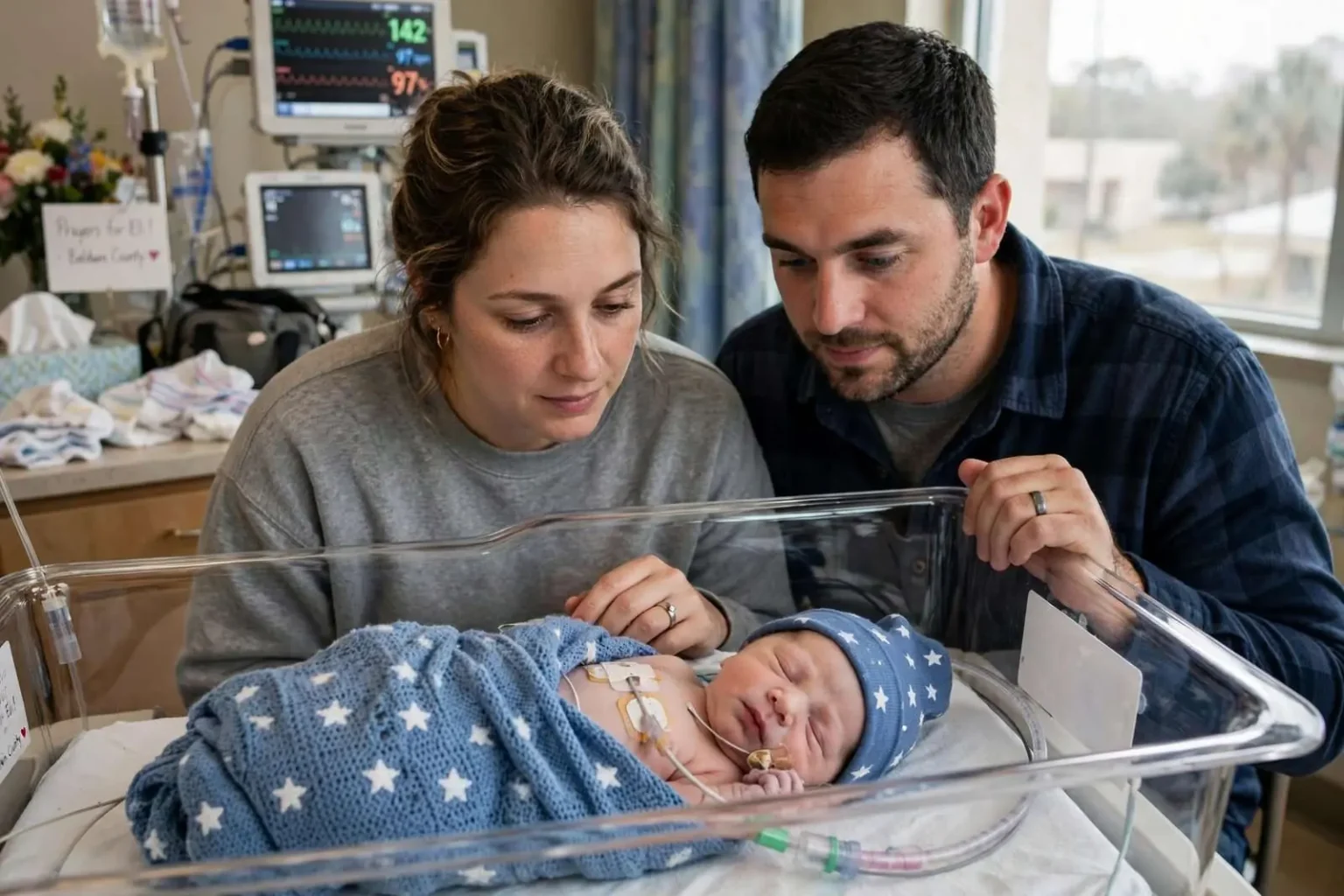
A Baldwin County couple is adjusting to life with a newborn who has become known locally as a miracle baby after he was born earlier this month with an extraordinarily rare congenital condition that left him without a nose. The story has spread quickly through the county’s close-knit communities, where word of the baby’s arrival — and his survival — has drawn an outpouring of support for a family facing a medical journey no parent expects.
The baby, named Eli, was born at South Baldwin Hospital weighing just over six and a half pounds. Moments after delivery, his mother noticed something was different and asked the delivery team whether everything was alright. She was initially reassured, but soon realized what she had first suspected: her son had been born without a nose, a condition doctors would later identify as complete congenital arhinia.
According to medical literature the family has since researched, arhinia is one of the rarest congenital conditions in the world, with only a few dozen documented cases globally and odds estimated at roughly one in 197 million births. Numbers of that scale are difficult to comprehend; put plainly, a case like Eli’s is not something most obstetricians, neonatologists or pediatric nurses will encounter even once in an entire career.
The first hours
Despite the shock of the diagnosis, doctors quickly determined the baby was breathing without major difficulty through his mouth and stabilized him with supplemental oxygen support in the hours after birth. That assessment mattered enormously, because the nose plays a critical role in a newborn’s airway, and the first question with any infant born without one is whether the baby can breathe and feed on his own.
Eli was soon transferred to USA Children’s and Women’s Hospital in Mobile for specialized care and evaluation. The Mobile hospital is the region’s referral center for high-risk newborns and children, serving families across south Alabama and the Gulf Coast, and its neonatal specialists have the equipment and expertise that a community hospital’s delivery team cannot provide for a case this rare.
His mother said she called the hospital repeatedly through the first night, uncertain whether her son would make it, and was relieved each time to learn he was holding steady. Those overnight hours — the phone calls, the uncertainty, the drive between Foley-area home and the Mobile hospital — are the part of the story that parents across the county have responded to most, because every family can imagine them.
In the days since, doctors and specialists caring for him have described the case as remarkable, both for its rarity and for how well the newborn has adapted. Babies are resilient in ways adult medicine does not always expect, and Eli’s ability to breathe and feed through his mouth, with support, has given his care team cautious optimism as they map out what comes next.
Nothing in the prenatal record
Physicians who reviewed the pregnancy records found nothing in the mother’s prenatal testing, ultrasounds or medical history that would have predicted the condition. A 3D ultrasound taken during the pregnancy had even shown what appeared to be a normally formed nose, made up of bone structure beneath the skin rather than the soft tissue that would typically develop into a visible nose.
That detail has been among the hardest for the family to reconcile. Parents rely on prenatal imaging to prepare for almost anything that can be seen, and the scan gave no indication that Eli’s development had taken the course it did. Complete congenital arhinia occurs so early in embryonic development — before most women know they are pregnant — that the nasal structures simply never form, and in cases like Eli’s the imaging can look reassuring even as the underlying anatomy is absent.
The experience has also been a sobering lesson in the limits of screening for the family’s doctors and, by extension, for other expectant parents in the community who have followed the story. With a condition this rare, there is no routine test and no reason one would have been ordered; the odds of roughly one in 197 million place arhinia far beyond the population-level risk thresholds that guide prenatal care.
What arhinia means medically
Doctors say children born with arhinia often require staged reconstructive surgery as they grow, along with ongoing care for breathing, feeding, tear drainage and, in many cases, vision and dental development. The nose is not a single structure but an interconnected system of airways, sinuses, tear ducts and facial bones, and its absence affects all of them to varying degrees.
Reconstructive approaches are typically spread across childhood and adolescence, with surgeons waiting for facial growth to reach key milestones before each stage. Families who have navigated the condition describe a marathon rather than a sprint: early procedures focused on securing a reliable airway, followed by years of monitoring and a series of operations intended to build both function and appearance over time.
Because so few cases exist worldwide, much of the medical guidance comes from case reports and the accumulated experience of craniofacial teams at major children’s hospitals. Families often become, out of necessity, deeply informed coordinators of their child’s care, connecting specialists across states to assemble a treatment plan that the medical literature can only sketch in broad terms.
Arhinia cases documented in the medical literature also note the condition’s frequent companions — differences in the sense of smell, tear drainage and the hard palate — which is why the evaluations ahead are so comprehensive. Nothing about Eli’s early adaptation guarantees what the coming evaluations will show, but his stable start has allowed his family and his care team to approach that work without the emergency posture that accompanied his first hours.
For now, Eli’s daily care centers on the fundamentals: making sure he breathes comfortably, feeds well and gains weight, with his care team in Mobile monitoring his progress and coordinating the evaluations that will determine the timing and shape of any surgical pathway ahead.
A community rallies
News of Eli’s birth has moved through Baldwin County the way such news always does — through congregations, school networks and social media groups — and the response has been immediate. Friends, neighbors and strangers alike have offered prayers, meals and practical help, in a pattern familiar to Gulf Coast communities that reliably show up for their own in moments of crisis.
Friends of the family have organized meal trains and errand help to keep the couple’s attention where it belongs, on their son and on the trips back and forth to Mobile. It is the kind of quiet logistics work that never makes headlines but often matters most, and it has freed the family to focus on feeding schedules, specialist appointments and the simple business of getting to know their newborn.
The family’s willingness to share their son’s story has itself drawn attention, in part because rare-condition families often carry a dual burden: adjusting to a diagnosis almost no one has heard of, and explaining it over and over to a well-meaning community. By talking openly about arhinia and about Eli’s progress, his parents have given the county something to rally around while also raising awareness of a condition most readers had never encountered.
South Baldwin Hospital’s delivery team, for its part, faced the kind of moment no amount of training fully prepares a unit for, and staff members have been credited by the family with guiding them through those first disorienting hours — stabilizing Eli, arranging the transfer to Mobile and helping his parents understand what was happening at each step.
The road ahead
The weeks and months ahead will be defined by evaluations. Specialists in Mobile and, likely, at craniofacial centers beyond the region will assess Eli’s airway, feeding, eyes and facial development to build the individualized plan his condition requires. Each finding will shape decisions about surgery, timing and the interventions he will need as he grows.
For his parents, the immediate milestones are the ones familiar to any family with a newborn — feeding schedules, weight checks, appointments — layered on top of a medical calendar no one planned for. They have described their son, in these first weeks, as a fighter, and his early resilience has been the thread the family has held onto through the uncertainty.
The medical literature on arhinia offers a wider measure of hope as well. Children documented with the condition have grown up attending school, playing sports and living full lives, with reconstructive surgery and adaptive care addressing the challenges as they arise. The rarity of the condition means every case adds to the world’s understanding of it, and Eli’s care, in time, will contribute to that growing body of knowledge.
For now, a Baldwin County family is taking the journey one day at a time, buoyed by a community that has embraced a baby who beat odds of one in 197 million simply by arriving — breathing, holding steady and, in the words of those caring for him, remarkable.