Bay Minette WWII Veteran Recalls Service Aboard Navy Ship, Decades at Phone Company
Will J. 'Billy' Steen, a 96-year-old WWII veteran living in Bay Minette, recalls his Navy service and decades helping build Alabama's phone lines.
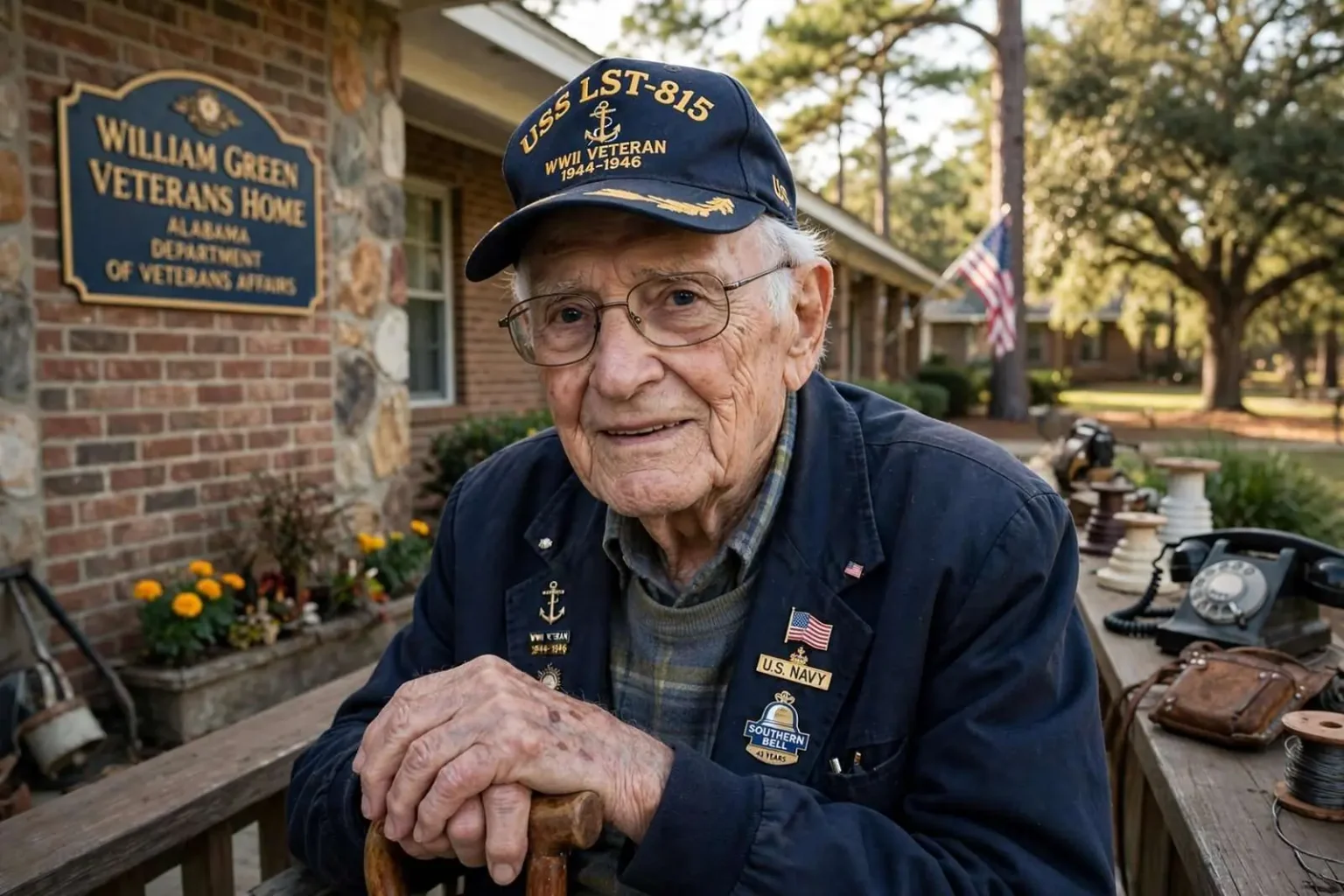
At the William Green Veterans Home in Bay Minette, 96-year-old Will J. “Billy” Steen spends his days sharing stories from a life that spanned a world war and nearly half a century with the same employer, building some of the earliest phone lines across central Alabama.
Steen is among the shrinking ranks of Americans who served in the Second World War, and his memories place him in two institutions that shaped modern Alabama: the wartime Navy that carried the country to victory in the Pacific and the telephone company that wired the state for the century that followed. Residents and staff at the home have come to know him as a storyteller whose recollections reach back to a time that now exists mostly in history books.
The Bay Minette facility, operated by the Alabama Department of Veterans Affairs, is one of the state’s veterans homes, providing long-term care for honorably discharged service members. For residents like Steen, it is also a place where military service remains the common language — where a story about a Navy generator room finds listeners who understand exactly what it means to have served.
Service aboard USS LST-815
Steen served in the U.S. Navy from 1944 through the end of 1946, working in the generator room of the USS LST-815, where he helped supply power to various parts of the ship.
Landing Ship, Tank vessels — LSTs — were the workhorses of the Allied war effort, designed to beach themselves on hostile shores and disgorge tanks, trucks and troops directly onto the sand. Thousands were built during the war, and their crews lived in close quarters while the ships carried everything from armored vehicles to fuel between islands, beaches and ports across the theaters of operation.
Aboard an LST, the generator room was the ship’s heartbeat. Power from the generators ran everything from the radios and navigation equipment to the galleys and pumps, and the men who kept the generators turning worked in a hot, loud space that most crew members never saw. It was essential duty, and Steen performed it from the time he boarded through the end of the war and beyond.
After the war ended, he spent time distributing surplus military equipment. “We hauled tanks and any kind of armor that the soldiers could grab and run off with,” he recalled.
The postwar demobilization created one of the largest logistics operations in history, as the military disposed of the mountains of equipment it had assembled to fight across two oceans. Steen’s assignment to that effort put him among the sailors handling the drawdown, moving the machinery of war to depots, sale lots and scrap lines while the nation brought its forces home.
Called to serve
Before he was drafted, Steen worked for Southern Bell Telephone Company, later known as BellSouth. Asked whether he was nervous when he received his call to serve, Steen didn’t hesitate: “You’re doggone right.”
His nerves were understandable for a young man leaving home for the first time in wartime. Even though his ship typically anchored in relatively safe waters, he said the uncertainty of wartime service was constant. “You’re always nervous because you don’t know what is going to happen to you,” he said.
That uncertainty was the shared condition of everyone in uniform between 1944 and 1946. Ships that spent their service in support roles could still face storms, accidents and the random dangers of wartime movement, and sailors aboard support vessels like LSTs lived with the knowledge that their assignments could change with little notice.
One thing Steen could count on was a job waiting for him back home. After his discharge at the end of 1946, he returned to Southern Bell and stayed with the company until his retirement in 1989 — a 43-year career built almost entirely around helping wire the region for telephone service.
Veterans returning from the Second World War came home to the most robust job market in a generation, and the telephone company was among the employers that absorbed them in large numbers. The skills, discipline and reliability that the military demanded translated directly to the lineman’s trade, where crews worked in all weather to build and maintain the network that connected Alabama’s towns to one another and to the rest of the country.
Wiring central Alabama
“He and his people put in some of the very first phone lines in central Alabama,” said his son, 70-year-old Will J. Steen Jr.
According to the younger Steen, crews in that era relied on manual labor and even horses and mules to string and tighten lines along utility poles. “It was a different era,” he said. “He had one job all his life. That was it.”
The telephone network that Steen helped build was, in its day, transformative infrastructure. In the decades after World War II, telephone service spread from cities into small towns and rural communities across the state, and the crews who strung the copper did the work pole by pole across hundreds of miles of Alabama countryside. The arrival of a line meant a farm or a town crossroads could reach a doctor, a sheriff or family members who had moved away — connections that earlier generations had made by letter or by travel.
The company Steen joined was part of the Bell System, the national network of regional operators that provided most American telephone service for the better part of a century. Southern Bell served the Southeast, and its Alabama operations grew steadily through the postwar decades before the corporate lineage eventually became BellSouth, which itself was absorbed into AT&T decades after Steen’s retirement.
A 43-year career with a single employer is a rarity in any era, and it was already unusual by the time Steen retired in 1989. His son’s summary — one job, all his life — captures a working generation for whom the pattern was not: men who came home from the war, took up a trade, and stayed with it until the pension arrived.
Steen’s path ran through the wire central Alabama town of Pine Apple, where he was born, and through Moore Academy, the town’s school, from which he graduated before eventually settling into his long career with the phone company. The community in Wilcox County was typical of the small towns his postwar work would later connect — the kind of place where a telephone line changed daily life.
Life at the veterans home
Today, Steen’s wartime and working years live on in the retelling at the William Green Veterans Home, where residents and staff count his stories among the facility’s treasures. Veterans homes like the one in Bay Minette serve men and women from every branch and every era, and the residents who lived through the Second World War occupy a place of honor in that community — their numbers growing smaller each year as the generation ages.
The home bears the name of William F. Green, a prominent Alabama veterans advocate, and it has served the state’s aging veterans for decades from its Baldwin County campus. For families in the region, it offers care designed around the particular needs and camaraderie of those who served, with staff who understand the experiences their residents carry.
Storytelling is more than pastime in such a setting. Researchers and caregivers who work with aging veterans have long noted the value of reminiscence — the retelling of a life’s events — for memory, mood and connection, and a resident like Steen, with stories that reach from a Navy generator room to the mule teams that strung telephone wire, offers his listeners a living bridge to a vanished era.
The generation he represents
Steen’s biography traces the arc of what has become known as the Greatest Generation: a small-town Alabama childhood, service in a global war, and a long working life building the infrastructure of modern life. Americans who served in the Second World War numbered more than 16 million, and by the mid-2010s fewer than a million remained, making each veteran’s account a record worth keeping.
The details of his service — the generator room, the surplus hauls, the constant low-grade uncertainty — are the details history books rarely capture. Official records describe what the LSTs carried and where they went; they do not describe what it sounded and felt like to keep the lights on aboard one, or what a young Alabaman thought about as he wondered what would happen next. It is precisely those details that survive only when veterans tell them and families and communities listen.
His working years, likewise, record a chapter of Alabama’s development that is easy to overlook. The copper lines Steen’s crews planted across central Alabama were the state’s first links in a communications revolution that has since run through satellites, cellular networks and fiber optics, each generation of technology building on the physical network that men like him assembled pole by pole.
Asked whether he would do it all again — both his wartime service and his decades-long career — Steen answered simply, “Heck yeah.”
That answer, delivered with a veteran’s economy of words, sums up a life measured in service: to the country in wartime, to the communities his phone lines connected, and to the family that now hears his stories at the Bay Minette home. Ninety-six years in, Billy Steen’s account of the Navy, the phone company and a different era remains as straightforward as the man himself — a job done, and done gladly, all his life.