University of Mobile to Host Civil War Historian for Anniversary Lecture Series
The University of Mobile marks the 10th year of its Billy G. Hinson Lecture Series with a talk on the legacy of Lee's surrender at Appomattox.
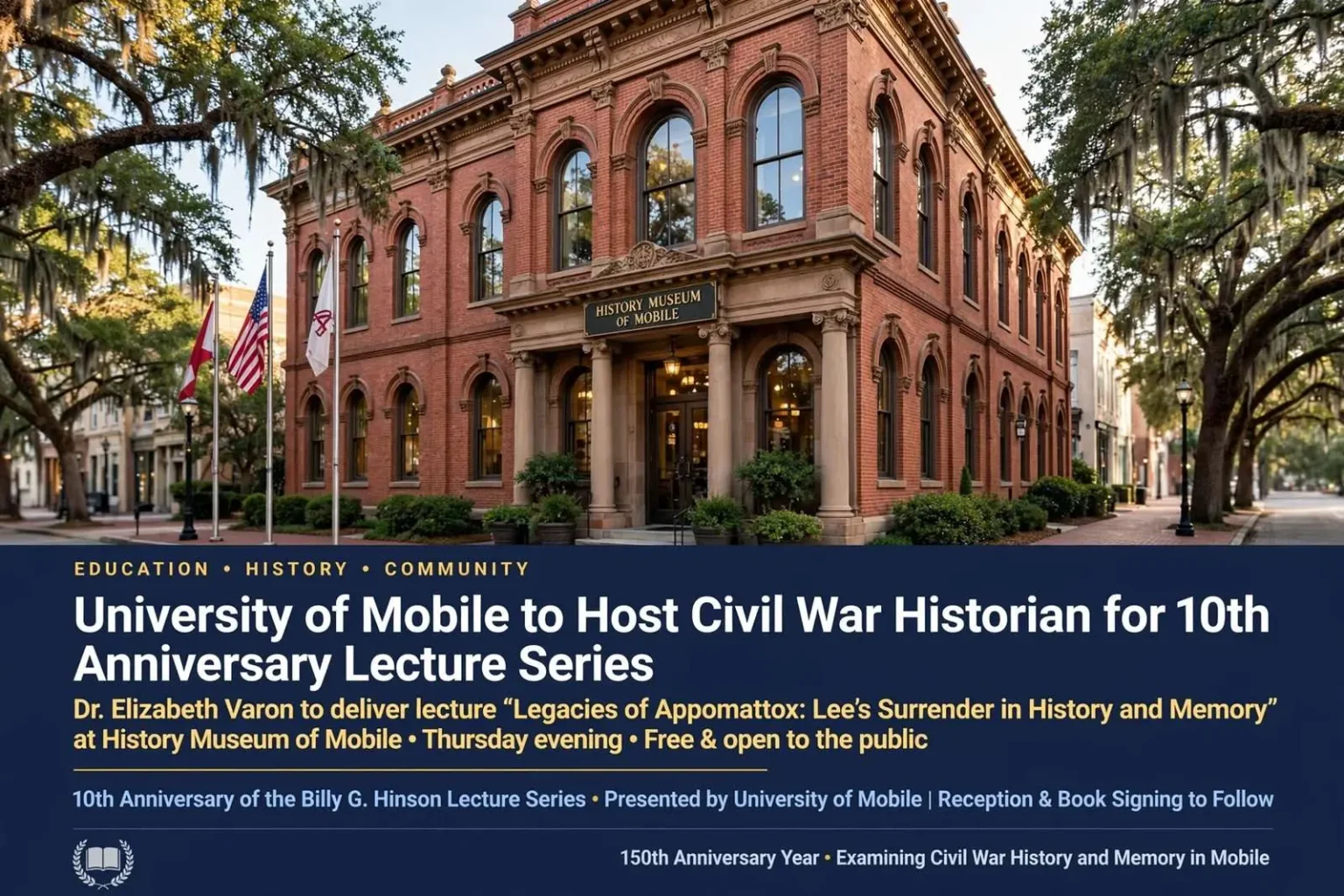
The University of Mobile is preparing to welcome a nationally recognized Civil War historian to campus this week as part of a decade-old lecture series honoring Southern history scholarship. Dr. Elizabeth Varon, a professor of American history at the University of Virginia, will speak at the History Museum of Mobile as the featured guest for the 10th anniversary of the Billy G. Hinson Lecture Series. Her talk, titled “Legacies of Appomattox: Lee’s Surrender in History and Memory,” is scheduled for Thursday evening and will include a reception and book signing following the lecture. The event is free and open to the public, a format that has made the series one of the most accessible intellectual offerings in the Mobile area each year.
Organizers say the timing is significant, arriving during the 150th anniversary year of the Civil War’s end. Communities across the South have spent the sesquicentennial period re-examining how the war is taught, remembered and commemorated, and Mobile has its own deep store of Civil War history, from the Battle of Mobile Bay to the city’s occupation by federal forces in the war’s final months. Hosting a scholar of Varon’s standing during the anniversary year gives local audiences a chance to engage with that history through current scholarship rather than inherited assumption, and organizers have framed the lecture as an invitation to think carefully about how the war’s ending shaped the century that followed.
Dr. Lonnie Burnett, a history professor at the University of Mobile who directs the lecture series, said Varon’s scholarship goes beyond a simple retelling of the surrender at Appomattox Court House. “She will examine not just the closing events of the American Civil War that led to the surrender, but will also explore the meaning of the war in historical memory,” Burnett said in announcing the event. The distinction Burnett draws is central to Varon’s reputation among historians. Where older accounts often treated Appomattox as a tidy endpoint, recent scholarship has examined the surrender as a contested moment whose meaning was argued over for generations, shaping everything from reunion narratives to the way the causes of the war were remembered in the former Confederate states.
A Scholar of National Standing
Varon holds a doctorate from Yale University and completed her undergraduate studies at Swarthmore College, an academic path that has carried her to the forefront of Civil War-era scholarship. She teaches American history at the University of Virginia, one of the nation’s most prominent public research universities, and her work is regularly assigned in graduate seminars on the Civil War and Reconstruction. Her 2014 book on the end of the Civil War, exploring themes of victory, defeat and freedom, won a Library of Virginia literary award for nonfiction and was a finalist for two other major historical writing prizes, a run of recognition that reflected how widely the book resonated both inside and outside the academy.
An earlier work profiling a Confederate-era figure was named by a national business publication as one of the top five books on the Civil War written outside the traditional battlefield narrative, further evidence of Varon’s reach beyond academic readers. Varon is a frequent speaker at academic conferences nationwide and has appeared on C-SPAN’s public affairs programming discussing Civil War history, appearances that have introduced her arguments to a broad public audience. For a Mobile audience, her visit offers the kind of speaker typically reserved for major universities in larger markets, and the lecture series’ organizers have long treated that access as part of the event’s mission.
A Series Built on a Teacher’s Legacy
The lecture series bears the name of Dr. Billy Hinson, a longtime history professor at the University of Mobile, and was created by the university’s College of Arts and Sciences to bring in scholars focused on Southern history topics. Hinson spent decades teaching generations of students on the campus and built a reputation as a devoted classroom instructor and a keeper of the region’s historical memory, and the series that carries his name was designed to extend that teaching beyond the university’s walls. Over the past decade, the series has become a fixture for history enthusiasts across the Mobile area looking for in-depth discussion beyond the classroom, drawing audiences of students, faculty, alumni and community members to each installment.
The choice of venue for the anniversary lecture reflects the series’ community orientation. The History Museum of Mobile sits in the city’s historic district and serves as the area’s principal institution for public history, making it a natural gathering place for an event expected to draw attendees with no formal connection to the university. Pairing the lecture with a reception and book signing gives attendees the chance to meet the speaker and have copies of her work inscribed, a detail that organizers of scholarly events have found turns a one-evening talk into a lasting engagement with the subject matter.
University officials say the event is intended for anyone with an interest in Civil War history, not just students or academics, and community members are encouraged to attend even if they have no formal ties to the university. That open-door approach has defined the series since its founding, and organizers have consistently resisted framing the lectures as purely academic exercises. The anniversary year adds an extra layer of significance for those who have followed the series from its beginning, offering a vantage point on how the event has grown and how the region’s appetite for serious historical discussion has held up over the decade.
The subject of Varon’s Mobile talk, the surrender at Appomattox Court House, remains one of the most closely studied episodes in American history. In April 1865, after a final campaign across Virginia, Confederate General Robert E. Lee surrendered the Army of Northern Virginia to Union General Ulysses S. Grant, an event that signaled the effective end of the major fighting of the Civil War and became, in the popular imagination, the symbolic close of the conflict itself. The terms Grant offered, which allowed Confederate soldiers to return home with their horses and without trials for treason, shaped the way the surrender was remembered and fed later arguments about the war’s meaning. Historians in recent decades have pressed on those memories, asking whose voices were included in the story of Appomattox and whose were pushed to its margins, questions that sit at the center of Varon’s published work.
For Mobile residents, the broader Civil War story has particular local texture. Mobile Bay was the scene of one of the war’s most famous naval engagements in August 1864, when a Union fleet under Adm. David Farragut ran past the bay’s defenses and closed the port to blockade runners. The city itself held out until the final weeks of the war, and federal troops occupied Mobile in the spring of 1865 as the Confederacy dissolved. That local experience of war’s end, coming in a city that had endured blockade and hardship for years, gives area audiences a personal stake in conversations about how the conflict’s conclusion is remembered, and it helps explain why the Hinson Lecture Series has found such a durable audience on the Gulf Coast.
Historical memory, the theme at the heart of the lecture, has been a growth area in Civil War scholarship over the past generation. Scholars increasingly distinguish between the events of the war and the stories Americans told about those events afterward, tracing how veterans’ organizations, textbook writers, monument builders and popular culture each shaped public understanding. The sesquicentennial years gave that work new urgency, as communities across the South weighed anniversaries and commemorations against a more complicated historical record. A lecture that takes historical memory as its subject invites the audience to consider not only what happened at Appomattox but why the meaning assigned to it has never stopped evolving.
The anniversary installment also underscores the University of Mobile’s broader investment in the humanities. Lecture series of this kind depend on sustained institutional support and on faculty willing to organize them year after year, and the Hinson series has provided a consistent public face for the university’s history program. Burnett and his colleagues have used the series to connect the campus with the city’s wider community of history readers, museum supporters and preservationists, relationships that benefit both sides. Students who attend gain exposure to working historians whose books they may later study, while community attendees gain a window into the university’s academic life.
Those with questions about the lecture or the series can contact the university’s history department directly. Doors for Thursday evening’s event are expected to fill with a mix of longtime series regulars and first-time attendees drawn by the anniversary and the prominence of the speaker, and organizers have suggested arriving early given the open seating. Additional information about the University of Mobile is available through the school’s enrollment services office. With a nationally recognized historian, a locally significant venue and a decade of tradition behind it, the 10th anniversary installment of the Billy G. Hinson Lecture Series stands as one of the highlights of Mobile’s cultural calendar this season, and a fitting tribute to the teaching legacy it commemorates.