University of South Alabama Mobile
University of South Alabama to Hold V-Day Events Addressing Violence Against Women
USA students will host a film screening, self-defense class and staged reading this month as part of the global V-Day campaign against gender violence.
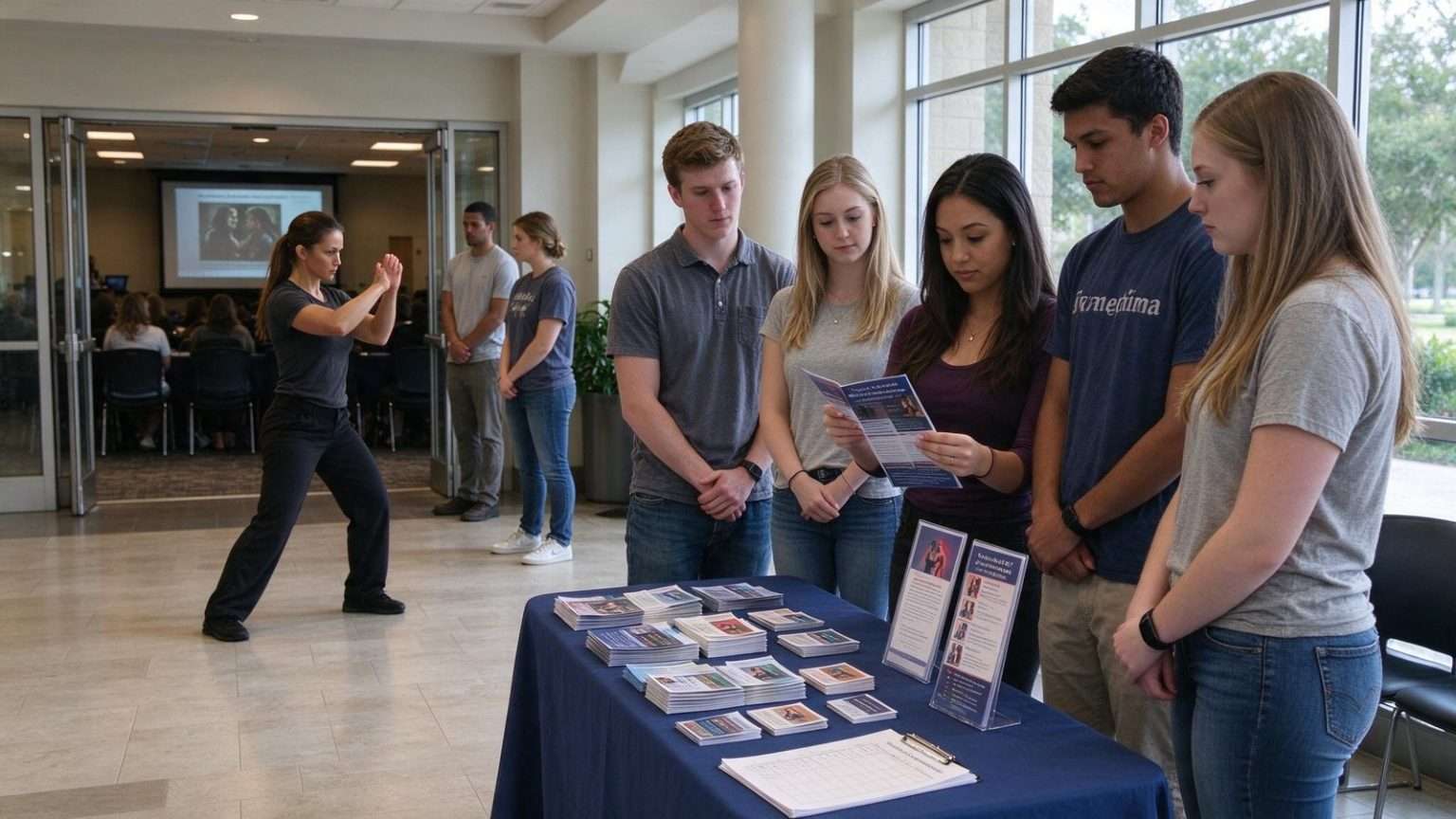
Students at the University of South Alabama are organizing a series of campus events this month tied to V-Day, a global campaign aimed at raising awareness about violence against women, including sexual assault, domestic abuse and human trafficking.
Event organizers on campus point to sobering national statistics as the reason for the effort. According to figures cited by campaign organizers, an American is sexually assaulted roughly every two minutes, and more than half of survivors never report the assault to police. National psychological research groups estimate that millions of women experience abuse from a partner each year, with roughly one in four women facing some form of abusive relationship in their lifetime.
Those numbers, drawn from national advocacy and research organizations, translate into a local reality on any campus the size of South Alabama. With an enrollment of more than 15,000 students, the university’s own community includes survivors of the violence the campaign addresses, and organizers say the week’s events are designed with that audience in mind — connecting students to resources rather than asking anyone to speak before they are ready.
A week of public events
The university’s campaign includes several public events planned for the week. A self-defense class will be offered to students earlier in the week, giving participants hands-on instruction aimed at personal safety awareness.
Self-defense programming has become a staple of campus prevention weeks nationwide, and instructors typically cover situational awareness, boundary-setting and basic physical techniques that students of any fitness level can learn. Campus police departments and local martial arts instructors frequently donate their time for such sessions, and organizers encourage students to sign up early because space is usually limited.
Later, the campus will host a free screening of a documentary film centered on sexual assault, followed by a discussion led by one of the people involved in producing it. That event is open to the public and will be held in the university’s student center ballroom.
Documentary screenings with a producer or subject present for discussion have proven to be among the most effective formats for campus awareness events, giving audiences a chance to ask questions that a film alone cannot answer. Opening the event to the Mobile community as well as students extends the reach of the campaign beyond campus boundaries and acknowledges that sexual violence is a community-wide issue rather than a purely academic one.
Reading for the Rape Crisis Center
The week will close with a staged reading of a well-known theatrical work built around women’s personal stories and experiences with relationships, identity and violence. Admission for that performance is a modest $5, with all proceeds benefiting the Rape Crisis Center of Mobile, a local organization that provides support services for survivors of sexual assault in the region.
Staged readings of this kind — performed by student volunteers, often without full staging or costumes — have raised money for local rape crisis centers on hundreds of college campuses each year as part of the V-Day campaign. The benefit model channels ticket money directly to local service providers, meaning the dollars raised on campus pay for counseling, hotline coverage and hospital accompaniment for survivors right here in the Mobile area.
The Rape Crisis Center of Mobile has served the region for decades as the primary community resource for sexual assault survivors. The center maintains a 24-hour hotline, trains volunteer advocates who accompany survivors through hospital examinations and court proceedings, and provides counseling and support groups at no cost to survivors and their families. Its service area covers Mobile County, and its staff work with both the University of South Alabama Medical Center and area hospitals that treat survivors after an assault.
The V-Day movement
V-Day began in the late 1990s as an outgrowth of a stage work that became a worldwide phenomenon, when the playwright and performers behind it realized the stories were generating both audience demand and money that could be redirected to anti-violence organizations. The campaign name intentionally connects Valentine’s Day — February 14 — with the word “victory” and the ending of the V-word that gives the founding play its title.
Since then, V-Day has grown into one of the largest anti-violence movements in the world, with tens of thousands of benefit performances and events staged annually by community groups and college campuses across the United States and beyond. The campaign has channeled millions of dollars to local organizations — shelters, rape crisis centers, legal aid programs — while keeping decision-making local: each campus or community group chooses its own beneficiary and produces its own events.
College campuses have historically been the backbone of the movement. Student organizers receive a license to produce benefit events, and in exchange the campaign asks them to direct proceeds to local anti-violence work and to frame the events around education as well as fundraising. That model is what brings the South Alabama organizers’ week together: the self-defense class, the documentary and the staged reading each address a different audience and a different aspect of the issue.
Why campuses focus on this issue
University organizers say the goal of the week is not only fundraising but also education, giving students exposure to the scope of the issue and connecting them with resources available both on campus and in the surrounding Mobile community.
Campus awareness campaigns address a problem that research has shown to be concentrated in the college years. National studies of sexual assault on campus have documented high rates of victimization among undergraduate women, along with chronic underreporting — a pattern the “more than half never report” figure cited by organizers reflects. Advocates say the barriers to reporting include fear of not being believed, uncertainty about the process, and in some cases relationships to the person responsible.
In response, universities across the country have built coordinated response systems: campus police departments with specialized training, victim advocates housed in student health or dean-of-students offices, conduct processes for cases involving students, and prevention programming for new students. South Alabama maintains such resources through its student affairs and university police offices, and events like V-Day week serve as their public face — making sure students know those doors exist before they ever need to walk through them.
A community partnership
The Rape Crisis Center of Mobile has long partnered with area colleges and community groups on awareness campaigns, and V-Day events have become a reliable point of connection between campus organizers and the professional advocates who staff the region’s response system.
Those partnerships matter beyond the month of February. Students who volunteer with the center as hotline advocates or community educators often continue serving after graduation, and the relationships built between university staff and center staff smooth the path for survivors who move between campus resources and community ones. The center’s work with area law enforcement and prosecutors on survivor-sensitive interviewing and court support also depends on the community awareness that campaigns like this one generate.
Organizers say they hope the week’s events leave students with three things: knowledge of the issue’s scale, familiarity with local resources, and a vocabulary for talking about consent and support. The $5 benefit performance closes the week by turning that awareness into direct support for the organization that answers the phone in Mobile when a survivor needs help.
Human trafficking on the Gulf Coast
The campaign’s inclusion of human trafficking alongside sexual assault and domestic abuse reflects a growing awareness of the problem along the Gulf Coast. Advocates in Mobile and Baldwin counties have worked in recent years to identify trafficking victims among populations that service providers already reach — runaway youth, survivors of domestic violence, and people experiencing homelessness — and the I-10 corridor that runs through the region has been identified nationally as a route used by traffickers moving victims between major cities.
Local response has grown accordingly. Area organizations have developed training programs for hotel workers, health care providers and first responders on recognizing the signs of trafficking, and the Mobile County District Attorney’s office has joined multi-agency efforts to investigate and prosecute such cases. Awareness weeks like South Alabama’s help introduce students to that landscape, and some participants go on to volunteer or intern with the organizations doing the work year-round.
The self-defense session in practice
For the students who attend the week’s opening self-defense class, instructors generally begin with the least dramatic lessons: awareness of surroundings, projecting confidence, and trusting instincts about situations that feel wrong. Research on resistance strategies consistently finds that assertive responses and early recognition of danger prevent more assaults than physical techniques alone, which is why the classes emphasize judgment as much as strikes.
The physical portion typically introduces a small set of techniques — breaking common grabs, creating distance, targeting vulnerable points — practiced repeatedly with partners until they become reflexive. Instructors stress that no technique guarantees safety, and that the goal is to buy time and opportunity to escape rather than to win a fight.
Campus organizers say the classes fill quickly wherever they are offered, and they encourage men to attend as well. Bystander intervention — the practice of recognizing potentially dangerous situations and stepping in safely — has become a central theme of modern campus prevention work, and self-defense training gives both men and women the confidence to act as effective bystanders.
Getting help in Mobile
Students and community members who need help have several doors open to them. On campus, the University of South Alabama’s counseling center provides confidential services to students, and university police maintain staff trained in working with survivors of sexual and relationship violence. In the wider community, the Rape Crisis Center of Mobile’s 24-hour hotline connects callers with trained advocates, and the center’s staff can accompany survivors to hospitals for forensic exams — services available regardless of whether a survivor chooses to report to police.
Advocates emphasize that forensic exams and related services are provided to survivors at no cost under federal law, and that survivors retain the right to receive medical care and evidence collection without filing a police report. For survivors who later choose to pursue legal action, evidence collected early can be preserved through anonymous reporting programs that Mobile-area hospitals and advocates support.
For domestic violence situations, regional shelters and court advocates assist with protective orders through the Mobile County court system, and the week’s events include information tables where students can pick up wallet cards listing these contacts. Organizers note that the most common outcome of an awareness week is quieter than any single event: a student who recognizes a friend’s situation, or a survivor who decides — sometimes years later — to make the call.
The V-Day events this month continue through the week’s closing benefit performance, with the student center ballroom events open to the public and tickets for the staged reading available at the door for $5.