University of South Alabama Mobile
USA Foundation Weighs $1 Million and $10 Million Scholarship Gifts
The University of South Alabama Foundation debated $1 million and $10 million gifts to the Mitchell-Moulton Scholarship Initiative before delaying a decision.
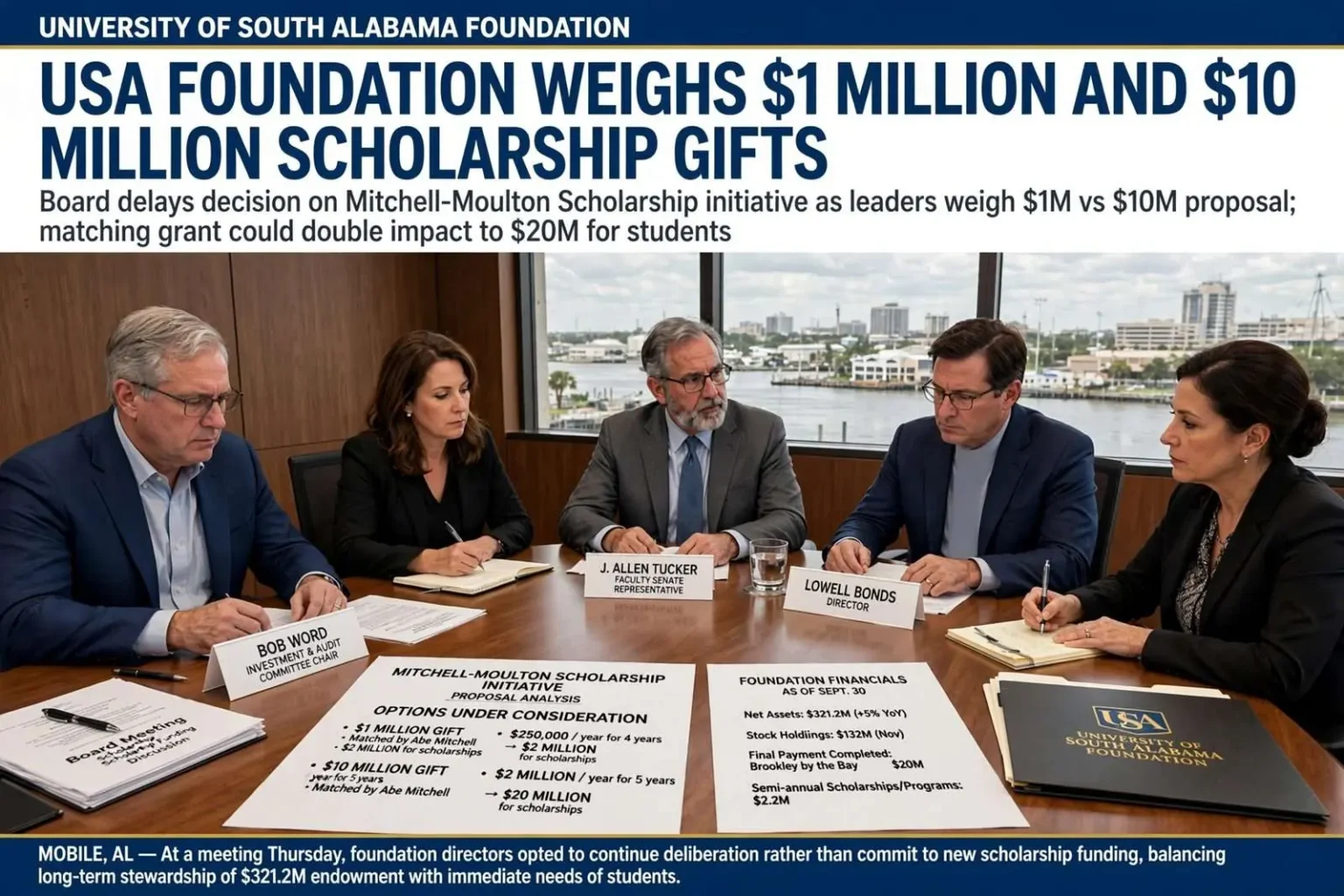
Leaders of the University of South Alabama Foundation weighed two very different visions for boosting student scholarships during a board meeting in Mobile, ultimately deciding to take more time before committing millions of dollars. The debate put the foundation’s long-term financial stewardship on a collision course with the immediate needs of a flagship scholarship program, and the board chose deliberation over a quick decision.
At issue were competing proposals to support the Mitchell-Moulton Scholarship Initiative. The foundation’s investment and audit committee recommended a $1 million gift, spread across four annual payments of $250,000. A second, far larger resolution, put forward by faculty senate representative J. Allen Tucker, called for a $10 million commitment paid in five yearly installments of $2 million to establish a dedicated foundation scholarship fund.
Every dollar carries added weight because gifts to the initiative are matched dollar for dollar by businessman Abe Mitchell. The matching arrangement effectively doubles the impact of whatever the foundation commits, turning a $1 million gift into $2 million of scholarship support and a $10 million commitment into $20 million, which explains why both proposals, modest and ambitious alike, carried real consequences for students.
The scholarship program represents half of Mitchell’s $50 million pledge to the university, which was announced in May 2013 during the school’s 50th anniversary celebration. The overall fundraising target for the initiative stands at $25 million, of which about $3.8 million had been raised at the time of the meeting. Against that gap, the difference between the two proposals was the difference between a token and a transformation.
A Balance Sheet Built Over Decades
Before turning to the proposals, directors reviewed the foundation’s finances. Net assets stood at $321.2 million as of Sept. 30, up roughly 5 percent from a year earlier, while the value of the foundation’s stock holdings reached $132 million by late November. The numbers describe one of the larger university foundations in the state, an institution whose endowment supports the university far beyond what state appropriations cover.
Directors also noted that the foundation had made its final payment on the Brookley by the Bay property, purchased in 2011 for $20 million, and approved a semi-annual contribution of $2.2 million for scholarships, professorships and university programs. The Brookley tract, waterfront land in Mobile that the university has planned for development, had been one of the foundation’s largest capital commitments, and retiring its debt marked the close of a significant chapter in the foundation’s recent history.
That context framed the scholarship debate. A foundation that had just completed a $20 million property purchase and was already contributing $2.2 million twice a year to university programs had demonstrated both its capacity and its caution. The question before the board was not whether it could afford a major scholarship gift, but how quickly and in what form that support should arrive.
The $2.2 million semi-annual contribution itself illustrates how foundation money reaches the university. Spread across scholarships, endowed professorships and program support, recurring contributions like it fund the margins of university life that tuition and state funding never fully cover, from faculty positions that attract researchers to financial aid that keeps capable students enrolled.
The Case for $1 Million
The investment and audit committee’s $1 million recommendation reflected a conservative approach to committing foundation assets. Spread over four years at $250,000 per year, the gift would be easy to absorb from operating budgets and predictable enough to plan around. Committee members pointed to the foundation’s obligations and the need to maintain flexibility for the future.
The Case for $10 Million
Tucker’s $10 million resolution rested on the opposite logic: that the foundation’s $321 million in net assets existed precisely to be deployed for the university’s benefit, and that a scholarship initiative matching every dollar was among the highest-value uses imaginable. Five installments of $2 million would create a dedicated scholarship fund whose earnings, once endowed, could support students for generations.
The debate over the larger gift revealed some hesitation. Bob Word, who chairs the investment and audit committee, said he wanted more research before endorsing the $10 million plan, and director Lowell Bonds urged the board to first determine where the money would come from. Others made emotional appeals in favor of acting boldly, arguing that students who need scholarships are enrolled now, not in some future fiscal year when the foundation’s models look more comfortable.
Those competing instincts, prudence versus urgency, define nearly every endowment decision at institutions like South Alabama. Foundation directors are fiduciaries for an endowment meant to outlast everyone in the room, and gifts paid in installments commit future boards as much as the present one. A $10 million pledge, even spread over five years, is money that must be earned, managed and withdrawn without endangering the principal that generates the foundation’s other support.
The matching structure complicates the calculus in an unusual way. Because Mitchell matches gifts dollar for dollar, deferring a decision also defers the matched money the initiative would receive; hesitation has a cost measured in unclaimed matching funds, not merely in delayed goodwill. Supporters of the larger gift pointed to that arithmetic, while skeptics answered that a commitment the foundation could not sustain would be worse than a slower one it could.
What the Mitchell-Moulton Initiative Does
The Mitchell-Moulton Scholarship Initiative stands at the center of the university’s scholarship fundraising, and its structure reflects the donor behind it. Half of Abe Mitchell’s $50 million pledge to the university, announced during the school’s 50th anniversary year, is devoted to the program, with the remaining half directed to other university priorities. Matching gifts amplify private donations across the board, an approach that lets a major donor multiply the effect of hundreds of smaller contributors rather than simply replacing them.
Scholarship programs of this scale change enrollment mathematics. At a university that serves many first-generation college students from Mobile and the surrounding Gulf Coast region, the difference between a modest aid package and a substantial one often determines whether a student enrolls at all, stays through to graduation, or takes on crushing loan debt. Every $2 million of matched scholarship money represents hundreds of student-years of support at typical in-state costs.
The university context matters as well. South Alabama, seated in Mobile as the Gulf Coast’s public university, has spent decades growing from a commuter extension center into a comprehensive institution with medical, engineering and business programs that draw students from across the region and around the world. Its foundation, like those at larger flagships, has become the engine behind much of that growth, acquiring property, funding endowed positions and building the financial reserves that state appropriations no longer supply.
The Brookley by the Bay purchase showed that role in action. The $20 million acquisition of waterfront land near the Brookley industrial complex tied the foundation’s balance sheet to Mobile’s broader economic development, betting on the growth of the airport district and the waterfront. Completing the payments on that purchase freed the foundation’s future budgets for exactly the kind of debate the board was now having about scholarships.
Deliberation as a Decision
In choosing to take more time, the board left both proposals on the table rather than picking between them. Delaying a decision on millions of dollars is itself a decision, and one with consequences: the initiative’s $25 million goal remained far off, with $3.8 million raised, and every month without a foundation commitment extended the timeline for students who might benefit.
Supporters of bold action framed the stakes in those human terms. The university’s students, they argued, are not a theoretical future population but enrolled young people working their way through school now, and a foundation with $321 million in net assets does not need years of study to recognize a matching opportunity that doubles its impact. The committee’s counterargument, that stewardship requires knowing where $10 million comes from before pledging it, reflects the discipline that built the endowment in the first place.
Boards resolve these tensions differently, and the outcome of the debate, whenever it arrives, will be watched closely by the university community. Faculty representatives, fundraising staff and scholarship administrators all have stakes in the answer, and the meeting demonstrated that the foundation’s directors understand the weight of the choice before them. Whether the final commitment lands at $1 million or $10 million, the matching dollars will make either figure mean twice as much.
The meeting also offered a lesson in how university governance works in practice. Foundation boards are typically made up of business leaders, alumni and community figures who volunteer their time, and their deliberations are usually conducted without much public attention. A debate this visible, with a faculty senate representative championing the larger gift, brought the foundation’s internal questions into the open and gave the university community a look at how its endowment’s priorities are actually set.
For students and families watching the initiative’s progress, the board’s deliberation period is a reminder of how scholarship funding comes together: not from a single donor or a single check, but from the accumulation of commitments, matches and endowment decisions made by people most students will never meet. The $3.8 million raised so far represents many separate gifts, each one doubled by Mitchell’s match, and each one waiting for the larger institutional contributions that only a foundation board can provide.