Acquitted in Court, Herman Thomas Faces the Alabama Bar Over His Law License
A month after his acquittal, former Circuit Judge Herman Thomas was set for a February 16 hearing before an Alabama State Bar panel that will decide whether he may practice law again.
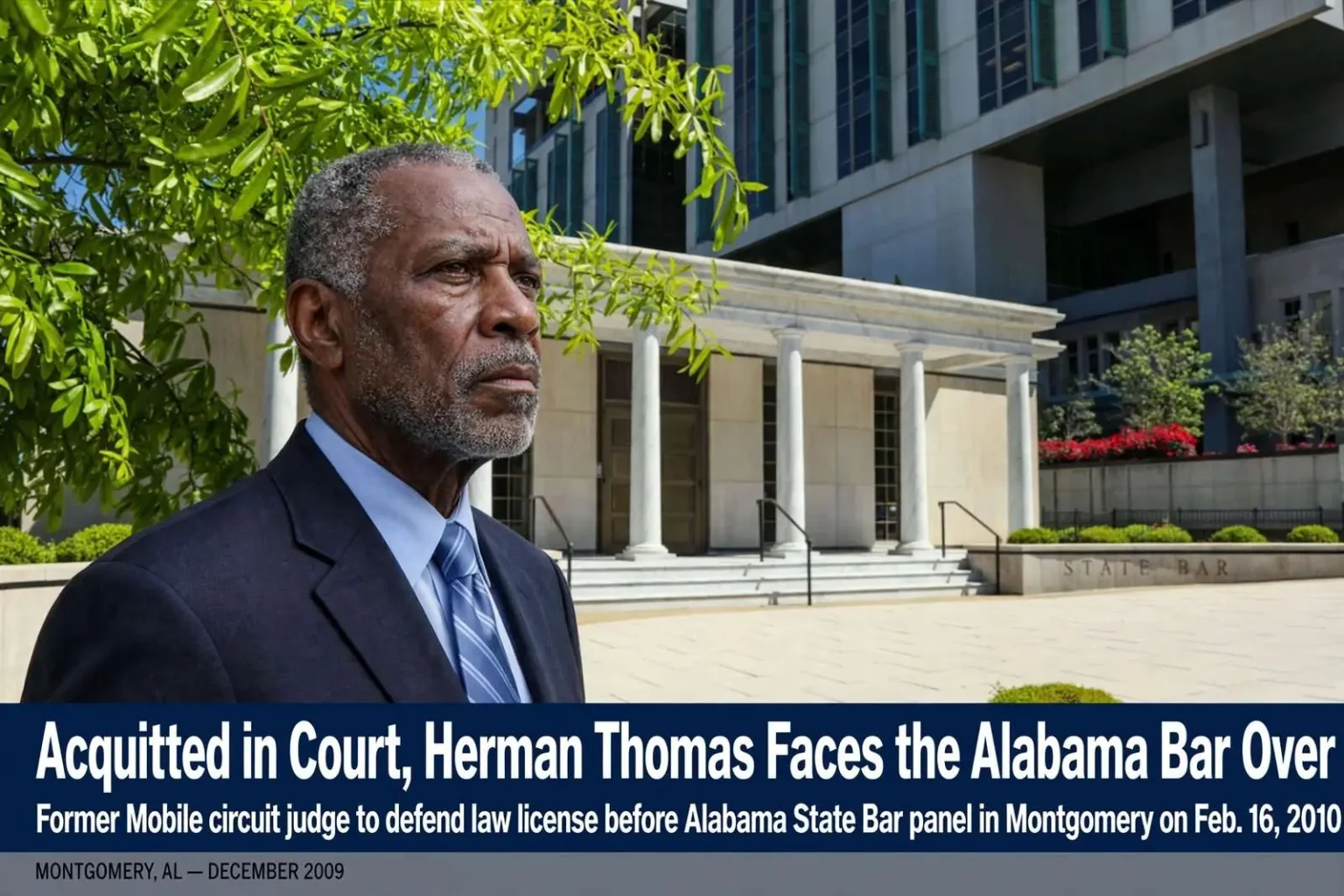
Herman Thomas was acquitted in criminal court in the fall of 2009. In December he learned the date on which he would have to defend himself again — this time over his license to practice law. The former Mobile circuit judge’s fight to reclaim his law license was scheduled for trial Feb. 16, 2010, before a panel of the Alabama State Bar in Montgomery, a proceeding that would determine whether the man who spent nearly two decades on the Mobile County bench would ever again stand in a courtroom as a lawyer.
“They filed charges, we filed an answer and now we go to trial,” said Thomas’s attorney, Robert “Cowboy Bob” Clark. Tony McLain, general counsel for the bar association, confirmed the date. Both sides had agreed to postpone the disciplinary case until the criminal proceedings were concluded, a common-sense sequencing that kept the bar from asking a disciplinary panel to weigh evidence while prosecutors were still presenting much of the same material to a jury. With the criminal case resolved, the way was clear for the second act.
What came before
Thomas served on the bench in Mobile for nearly two decades, first in district court and later in circuit court, before resigning his judgeship in 2007 as he was about to face trial before the Alabama Court of the Judiciary, the body that disciplines judges. He was subsequently charged with more than 100 criminal counts arising from his conduct in office, and the resulting trial became one of the most closely watched legal proceedings in south Alabama in a generation.
At his three-week trial, a dozen young Black men testified that Thomas had used his judicial authority to bring them out of jail for extrajudicial purposes, including paddling them in a spare courthouse office. Prosecutors contended the inmates received leniency in exchange for submitting to the judge’s demands. Thomas denied wrongdoing throughout, and at the end of the trial he was acquitted of every charge — some by directed order of specially appointed Judge Claud Neilson, meaning the evidence on those counts was legally insufficient for any jury to convict, and the rest by the jury itself.
The state bar had suspended Thomas’s license to practice while the criminal case was pending, an interim measure that left the underlying disciplinary question unresolved. The suspension protected the public during the criminal proceedings but decided nothing about whether Thomas’s conduct, as described by witnesses and contested by his defense, violated the professional conduct rules that govern every lawyer in Alabama. That question would now be heard on its merits.
A lower bar to clear
The proceeding in Montgomery will differ from the one in Mobile in a way that matters enormously to both sides. A criminal jury must be convinced of guilt beyond a reasonable doubt, the most demanding standard in American law. The bar’s disciplinary panel operates closer to a civil standard, in which a preponderance of the evidence is sufficient — the same measure that decides ordinary lawsuits. Evidence that failed to produce a conviction can still support a finding of professional misconduct, and both the bar and the defense understand that the dynamic of proof has shifted.
Disciplinary panels of this kind are built differently from courtrooms as well. The bar’s disciplinary committee assigns a five-member panel, including one layperson, to serve as the fact-finders in an action of this kind. They hear testimony, weigh exhibits and render findings that govern whether an attorney may continue to practice in Alabama. The panel’s range of possible outcomes is broad: dismissal of the charges, a private reprimand, a public reprimand, a suspension of defined length, or permanent disbarment. There is no jury to persuade and no prosecutor constrained by the criminal rules of proof.
For Thomas, the practical effect of the lighter standard is that the trial testimony — the accounts of the young men who described what happened in the spare courthouse office — will be in front of the panel again, considered this time by a measure that asks whether it is more likely than not rather than whether it proves guilt beyond doubt. For the bar, the acquittal is not a bar to discipline; the rules of professional conduct ask different questions than the penal code, and the panel is entitled to answer them independently.
No settlement, says the defense
Clark, whose combative style was among the more memorable features of the criminal trial, said flatly that there would be no negotiated resolution while he remained lead counsel. “Even if they offer him a slap on the wrist, we won’t take it or I will withdraw,” Clark said. “I won’t represent him and be party to that.”
He dismissed the bar’s case as no better founded than the criminal charges had been and said he intended to try it to a conclusion. He would not back down, he said, adding in his characteristic register that he “was screaming charge when Custer was throwing in the towel” and that his adversaries “can shoot me but they can’t eat me.” Having spent much of the year opposing Mobile County District Attorney John Tyson in the criminal courts, Clark said he was now prepared to spend the next one opposing the state bar in Montgomery.
Clark’s defiance carried a practical message as well as a rhetorical one. Disciplinary matters are frequently resolved through consent agreements in which a lawyer accepts a reprimand or a short suspension in exchange for closing the file, and the bar’s docket depends on such resolutions. By announcing in advance that he would regard any consent disposition as a betrayal of his client, Clark made clear that the Feb. 16 trial would actually be tried — a prospect that promised to put the full record of the criminal case, and the defense’s answer to it, before the panel and the public once more.
What the bar will weigh
The charges before the panel center on the same conduct that produced the criminal indictment, but the analytical framework differs. Alabama’s Rules of Professional Conduct govern a lawyer’s conduct in and out of the courtroom, and a judge practicing law holds a position of particular public trust. Conduct that a jury found not guilty beyond a reasonable doubt can still be found to have violated professional obligations, because the rules ask whether a lawyer’s behavior was consistent with the integrity of the profession rather than whether it fit the elements of a crime.
Among the questions the panel can be expected to consider is the nature of a judge’s authority over people in custody. The testimony at trial described men brought from the county jail to the courthouse, at the judge’s direction, in circumstances entirely outside any docketed case. Whatever the panel ultimately makes of that testimony, the proceeding will force a formal reckoning with the boundary between judicial discretion and personal conduct — a boundary the criminal trial skirted but never conclusively drew.
Timing matters too. An interim suspension, like the one Thomas has lived under, is by design provisional. Once the panel rules, the outcome becomes final subject to appeal to the Alabama Supreme Court, which reviews disciplinary decisions just as it reviews other adjudications. Either side can carry the case up if it loses below, which means the February trial may be the middle of the story rather than the end of it.
Whatever the outcome, the case will leave its mark on how Mobile’s legal community talks about judicial accountability. Bar discipline is a private-sounding term for what is, in practice, a public proceeding, and the February hearing will unfold with the same press attention that followed the criminal trial. The panel’s findings, whatever they are, will become part of the formal record of one of the most turbulent chapters in the county’s legal history.
Why it matters
Disciplinary proceedings rarely draw public attention, but this one was different. The criminal trial had exposed the internal workings of the Mobile County courthouse to a degree few residents had ever seen — how cases were assigned, how appointed counsel was chosen and paid, and how much unreviewed discretion a single judge could exercise over people in his custody. Courthouse reporters, defense attorneys and prosecutors alike testified to practices that had never been laid out in public before.
An acquittal ended the state’s criminal case, but it did not settle the question of whether the conduct described at trial was compatible with the practice of law. That question now belonged to five people in a room in Montgomery, and their answer would determine whether a man who spent 20 years on the bench in Mobile would ever again appear before one — this time holding a lawyer’s license rather than a judge’s gavel. For the young men who testified, the hearing represented the last formal venue in which their accounts would be weighed on the record; for Thomas, it was the final obstacle between him and the restoration of the profession he trained for decades ago.