Prichard Police Seek Vehicle in Fatal Gas Station Shooting
Prichard police are searching for a white Chrysler 300C connected to a fatal shooting outside a gas station near Interstate 65 on Tuesday afternoon.
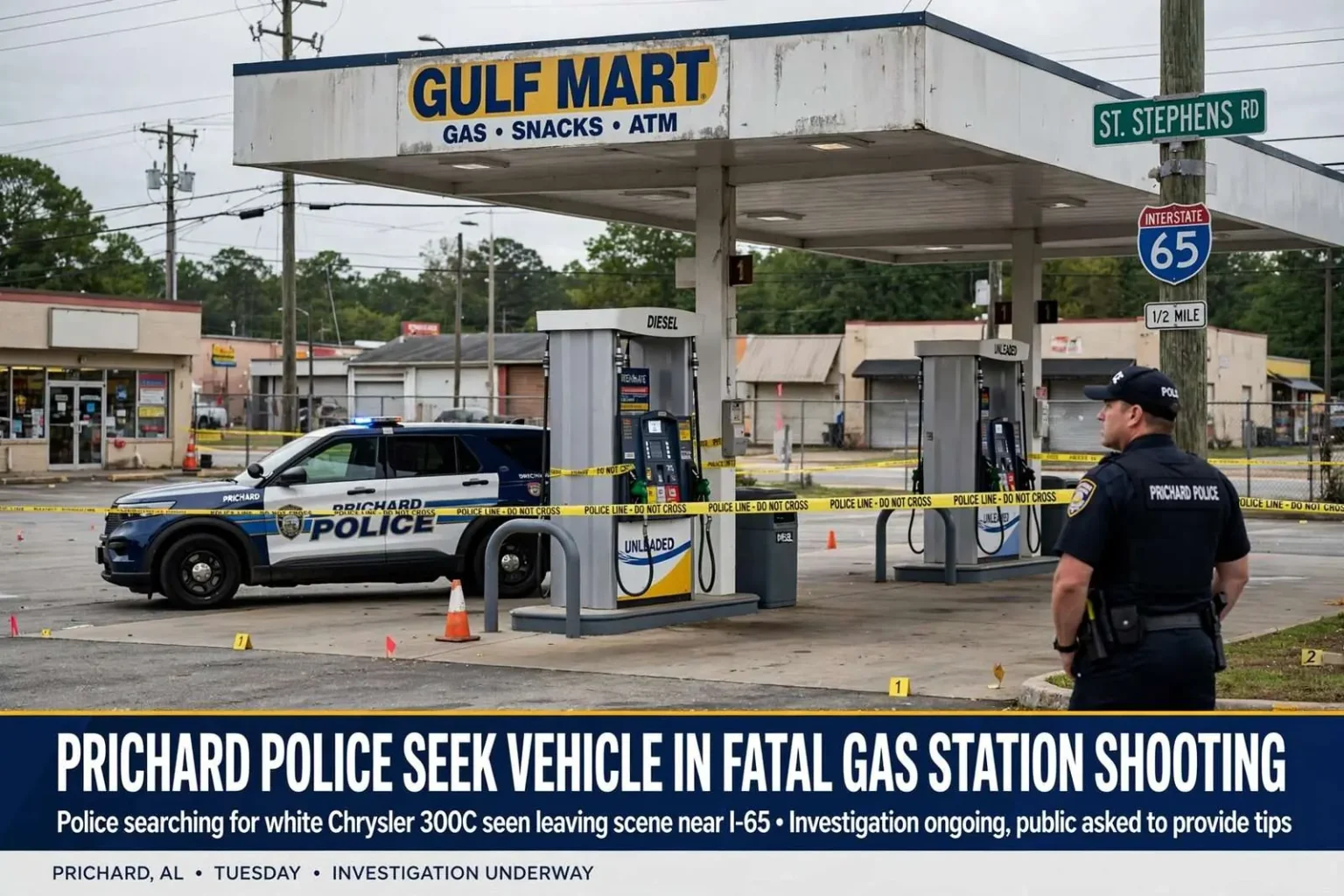
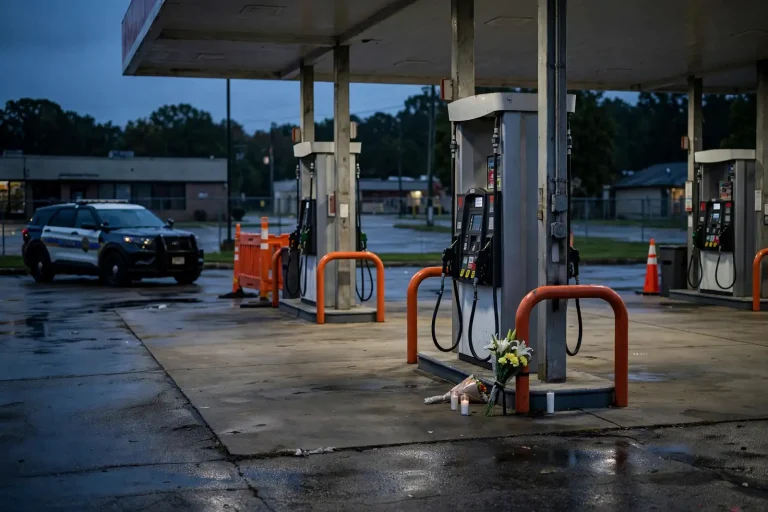
Prichard police are searching for a vehicle they believe is connected to a fatal shooting outside a gas station that left a man dead Tuesday afternoon. The killing — the kind of midday violence that reverberates through a close-knit community — drew investigators to a busy commercial corner in the heart of the city and left residents of the surrounding neighborhoods asking familiar questions about how such a shooting could unfold in daylight along one of Prichard’s main corridors.
The shooting occurred at a gas station along St. Stephens Road near Interstate 65, according to police. Investigators reviewing surveillance footage from the station determined that the victim had just left the store after making a purchase when he was shot multiple times in the parking area. The footage gave detectives a timeline of the final moments — a routine stop for gas or a snack ending in gunfire — and provided the most important investigative lead in the case’s early hours.
Police say they are looking for a white Chrysler 300C seen leaving the scene shortly after the shooting. Investigators have not released a description of the vehicle’s occupants or said how many people may have been inside at the time. The announcement of a suspect vehicle within hours of the shooting suggested that the surveillance system at the station captured usable images, and that detectives believed the car could be identified quickly if members of the public were watching for it.
The victim’s identity had not been officially confirmed by police as of Tuesday evening, though local media outlets reported that family members had identified him. Until investigators complete that confirmation and notify next of kin in accordance with department practice, authorities generally withhold the name — a process that can feel slow to a community already sharing news of the death, but one that protects both the family and the integrity of the case.
Prichard police said the investigation remained active and that detectives were working to establish a motive and identify those responsible. Investigators have not said whether they believe the shooting was targeted or connected to any ongoing dispute. That distinction — a random attack versus a targeted one — shapes almost everything about how a case proceeds, from which detective squads take the lead to which neighborhoods canvassers knock on and which databases detectives query first.
A Busy Corridor, A Familiar Pattern
The gas station where the shooting occurred sits near a heavily traveled stretch of St. Stephens Road close to the interstate interchange, an area that has seen periodic reports of violent crime in recent years. St. Stephens Road is one of the oldest and most historic roadways in the Mobile area, tracing its route back to the colonial-era path that connected Mobile to the historic town of St. Stephens, once the territorial capital of the Alabama Territory. Today the corridor serves as a commercial spine for Prichard and neighboring communities, lined with storefronts, churches and service businesses that depend on steady traffic from the interstate and the surrounding neighborhoods.
Proximity to Interstate 65 cuts both ways for such a location. The highway brings customers through the corridor, but it also offers a quick escape route for anyone leaving the scene of a crime, which investigators always factor into their thinking when a violent act occurs near an interchange. Surveillance cameras at the gas station and neighboring businesses become especially valuable in those settings, because a vehicle that spends only seconds in a parking lot may still be traced through the network of cameras that line a commercial strip.
Prichard, a small city in Mobile County, has grappled with elevated crime rates for years even as city leaders have pursued various public safety and community redevelopment initiatives. The city of roughly 20,000 residents sits just north of Mobile along the Mobile River delta, and its history mirrors that of many Southern industrial suburbs: a boomtown in the shipbuilding years of the 1940s, a thriving middle-class city at mid-century, and a community that has fought decades of population loss, economic disinvestment and fiscal strain since the 1970s. Those pressures have made public safety a central issue in every city election for a generation.
The city’s challenges came to a head in 2009, when Prichard filed for bankruptcy protection in a dispute over its employee pension fund, becoming one of the first municipalities in modern Alabama history to do so. The fiscal crisis constrained city services for years and complicated the city’s efforts to rebuild its police staffing and neighborhood programs. City leaders since then have tried to pair redevelopment efforts — housing projects, commercial incentives, blight removal — with the kind of community policing that residents say they want.
Police officials have said solving violent crimes quickly is a top priority for the department, both to bring justice to victims’ families and to reassure residents and business owners in affected areas. Speed matters in homicide investigations for practical reasons: witnesses’ memories fade, surveillance footage gets overwritten, and suspects move. Every hour that passes without a tip makes the job harder, which is why departments across Mobile County increasingly rely on public appeals and anonymous tip lines to generate leads that detectives can chase while they are still fresh.
How the Case Proceeds
Anyone with information about the vehicle or the shooting is asked to contact Prichard police or submit a tip anonymously through Crime Stoppers. Crime Stoppers programs across the Gulf Coast allow tipsters to submit information by phone, web or mobile app without revealing their identities, and reward payments are made through a code system that keeps callers anonymous even when a tip produces an arrest. For residents who may know something but fear being labeled a snitch, the anonymity is often what makes the difference between silence and a call that breaks a case.
Investigators say surveillance footage from the gas station and cooperation from witnesses in the area will likely play a key role in identifying a suspect. Modern gas station camera systems can capture license plates, faces and the direction of travel, and investigators will typically pull footage from neighboring businesses, nearby homes with doorbell cameras and passing traffic cameras to reconstruct the suspect’s route away from the scene. In commercial corridors like St. Stephens Road, that network of lenses has become one of the most productive tools in local homicide work.
Police have not announced any arrests in connection with the shooting as the investigation continues. Until an arrest is made, the case remains open — worked by detectives, reviewed by prosecutors only when evidence is ready, and kept in front of the public whenever authorities believe an appeal will help. Families of homicide victims in such cases often describe the waiting as its own ordeal, and community groups in the area have long emphasized the importance of public cooperation in shortening it.
For the neighborhoods around the shooting scene, the investigation’s progress will be measured in more than an arrest. Residents and business owners along St. Stephens Road have pressed city officials for years for better lighting, more patrols and faster response to the loitering and small-scale crime that they say precedes the violence. The gas station shooting gave those demands a fresh urgency, and it put the spotlight back on the question that has defined Prichard’s public safety debate for decades: whether the city can make its main corridors feel safe to the families and businesses that depend on them.
What is known so far is limited and grim: a man is dead, a white Chrysler 300C left the scene, and detectives believe the answers are on the surveillance footage and in the memories of the people who were there. Between the cameras and the community, investigators will hope, the picture of what happened in that parking lot will come together quickly enough to give the victim’s family an answer.
The Chrysler 300C itself may prove a meaningful clue. The large sedan has been common on Gulf Coast roads for years, and hundreds of white examples are registered across Mobile County, so detectives will narrow the field using details from the footage — body condition, wheel style, window tint, temporary tags — before cross-checking registrations. Investigators often pair that work with a public appeal precisely because a distinctive vehicle sighting reported by a resident can cut days off the search.
The timing of the shooting, in daylight on a weekday afternoon, also matters to investigators. Midday shootings in commercial areas typically mean witnesses were present — customers at the pumps, employees inside the store, drivers passing on St. Stephens Road — and that traffic cameras along the corridor recorded the moments before and after. Detectives will try to convert that presence into cooperation, urging anyone who was at the station around the time of the shooting to come forward even if they believe they saw nothing important; small details, like a car that circled the lot twice, often prove decisive.
Prichard police detectives will also be working with counterparts across the county line, as they routinely do in violent-crime cases. The Mobile County District Attorney’s office, the Mobile Police Department and the Alabama Law Enforcement Agency all maintain resources that small departments draw on — crime lab services, gang intelligence, regional task force participation. In a jurisdiction with a limited detective roster, those partnerships determine how quickly a case like Tuesday’s shooting can move from canvass to charges.