Governor Set to Tour Daphne Company Turning Algae Into Fuel
Gov. Robert Bentley toured a small Daphne company that converts Baldwin County wastewater and algae into bio-crude oil and clean drinking water.
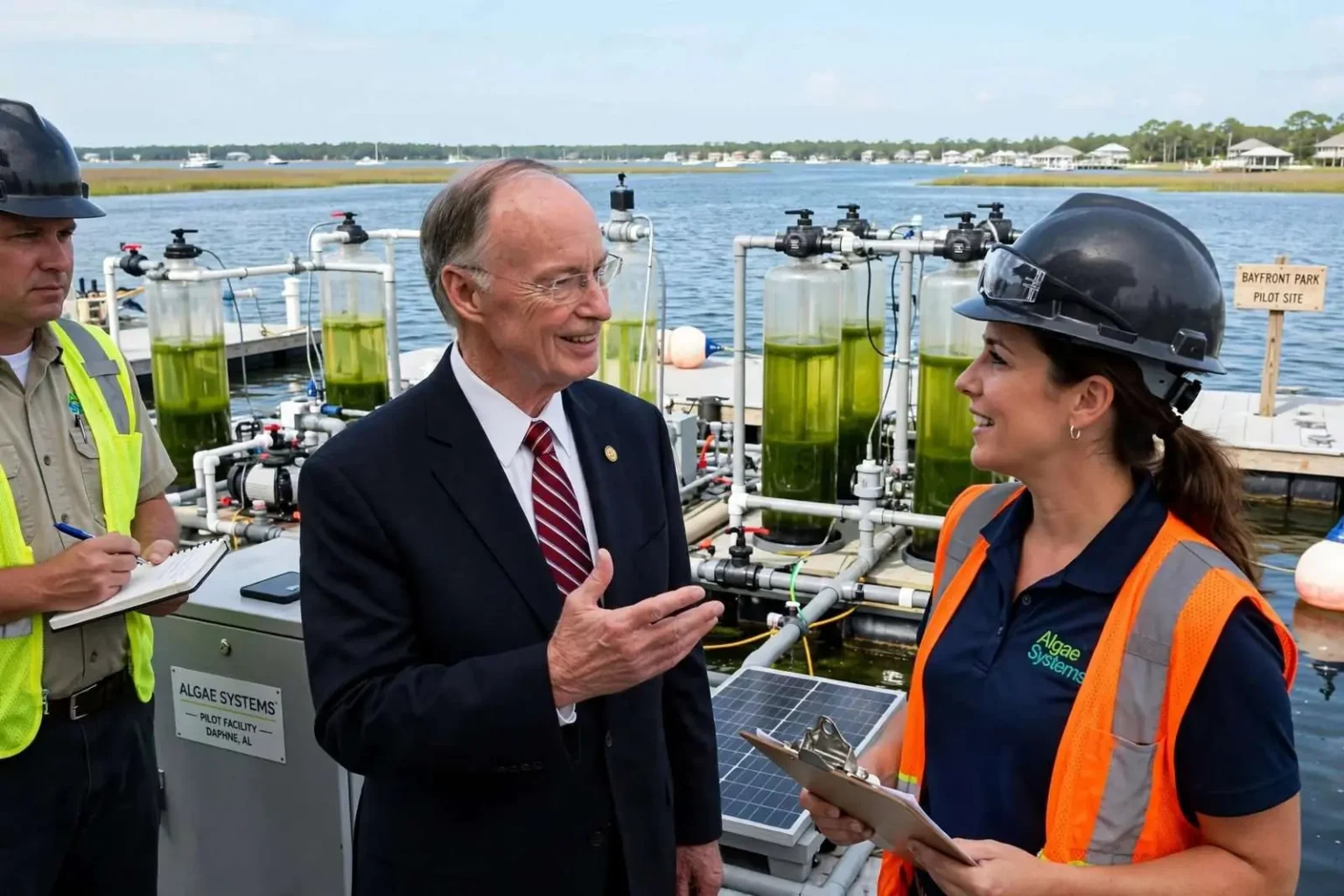
Gov. Robert Bentley toured a small but closely watched Daphne company that has spent the past two years experimenting with an unusual process: turning algae grown in treated wastewater into crude oil and clean drinking water. The visit put the Baldwin County pilot project in front of the state’s highest office, a platform its backers hope will help carry the technology from experiment to industry.
Bentley’s tour of Algae Systems spotlighted a Baldwin County pilot program that has already drawn national attention. Originally launched in 2012, the venture grew out of a chance connection made over social media between a Nevada-based innovator and a local economic development contact, according to company representatives, and it has since attracted roughly $15 million in backing from a Japanese engineering firm along with more than $7.5 million in local investment.
For Daphne, a city of modest size on the eastern shore of Mobile Bay, hosting a venture with that kind of international backing is unusual. The company has operated on a small plot of the city’s own infrastructure — its wastewater — turning a disposal problem into the raw material for a fuel experiment that has attracted scientists, investors and now the governor’s office to the bayfront.
How the process works
The company’s process starts with the city of Daphne’s wastewater, which is piped to a floating platform extending into Mobile Bay near Bayfront Park. There, sunlight and wave motion drive controlled algae blooms inside large plastic enclosures. The algae consumes nutrients from the wastewater, effectively cleaning it, before being harvested and heated to produce a bio-crude oil that can be refined into diesel fuel.
The design borrows deliberately from the natural world. Algae are among the fastest-growing organisms on the planet, and in open water they multiply on exactly the nutrients that municipal wastewater carries in abundance — nitrogen and phosphorus that would otherwise have to be removed by conventional, energy-intensive treatment methods. Floating the enclosures on the bay means the natural churn of waves mixes the algae without mechanical aeration, and the Gulf Coast’s abundant sunshine does the work that electric lights would perform indoors.
The result, in principle, is a rare trifecta. Company officials say the approach treats municipal sewage, generates a usable fuel product and produces carbon credits tied to advanced biofuel standards — three revenue streams from a single process that starts with material cities currently pay to dispose of. If the economics hold up at a larger scale, backers argue the process could remove more carbon from the atmosphere than burning the resulting fuel releases, because the algae draw carbon dioxide as they grow.
The drinking-water element rounds out the pitch. Alongside the fuel production, the process is designed to leave behind clean water, an increasingly valuable commodity as coastal communities weigh the demands of growth against the capacity of their treatment systems.
Why Daphne
The project’s location is no accident. Daphne’s wastewater system discharges near Mobile Bay, and the city’s leaders were willing to let a startup experiment on a piece of public infrastructure that most communities guard carefully. The floating platform near Bayfront Park gave researchers a real-world test site — real wastewater, real weather, real waves — rather than a laboratory simulation, and the bay’s shallow, protected waters offered conditions gentle enough to keep the enclosures workable.
Baldwin County has been among the fastest-growing counties in Alabama for years, and that growth puts constant pressure on municipal utilities. Every new subdivision adds load to treatment systems that must remove nutrients before discharging into the bay, where excess nitrogen and phosphorus can feed algal problems of the undesirable variety. A technology that turns that same nutrient load into fuel, rather than a disposal cost, offers utilities an entirely different way to think about their worst problem.
The company’s path to Daphne began with a social media connection between a Nevada-based innovator and a local economic development contact — an unlikely origin for a project that has since drawn backing from a Japanese engineering firm. The roughly $15 million from that firm, combined with more than $7.5 million in local investment, funded the pilot scale-up that the governor walked through on his tour.
Algae Systems has employed about 25 people, a modest but meaningful number for the Baldwin County economy, and has become something of a local point of pride as it drew coverage from national outlets exploring the science behind the wastewater-to-fuel process. For a county whose economy is dominated by tourism, retirement migration and commuting, the prospect of a homegrown advanced-energy industry carried obvious appeal.
The visit also gave state officials a closer look at a technology they had mostly known from coverage. Algae-to-fuel concepts have circulated in energy circles for years, but few have reached the demonstration stage on real municipal wastewater, and fewer still have done it with private investment rather than research grants. Walking the platform and seeing the enclosures working in the bay gave the delegation a concrete answer to the question every advanced-energy pitch faces: does it actually run?
Alabama’s energy play
State and local officials joined Bentley for the site visit, which comes as Alabama continues courting alternative-energy investment along the Gulf Coast. The state’s industrial development strategy has historically centered on heavy manufacturing — automotive plants, shipbuilding, chemicals and, increasingly, aerospace — but economic developers have pursued biofuels, renewable projects and energy technology as a complement to those pillars.
The Gulf Coast offers advantages that biofuel ventures in particular find attractive: warm temperatures that extend growing seasons, industrial infrastructure built around energy, deepwater ports for moving product, and universities that supply engineering talent. A working pilot in Daphne gives the state a showcase it can point to when companies weighing a Gulf Coast investment ask what Alabama has done in the field.
Governors’ visits to small companies carry practical weight beyond the photograph. A tour by the state’s chief executive signals to agencies, investors and site selectors that a project has attention at the top, and company representatives in Daphne made no secret of their hope that the visit would help smooth whatever permitting, partnership or funding steps come next.
The question of scale
Whether the technology can be scaled beyond a pilot project remains an open question, and it is the question on which the entire venture turns. Pilot plants succeed at small scale for reasons that do not always survive growth: contamination that a small, closely watched system can manage becomes harder to control across acres of enclosures; harvesting costs that are tolerable in a demonstration become crushing at industrial volumes; and the price that a refiner will pay for bio-crude must compete with oil from wells that have spent a century driving down costs.
The company’s answer to that challenge is the three-revenue model — treatment service, fuel and carbon credits — which spreads the economics across multiple markets instead of betting everything on fuel alone. Municipalities already pay for wastewater treatment, so a process that treats water while producing fuel changes the arithmetic of the comparison. Carbon credit markets, tied to advanced biofuel standards that mandate increasingly low-carbon transportation fuel, add a third line that conventional oil never sees.
The carbon mathematics is the most intriguing part of the pitch. Because algae consume carbon dioxide as they grow, a full accounting of the process could show more carbon removed from the atmosphere than released when the resulting diesel is burned — a claim conventional biofuels have struggled to make. Independent verification of that balance at commercial scale would put the Daphne process in rare company among energy technologies.
For now, the measure of success remains modest: a platform on Mobile Bay near Bayfront Park, a few dozen jobs, and a process that has run long enough to attract a governor’s attention. Bentley’s tour ended without announcements of new money or new contracts, but the visit itself marked a milestone for a company that began with a message sent over social media two years earlier.
Local pride aside, the project’s supporters argue the timing favors a push to scale. Fuel prices, carbon markets and water-quality regulations all move in directions that make nutrient-recovery technology more valuable over time, and a process proven on the Gulf Coast could find customers in coastal cities across the South and beyond that face the same combination of wastewater costs and warm, sunny water.
What happens next will be decided by economics rather than enthusiasm. If the Daphne pilot’s numbers hold as the system grows, the eastern shore of Mobile Bay could claim a place in the history of American biofuels. If they do not, the project will still have left behind something valuable — a demonstrated experiment in treating a city’s wastewater as a resource rather than a burden, conducted at full scale, in public view, on the waters of the bay.