Governor to tour Daphne firm turning bay algae into fuel and clean water
Gov. Robert Bentley is set to tour Algae Systems in Daphne, a startup on Mobile Bay that turns algae and wastewater into bio-crude fuel and drinking water.
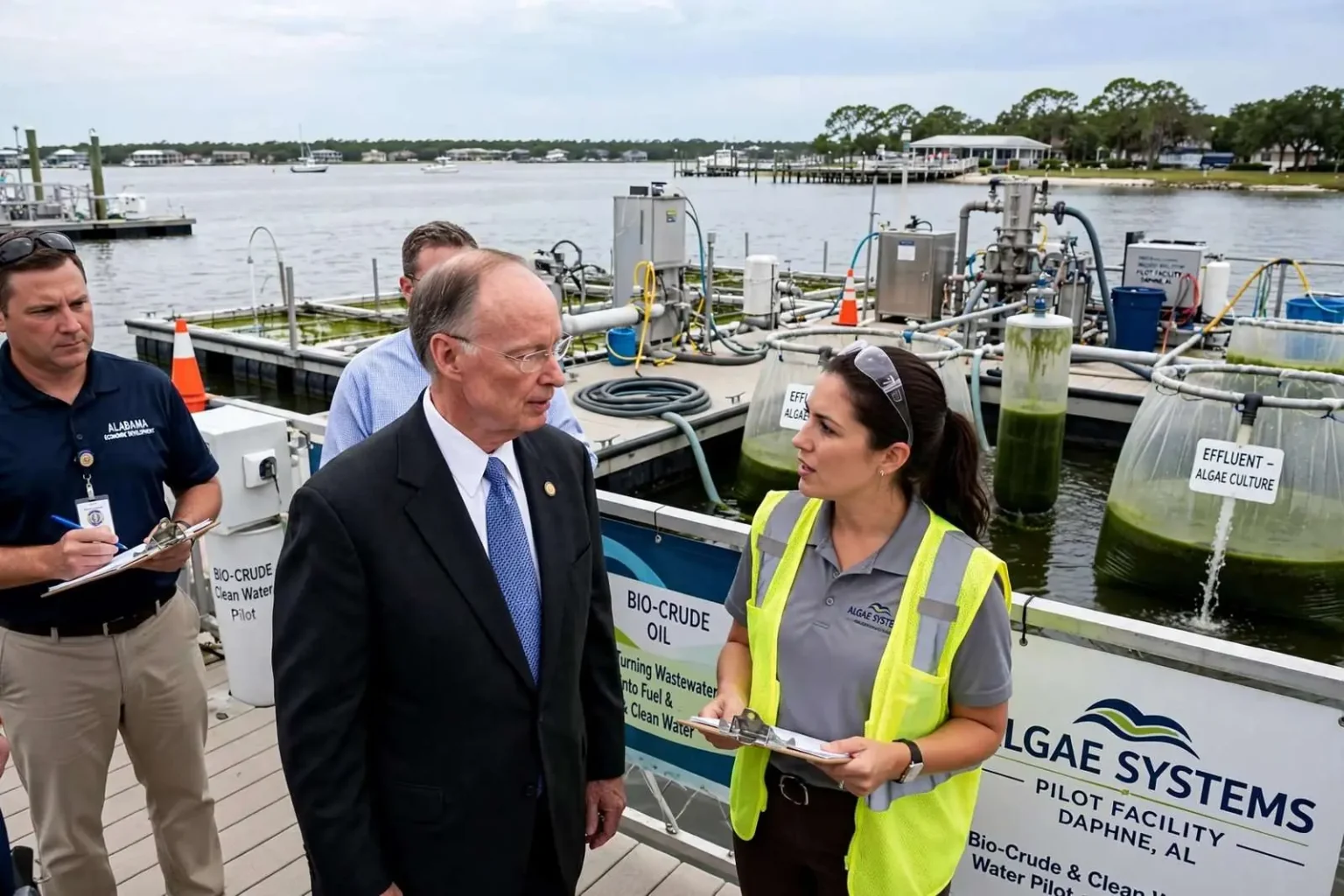
A small Daphne startup that turns pond scum into fuel and clean water is about to get a high-profile visitor. Gov. Robert Bentley is scheduled to tour Algae Systems’ pilot operation on Mobile Bay, joining state and local officials for a 2 p.m. walkthrough on Wednesday. The visit puts the state’s highest office on the shoreline where the company has been quietly testing an idea that sounds, at first telling, like science fiction: growing algae in municipal wastewater, harvesting it, and converting it into crude oil.
The company has quietly become one of Baldwin County’s more intriguing technology ventures. What started from a chance connection on social media has grown into a roughly 25-person operation that has poured more than $7.5 million into the local economy since setting up along the bay. For a county whose economy has historically run on real estate, tourism, and the aerospace corridor to the north, a research-and-development operation of this kind is an outlier — and, local officials hope, a sign of what the region’s waterfronts could host in a diversified economy.
Algae Systems is headquartered in Nevada but chose Daphne for its experimental plant, drawn in part by the water and sunlight of Mobile Bay. The 2012 startup got off the ground with a $15 million investment from the Japanese engineering firm IHI and has concentrated on producing bio-crude oil and drinking water using algae grown in the bay. The partnership with IHI gave the young company both the capital and the engineering pedigree to attempt a process that has defeated larger research programs, and Mobile Bay gave it the natural conditions — warm water, abundant sunshine, and a sheltered bay — that algae cultivation demands.
How the Process Works
The process is unusual. The plant draws in municipal wastewater and uses it as a nutrient to feed controlled algae blooms. As the algae grow, they help clean the water; the harvested biomass is then run through a high-heat process that yields a bio-crude that can be refined into diesel fuel. In effect, the system treats sewage and manufactures fuel in the same motion, converting the nutrients that wastewater plants must otherwise remove into an energy product.
A floating dock reaching into the bay near Bayfront Park holds bags of effluent, and the reaction is driven largely by wave motion and sunlight rather than added energy. That design choice is central to the company’s argument that its fuel can be produced at a competitive cost: conventional algae-cultivation schemes have struggled with the energy and capital costs of pumping, mixing, and feeding large algae cultures, and a system that lets the bay’s own waves do the mixing sidesteps much of that burden.
The company says the approach does more than make fuel. By its account, the system simultaneously produces clean water from sewage, converts carbon-rich residue into fertilizer, and generates credits for advanced biofuels. Each output attacks a different cost line — the clean water reduces the treatment burden on municipal utilities, the fertilizer creates a saleable byproduct from what would otherwise be waste, and the credits attach a second revenue stream to every gallon of fuel produced.
If the technology performs as promised, officials with the firm contend it could pull more carbon out of the atmosphere than is released when the resulting fuel is burned. That carbon math is the holy grail of the biofuel industry: most biofuels reduce emissions only modestly compared with petroleum, but a fuel made from algae fed on wastewater — where the carbon in the fuel is drawn from the air and the water rather than from geological reserves — could in theory flip the equation entirely.
That combination has attracted attention well beyond the Gulf Coast. The pilot plant drew national coverage over the summer, including a feature in a major national newspaper that highlighted the Daphne operation as a rare example of a next-generation biofuel project actually running at scale rather than living in a laboratory. The biofuel industry’s history is littered with promising pilots that never survived contact with real-world economics, which is why a working operation — with a dock in the water, bags of effluent growing algae, and barrels of bio-crude coming out the other end — draws the kind of coverage it has.
The governor’s visit signals the kind of attention state officials pay to ventures that could anchor a new sector. For a state whose economic development strategy has long celebrated big manufacturing wins — automotive plants, aerospace facilities, shipyards — a 25-person research operation may look small, but the potential trajectory matters more than the headcount. A demonstrated technology that scales could turn a single pilot dock into a full commercial plant, and the state that hosted the pilot is positioned to compete for what follows.
Why Daphne and Mobile Bay
The choice of Daphne was not accidental. Mobile Bay offers the combination the process requires: warm temperatures most of the year, strong sunlight for photosynthesis, and a broad, relatively sheltered body of water where floating equipment can operate without open-ocean wave action. The bay’s location beside a working city also matters, because the process depends on a steady supply of municipal wastewater — a resource that urban areas produce in abundance and treat as a burden rather than a feedstock.
Bayfront Park, near where the company’s floating dock reaches into the bay, sits along Daphne’s waterfront on the eastern shore, close enough to the city’s infrastructure to make the wastewater connection practical. The eastern shore communities of Daphne and Fairhope have watched the operation with a mix of curiosity and pride, the sort reserved for local projects that end up in national headlines. For a park that families use for fishing piers and playgrounds, the industrial-adjacent experiment just offshore has become a conversation piece.
The company’s local spending, more than $7.5 million since arrival, has flowed through construction, wages, equipment, and services — the unglamorous ledger of a research operation, but a real contribution to a small city’s economy. Roughly two dozen jobs in Daphne may not transform the county’s employment picture, but research jobs of this kind tend to be well paid and skilled, the kind that anchor careers rather than shifts.
The Governor’s Tour and What It Signals
State and local officials joining Bentley on the Wednesday walkthrough will see the operation up close: the floating bags of effluent, the harvesting equipment, and the heat-based processing that turns biomass into bio-crude. Such visits are part ceremony and part diligence — a chance for the governor’s office and economic development staff to evaluate, on the ground, whether a technology deserves the state’s support as it moves from pilot toward commercialization.
The broader backdrop is the nationwide race to commercialize advanced biofuels, a field where military interest has played a major role. The Department of Defense has invested heavily in alternative fuels as a strategic hedge against petroleum dependence, and diesel from algae — which can be dropped into existing engines and supply chains without modification — sits high on that list of candidates. A demonstration plant in Mobile Bay sits squarely within that national effort, whatever its eventual commercial fate.
For now, Algae Systems remains what it has been since arriving on the eastern shore: an experiment in progress, powered by sunlight, wave motion, and wastewater, watched closely by its Japanese investors, its local hosts, and now the governor of the state that gave it a place on the bay to prove itself.
The wastewater angle may prove to be the technology’s most marketable feature. Municipal utilities across the Gulf Coast face tightening limits on the nitrogen and phosphorus their treatment plants discharge into bays and estuaries, nutrients that feed harmful algal blooms and low-oxygen dead zones in receiving waters. A system that consumes those nutrients as algae feedstock turns a regulatory liability into raw material, and utilities that have spent decades paying to remove nutrients now have a version of the process that someone else might pay to operate.
Algae themselves are the unsung workhorse of the whole concept. Fast-growing and undemanding, certain algae strains can double their mass in a day under good conditions, and their cells accumulate oils that, under heat and pressure, convert into a substance chemically similar to conventional crude. The high-heat process the company uses mirrors what geology does over millions of years, compressed into hours — pressure-cooking the biomass until its hydrocarbons separate out as bio-crude that existing refineries can process into diesel and other fuels.
The fertilizer byproduct closes another loop in the system. What remains after the oils are extracted is rich in carbon and nutrients — precisely the profile of a soil amendment — which means the residue from fuel production returns to the land rather than to a landfill. Systems that convert their own waste streams into secondary products are the hallmark of what engineers call integrated biorefineries, and they are how a plant’s overall economics improve as each output finds a buyer.
Whether Algae Systems’ Daphne pilot becomes the template for commercial plants or another instructive experiment in a difficult industry will be decided in the years ahead, in the data the bay produces and the investment the results attract. But the governor’s walkthrough Wednesday reflects the plain fact that, for once, the next-energy future is visible from a public park in Baldwin County — floating on the same bay that has sustained the Gulf Coast’s economies for centuries, quietly making diesel from sewage and sunlight while the state’s leaders come to see it for themselves.