Mobile County DA Moves to Remove Two Constables From Office
The Mobile County District Attorney's Office is seeking to remove two elected constables tied to a murder charge and a cocaine trafficking conviction.
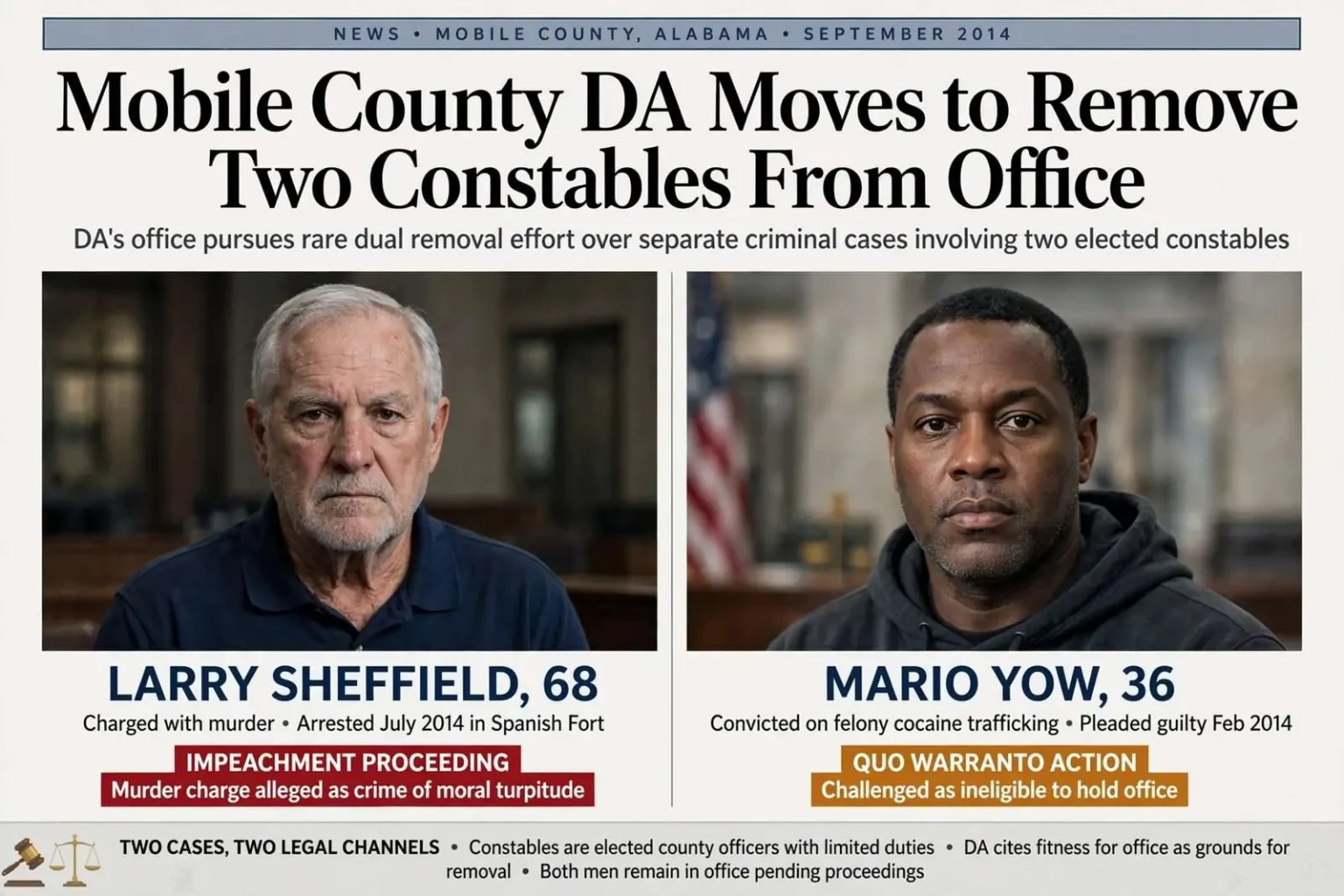
The Mobile County District Attorney’s Office has launched efforts to strip two elected constables of their positions, pointing to separate criminal cases involving each man. Prosecutors say both should be barred from holding the office, and they are pursuing removal through two different legal channels — a rare double move against an obscure county office that most residents could not name, let alone vote in.
One case targets Larry Sheffield, 68, who was arrested earlier in 2014 in Spanish Fort on a murder charge. Sheffield is accused in the July 20 shooting death of a 52-year-old man outside a Baldwin County bar, though he has maintained the shooting was an act of self-defense. Prosecutors argue that the underlying charge disqualifies him from public service.
“We are alleging that the murder that he is charged with over in Baldwin County is a crime of moral turpitude,” Assistant District Attorney Keith Blackwood said. “Based on that fact, he shouldn’t be able to serve as a constable.”
The second case involves Mario Yow, 36, who was arrested in August 2012 on a felony cocaine trafficking charge. Yow went on to win election as a constable that November as a write-in candidate. In February 2014, he pleaded guilty to the trafficking charge in Mobile County Circuit Court and received a 10-year suspended sentence along with three years of probation. Prosecutors contend that the conviction rendered Yow ineligible to serve.
“We are alleging that he is basically usurping the office, that he was ineligible for office from the moment of that conviction,” Blackwood said.
Yow, however, said he intends to fight the effort and take his case as far as possible. “They’ll probably be more upset with me because I will take it all the way before a jury,” Yow said. “My constituents and I talk all the time. I still patrol the district that voted me in. Those people are really behind me because those people knew me before I became a constable and how active I was in the community.”
What a constable actually does
Constables in Alabama are elected county officers whose modern duties are narrow: historically they served civil papers and provided security for the courts, and today many hold the title with little formal work attached. In Mobile County, constables are elected by districts, receive no regular salary, and function in a gray zone between honorific office and actual law enforcement — a status that makes both the office and its oversight easy to overlook.
That structure is what makes removal complicated. Unlike a sheriff, who faces defined state procedures, a constable accused of disqualifying conduct must be unseated through mechanisms that were built for other offices and stretched to fit. The District Attorney’s Office found itself applying two of them at once, for two different men whose offenses occurred at different stages of their tenures.
The officeholders themselves illustrate how loose the system’s edges are. A man facing a murder charge continued to hold an elected position; another pleaded guilty to a felony after his election and kept patrolling his district. Neither officeholder’s status automatically vacated the seat, which is why prosecutors had to act.
Two cases, two channels
The two removals are moving forward under different procedures. In Sheffield’s case, prosecutors presented the matter to a grand jury, which reviewed it and recommended impeachment. That process is not a criminal proceeding but is handled in a similar manner. Sheffield can either resign, which would end the impeachment, or challenge it and go to trial, where a jury would decide whether he stays in office.
The grand jury route treats the constable like other public officials subject to impeachment in Alabama — an accusation brought and a determination made, separate from the criminal case that prompted it. For Sheffield, that means two parallel tracks: the murder charge in Baldwin County’s courts and an impeachment fight that could cost him a mostly ceremonial Mobile County office. He was free on $250,000 bail, and efforts to reach him were unsuccessful.
For Yow, the office is using a civil procedure known as quo warranto, appropriate because his conviction came after he was elected. Quo warranto — literally “by what authority” — is the ancient legal instrument for challenging whether someone is rightfully holding a public office at all. Rather than punishing Yow, it asks a court to declare that his conviction disqualified him from the seat he continues to occupy.
The distinction matters procedurally. Because Yow’s conviction postdated his election, there was no moment when he was ineligible on the ballot; instead, the law’s qualification requirements operate prospectively, and the state argues they now operate against him. Quo warranto is the remedy designed for exactly that gap — an officeholder who was validly elected and is no longer validly serving.
Blackwood said his office was obligated to act once the situation was flagged. “Our office is tasked with pursuing this once it has been brought to our attention,” he said, noting that news coverage and another constable had raised the issue. The admission is telling: neither case arrived through a formal screening process, but through press reports and a colleague’s complaint — a reminder that oversight of the constable ranks depends largely on whoever happens to be paying attention.
Yow, too, has the option to resign, which would make the civil case moot. Both sides are entitled to a jury trial, though they can also agree to let a judge decide. Yow’s public posture suggests he will do neither, preferring a courtroom fight that he frames as loyalty to the voters who wrote his name in.
The self-defense question
Sheffield’s case carries a complication the paperwork does not capture: the underlying charge is contested. A murder accusation is a prosecutor’s allegation, and Sheffield’s claim of self-defense will be tested in Baldwin County, where the shooting occurred outside a bar on a July evening. Alabama’s self-defense law, strengthened by the state’s stand-your-ground statute, can justify a killing in circumstances where a person reasonably feared death or serious injury — but that determination belongs to a jury, months down the road.
Prosecutors did not wait for that verdict to move on the constable’s seat, arguing instead that the charge itself — a crime of moral turpitude, in their framing — is disqualifying while it stands. Whether an accusation, rather than a conviction, is enough to unseat an elected official is the sharper legal question in Sheffield’s case, and it is the question the impeachment proceeding will answer if he chooses to fight.
The two cases together press on the same weak spot from different directions. If an accusation can remove Sheffield, the threshold for unseating local officials drops. If a conviction is not enough to remove Yow promptly, the threshold rises. The District Attorney’s Office is effectively arguing that both men fail the same test — fitness for office — and that the law has a path for each.
Small offices, real stakes
Constable removals rarely draw headlines, but the underlying questions are the ones that attach to every elected position in Alabama: who checks an officeholder’s qualifications, and how quickly the system responds when they fail. In this case the answer came from a district attorney’s office acting on its own reading of the law, months after the conduct at issue, and only after outsiders flagged it.
For now, both men hold the titles they were elected to. Sheffield faces a murder charge in Baldwin County and an impeachment recommendation in Mobile. Yow faces a quo warranto action and a promise to “take it all the way before a jury.” The offices will be settled in courtrooms, one way or the other — or sooner, if either man decides that resignation is the cheaper exit from a fight neither can fully control.
The write-in election
Yow’s path to the office is its own chapter. Write-in candidacies almost never succeed in Alabama elections, where party primaries decide most seats and the November ballot is largely a formality. A write-in win means a candidate’s name spread by word of mouth through a district wide enough that enough voters bothered to type it — evidence of exactly the local following Yow cites when he describes his constituents’ support.
His arrest came in August 2012, months before that election, and his guilty plea came more than a year after he took office. Voters who wrote in his name in November 2012 knew, or could have known, about the pending trafficking charge; what they could not know was that a felony conviction would follow. The quo warranto case turns on that sequence — elected before the conviction, disqualified by it after — rather than on anything the election itself contained.
The case also explains why the District Attorney’s Office treated the two men differently. Sheffield’s alleged crime predates no disqualification rule but is unproven, so it goes to a grand jury under the impeachment channel built for accusations. Yow’s crime is admitted and final, so it goes to a civil court under the channel built for ineligible officeholders. Same objective, different tools, chosen by the circumstances each case presents.
However the cases end, they have already done one thing: dragged a nearly invisible office into the light. Mobile County voters who could not have named their constable a year ago now know that the position exists, that it is elected by district, and that removing someone from it requires a grand jury, a quo warranto action, or a resignation — in roughly that order of convenience.