Nodine Retains New Defense Team as Impeachment Trial Is Set for June 8
Criminal defense attorneys Dennis Knizley and John Williams were retained to lead the defense of Commissioner Steve Nodine, whose impeachment trial was set before Circuit Judge Sarah Stewart.
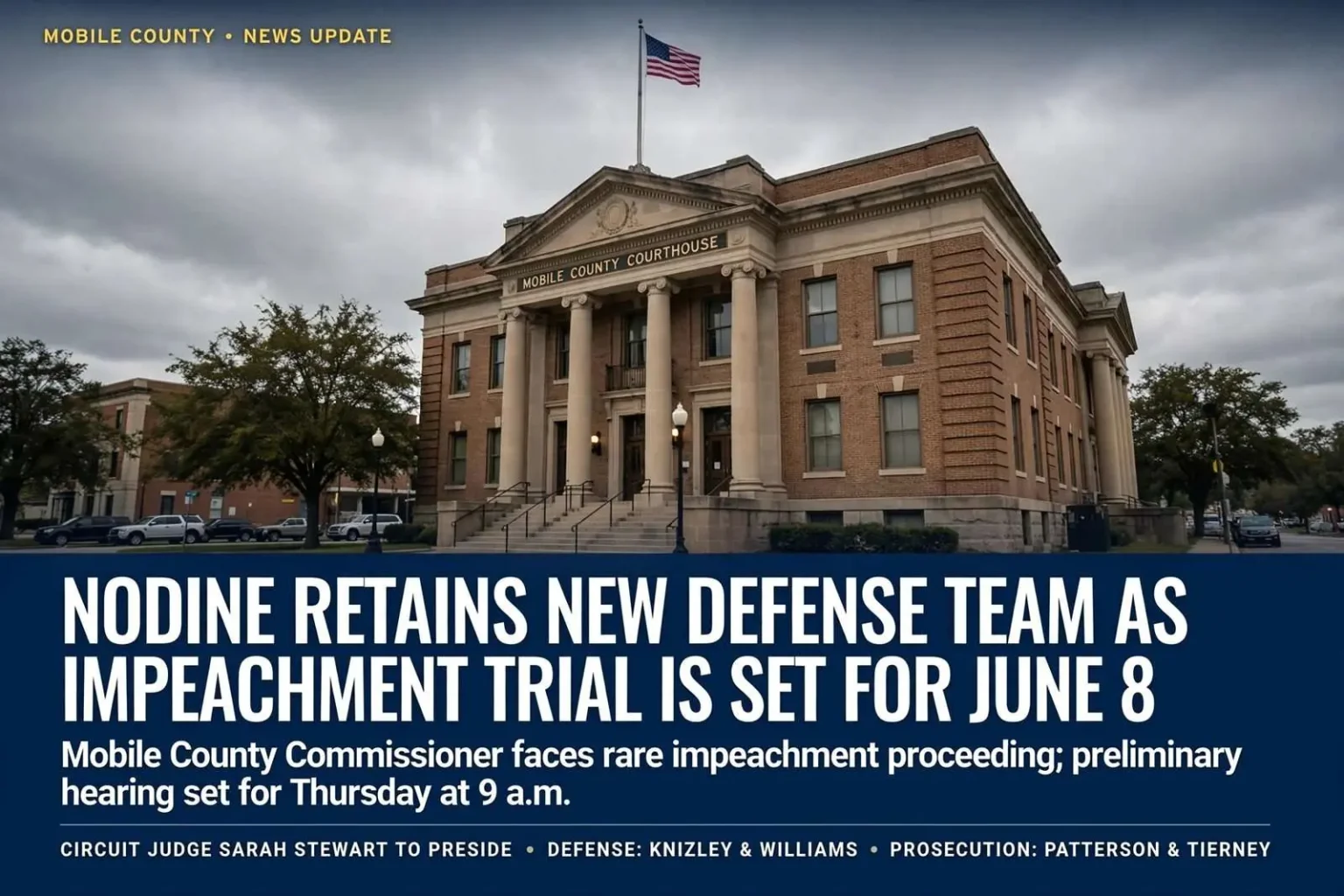
Criminal defense attorneys Dennis Knizley and John Williams have been retained to lead the defense of Mobile County Commissioner Steve Nodine, whose impeachment trial was set for June 8 in Mobile County Circuit Court. Circuit Judge Sarah Stewart was assigned to preside over the rare proceeding, which could end Nodine’s tenure on the county’s governing body.
On the prosecution side, Chief Assistant District Attorney Nicki Patterson and Assistant District Attorney Martha Tierney were named to spearhead the case. Stewart scheduled a preliminary hearing in the matter for 9 a.m. Thursday, an early procedural step that will help frame how the unusual case moves toward trial.
The impeachment action traces to Friday, when a Mobile County grand jury returned an impeachment petition against Nodine alleging five distinct counts: corruption in office, incompetency, intemperance in the use of alcohol or narcotics, offenses involving moral turpitude, and willful neglect of duty. Together, the counts form the basis for an attempt to remove an elected county commissioner from office through the courts rather than at the ballot box.
The same grand jury also returned a separate criminal indictment charging the 46-year-old commissioner with possession of a controlled substance, second-degree possession of marijuana, and possession of drug paraphernalia. Those charges grew out of the discovery of drugs in his county-issued pickup truck during a routine service visit to the county garage, an episode that has shadowed Nodine’s public life for months and prompted scrutiny of how county vehicles are used and monitored.
A rare proceeding with a recent precedent
Impeachment proceedings against county officials are uncommon in Alabama, but the two prosecutors assigned to the Nodine case arrive with experience few in the state can claim. Patterson and Tierney had handled one such case before, prosecuting the impeachment of School Commissioner David Thomas Jr., who was ultimately removed from office. Thomas was defended in that matter by Mobile attorneys Donald Briskman and Christ Coumanis.
That prior experience matters, because impeachment cases blend two bodies of law in a way that ordinary criminal cases do not. Under Alabama law, an impeachment case is tried largely under civil procedure, with relaxed rules about the flow of evidence and the structure of the proceeding, but the state must still prove its allegations beyond a reasonable doubt, the demanding standard reserved for criminal matters. The stakes are different as well: removal from office, not incarceration, is the remedy the court can impose. A commissioner who is impeached loses his seat and its salary, but the proceeding itself cannot send him to jail.
The framework means that the June 8 trial will look unfamiliar to courtroom watchers accustomed to typical criminal dockets. There is no jury requirement of the usual kind in many impeachment settings, and the judge has wide latitude in managing a proceeding that tests both an officeholder’s fitness and, in practical terms, the will of the voters who elected him. For Mobile County, the case is the most visible use of the mechanism in recent memory, and the presence of prosecutors and defense attorneys who have navigated it before adds an unusual layer of institutional knowledge to an already rare dispute.
The shadow of the Gulf Shores case
Nodine also remained the only suspect identified by Baldwin County authorities in the murder investigation into the Mother’s Day evening shooting death of Angel Downs, 45, outside her Gulf Shores townhouse. He had not been charged in that case, which remained open as the impeachment calendar filled.
The overlap created an unusual legal problem for the defense. Any testimony Nodine gave in the impeachment proceeding could be used against him in a potential criminal prosecution across the bay, so his attorneys had to weigh every filing and every witness decision with an eye toward both courtrooms at once. Defense lawyers in such positions often advise clients to remain silent, but an impeachment trial is fundamentally about the officeholder’s own conduct, making it difficult to defend the seat without addressing the allegations directly. The tension between protecting a client’s Fifth Amendment rights and fighting to preserve his elected office shaped the strategy discussions from the moment Knizley and Williams took the file.
For Baldwin County investigators, the case remained unsolved, and the passage of time did not quiet public attention. The shooting drew coverage across the Gulf Coast from the day it happened, and every development in Nodine’s legal troubles in Mobile County renewed questions about where the Baldwin County investigation stood. Authorities there did not announce charges, and Nodine’s defense team did not treat the Mobile County matters as a proxy for anything in the Downs case, but the two matters were inseparable in the public mind.
What impeachment means for Mobile County government
Nodine’s seat on the Mobile County Commission represents a district that includes communities in the western part of the county, and his absence from routine commission business has practical consequences. The three-member commission oversees county roads, garbage collection in unincorporated areas, the county health department’s budget, emergency management spending, and economic development incentives, among other responsibilities. With a commissioner tied up in litigation, votes that require the full board can stall, and constituent services in his district operate through the remaining staff and the two other commissioners.
If the impeachment succeeds, the seat becomes vacant and the machinery for filling it engages under Alabama law, a process that could put the decision before the governor or trigger a special election depending on how the removal is structured. If it fails, Nodine retains the office but carries the political weight of a contested term. Either outcome leaves the county’s governing board navigating months of uncertainty that residents did not choose and cannot vote to end until the process plays out.
The criminal charges accompanying the impeachment carry their own timeline. Possession of a controlled substance and second-degree possession of marijuana are separate prosecutions from the impeachment case, heard under standard criminal procedure, and their outcome can influence the political and legal pressure surrounding the officeholder even though a criminal conviction is not required for the commission to lose its seat. Courts handling overlapping criminal and impeachment matters must sequence hearings carefully to avoid prejudicing either case, which is one more reason Judge Stewart’s preliminary hearing on Thursday carries significance beyond its place on the calendar.
The attorneys on both sides
Knizley and Williams are among the best-known criminal defense figures on the Gulf Coast, and their retention signaled that Nodine intended to fight the removal effort with a full defense rather than negotiate an exit. The pair’s involvement also connects the case to a Mobile legal community that has watched the intersection of the commissioner’s criminal and political troubles unfold with unusual attention.
On the state’s side, Patterson and Tierney’s prior impeachment work gave the District Attorney’s office a template. In the Thomas matter, the prosecution successfully argued that the school commissioner’s conduct met the statutory grounds for removal, and the court agreed. The lesson from that case, practitioners in Mobile note, is that Alabama courts will act on impeachment petitions when the evidence supports them, even though the remedy is rare enough that many county officials serve entire careers without ever considering the possibility.
The Thursday hearing before Judge Stewart is expected to address scheduling and preliminary legal questions rather than the merits. From there, the case heads toward the June 8 trial date, with both sides preparing for a proceeding that is at once a courtroom trial, a political reckoning, and, for Mobile County, a test of a remedy the state’s constitution provides but rarely uses.
The five counts themselves carry weight in Alabama’s statutory scheme for removal. Corruption in office and willful neglect of duty address how an official exercises the powers of his position, while incompetency speaks to capacity to serve at all. Intemperance in the use of alcohol or narcotics and offenses involving moral turpitude reach personal conduct that the law treats as incompatible with public trust. Prosecutors do not need to prove all five counts; prevailing on any one of them is enough to support removal, which shapes how a defense allocates its energy across the petition.
County residents have watched the case develop through channels they rarely see in action. Grand jury proceedings are secret, so the public learned of the impeachment action only when it was returned, and the specific factual allegations underlying each count emerge in detail only as hearings proceed. That opacity has left room for speculation on talk radio and in online comments, but the formal record remains thin until the preliminary hearing begins to flesh out what the state believes it can prove.
For the region’s legal observers, the Nodine case is also a reminder that Alabama’s constitution treats public office as a trust that courts can police. The state’s impeachment provisions reach beyond the governor and statewide officers to county commissions and school boards, a scope many neighboring states do not match. How Mobile County Circuit Court manages this trial — from evidentiary rulings to the pacing of a docket that includes an open murder investigation in an adjoining county — will be studied by officials and attorneys across Alabama who may one day face the same rare mechanism.