Two Killed in Mobile Photography Studio Shooting Tied to Domestic Conflict
A mother and son were fatally shot inside a Mobile photography studio in a case police tied to a domestic conflict; the suspect later took his own life.
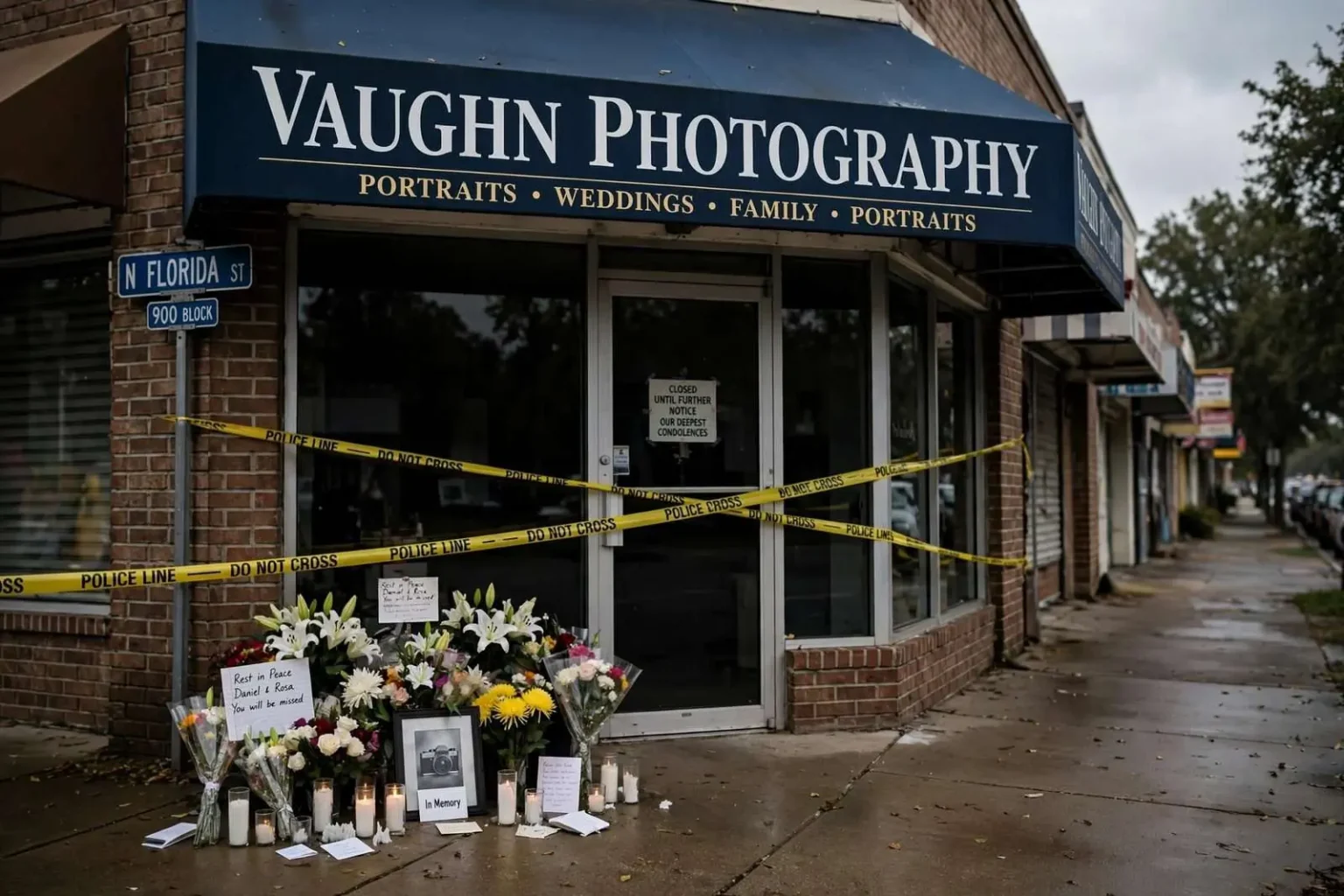
A shooting inside a Mobile photography studio left two family members dead and shook a wide circle of relatives, friends and former students, according to police and a family member who spoke about the loss. The deaths, and the manhunt that ended hours away in another state, drew attention across the Gulf Coast as investigators worked to piece together what happened inside the small business on North Florida Street.
Investigators said Daniel Herbert Vaughn, 43, of Mobile and his mother, 67-year-old Rosa Vaughn McGahagin of Spanish Fort, were fatally shot inside Vaughn Photography on North Florida Street. Mobile police said officers were called to the studio around 4 p.m. after someone walked in and found the two dead, a discovery that turned an ordinary afternoon on the corridor into the scene of a double homicide investigation.
Authorities identified 56-year-old Terry Walton as the suspect in the killings. When deputies in Escambia County, Fla., went to Walton’s home in Pensacola, he fatally shot himself inside the residence, according to police. Investigators said the case was considered cleared with his death, closing the search for a suspect but leaving the people who knew the victims with questions that an official clearing can never fully answer.
A relative said the violence grew out of a domestic conflict connected to Vaughn. Domestic disputes that escalate to violence remain among the most difficult cases police confront, precisely because the relationships involved are private, the warning signs are often visible only to those closest to the parties, and the danger can follow people across city and state lines.
Remembering the victims
Betty Bacon, an aunt of Vaughn’s estranged wife, remembered him warmly. “He was a good guy. He was one of the white hats,” she said, describing a man whose reputation in the community rested on decades of photographs — weddings, portraits, family milestones — rather than on the circumstances of his death.
Rosa McGahagin had recently started working alongside her son at the studio to help with the business, Bacon said. She called the deaths “an unfortunate tragedy,” a measured description of a loss that took a mother and son on the same afternoon in the place where they had recently begun working together.
Vaughn was the father of two children who attend schools in Mobile, a detail that rippled quickly through the school community as families learned of the deaths. “Daniel’s children lost both their dad and grandmother in one night,” Bacon said. She noted that McGahagin also had another child, and estimated that dozens of people were touched by the loss.
“There’s probably at least 50 people that are directly affected by this man’s actions, who we never met, we never knew,” she said — a reminder that the reach of a violent act extends far beyond its immediate victims, to in-laws, classmates, clients and friends who had no connection to the conflict at its center.
Beyond his photography work, Vaughn had been furthering his education with the goal of returning to teaching, according to Bacon, who said he had previously taught summer photography courses at Spring Hill College in Mobile. The small liberal arts college, founded in 1830 and located in the Spring Hill neighborhood of the city, has long been part of Mobile’s educational landscape, and Vaughn’s time teaching there connected him to generations of students who learned the craft from a working professional.
The decision to return to school as an adult, with two children at home and an established business, reflected an ambition beyond the studio. Teaching had clearly remained a calling for Vaughn even after his photography career took root, and those who knew him described a man building toward the next chapter of a working life rather than winding one down.
Court records show he had been married since 1992, though he and his wife were separated at the time of his death. Mobile Police Department spokeswoman Ashley Rains confirmed the details of the investigation as it moved forward, with detectives documenting the scene, interviewing those close to the victims and coordinating with authorities in Florida as the trail led across state lines.
The investigation, step by step
When Mobile officers arrived at the studio shortly after the 4 p.m. call, their first tasks were the ones that define any death investigation: securing the scene, confirming the condition of the two victims and beginning the process of identifying who had been inside and why. Homicide detectives took over the case, and the early identification of a suspect came together quickly enough that the focus shifted across state lines the same day.
The coordination between Mobile police and Escambia County deputies in Florida illustrates how regional law enforcement works when a suspect crosses state lines. The two jurisdictions sit barely an hour apart by interstate highway, and agencies along the Gulf Coast maintain standing relationships that allow information — addresses, vehicle descriptions, warrants — to move faster than a suspect can travel. In this case, deputies went to the Pensacola home where Walton was believed to be, and the case ended there when he took his own life.
An investigation cleared by the death of the suspect means no trial will answer the remaining questions: what precisely set the conflict in motion, and why it ended in a photography studio where a mother had recently come to work beside her son. For investigators, the clearance closes the case file; for families, it often marks the beginning of a longer reckoning.
The studio and its neighborhood
Vaughn Photography operated along North Florida Street, a corridor that runs north from midtown Mobile through a stretch of small businesses, churches and neighborhood storefronts. Photography studios occupy a distinctive place in the commercial life of a city — they are, by design, places where families gather at the happiest moments of their lives, from newborn portraits to wedding parties to multigenerational family photographs.
That makes violence inside one feel like a violation of more than a business. Clients who had scheduled sessions, families whose wedding albums carried Vaughn’s name and students who had learned from him at Spring Hill College all found themselves connected to the case in ways none of them expected when the day began.
Domestic conflict and its aftermath
Law enforcement officials have long identified domestic conflict as a driving factor in violent deaths across Alabama and the nation, and cases that end in murder-suicide carry a particular weight for surviving families, who grieve their dead while also confronting the reality that the person responsible will never face a court. Advocates who work with families in these situations emphasize that the aftermath — custody questions, estate matters, counseling for children — unfolds over months and years, not days.
For the children at the center of this case, the loss of a father and grandmother in a single act of violence will follow them through their school years in Mobile. School counselors, pastors and extended family typically shoulder the work of helping children absorb a loss of this size, and Bacon’s description of dozens of directly affected relatives and friends gives some measure of how many people that burden now touches.
The case also stands as an example of how quickly domestic conflict can move from private trouble to public tragedy. Family members described a relationship that had broken down, a separation recorded in court files, and a dispute that outsiders could see only in fragments. Police departments across the region consistently urge anyone who sees escalation in a family conflict — their own or a relative’s — to seek help early, through law enforcement or through the domestic violence resources that operate in every Alabama county, before a dispute reaches the point of no return.
What remains
In the days after the shooting, the practical artifacts of the loss told their own story: a studio with its appointments now unfillable, photographs from years of Mobile weddings and family sittings, a college course listing with one fewer instructor. Neighbors along North Florida Street passed the storefront as detectives finished their work, and the corridor resumed its ordinary rhythm around a space that would not.
The deaths of Vaughn and McGahagin join a grim category that police statistics track but never fully capture — the domestic disputes that end in fatal violence, in this case spreading across two cities, two states and at least three families’ worth of grief. Mobile police closed their investigation with the suspect’s death in Pensacola, and the record of what happened inside Vaughn Photography now belongs to the relatives, clients and students who knew the two victims as far more than the subject of a police report.
For a community that knew the studio’s owner as “one of the white hats,” the final accounting is the one Bacon offered: at least 50 people directly affected by the actions of a man none of them had ever met, and two children left to grow up without a father or a grandmother because of a conflict that ended before anyone could stand between them.