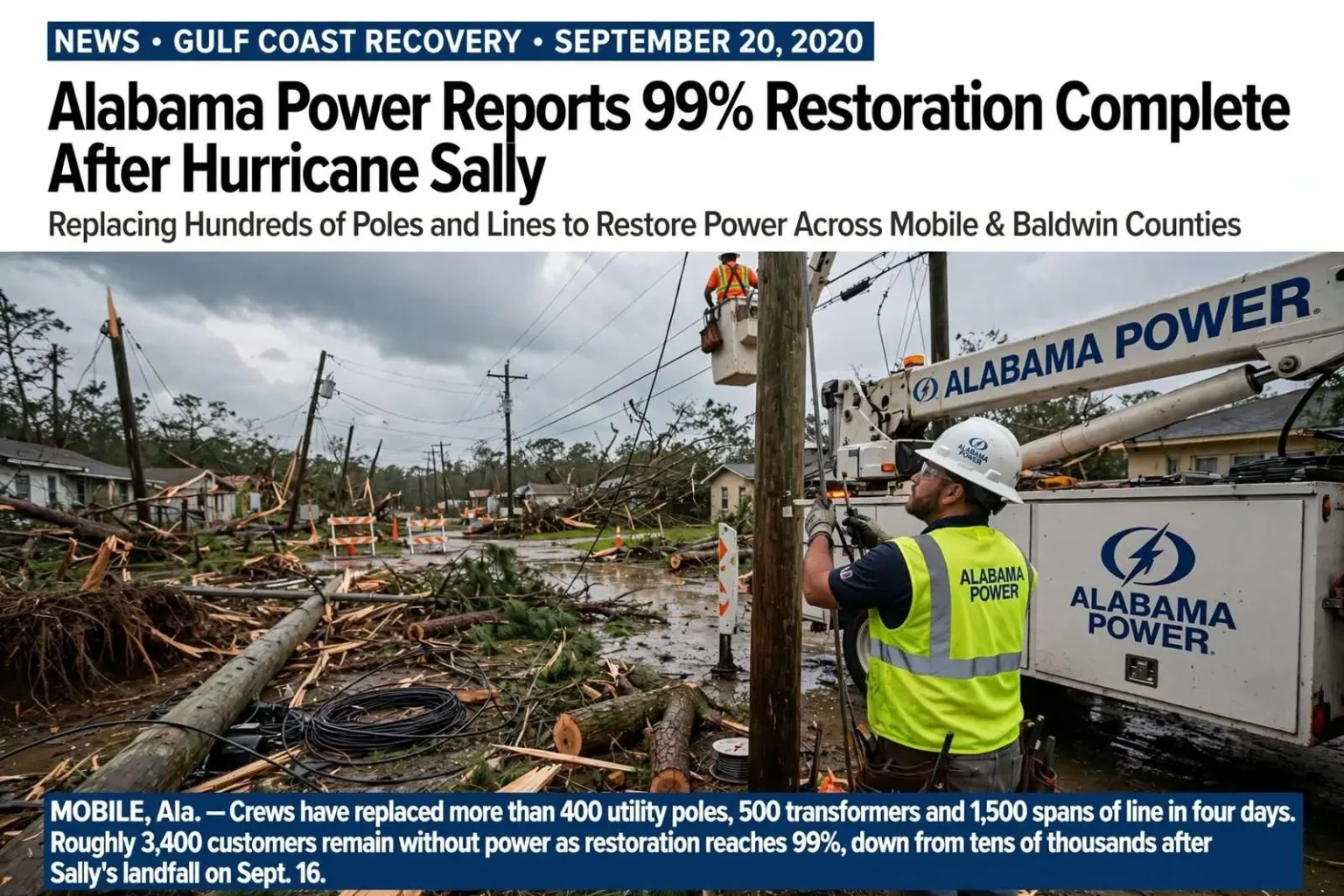
MOBILE, Ala. — Alabama Power reported Sunday that its restoration effort following Hurricane Sally had reached 99 percent, with crews having replaced more than 400 utility poles, more than 500 transformers and more than 1,500 spans of power lines damaged or destroyed during the storm. The figures, released four days after Sally’s landfall, charted the scale of one of the most disruptive storms to hit the central Gulf Coast in years.
By noon on September 20, 2020, the company said the vast majority of customers who lost power when Sally made landfall on September 16 were back online. A 9 p.m. update that evening indicated roughly 3,400 customers in the Mobile area were still without service, down from tens of thousands at the storm’s peak — a restoration curve that moved from widespread blackout to scattered outages in under a week.
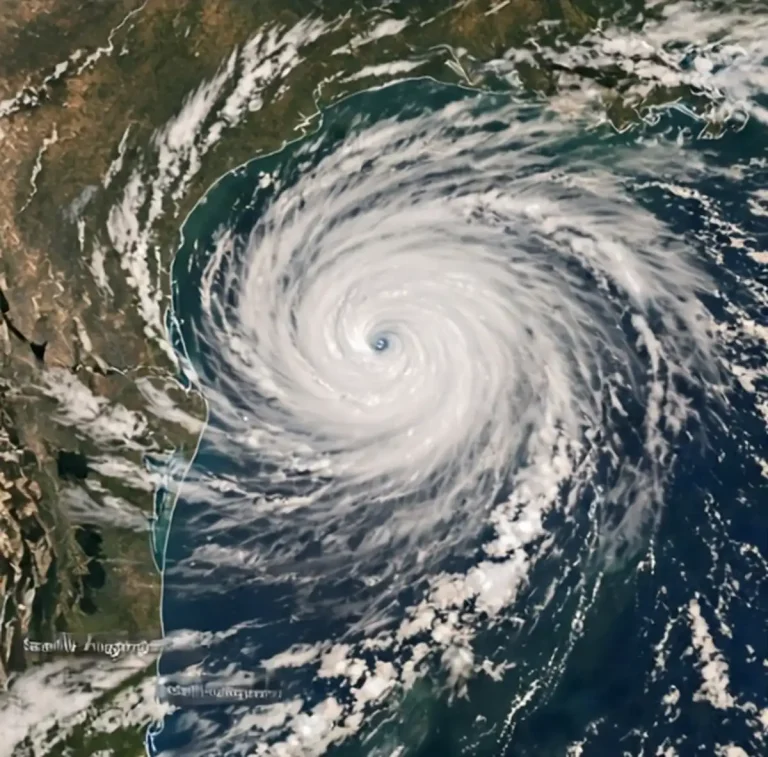
Hurricane Sally came ashore near Gulf Shores as a Category 2 storm, bringing sustained winds and historic rainfall that toppled trees, snapped utility poles and flooded substations across Mobile and Baldwin counties. The storm’s slow forward motion magnified its impact on the electrical grid: hours of sustained wind on saturated ground gave trees time to fall across lines, and prolonged rain turned right-of-way access roads into mud. What a faster-moving system might have done in an hour of wind, Sally did over a day and more.
What the numbers say about the damage
Replacing more than 400 poles in four days is a measure of both the destruction and the response. A single utility pole crew can set only a handful of new poles in a day under good conditions, and Sally’s aftermath was anything but good — roads blocked by fallen trees and debris, floodwater standing in low-lying neighborhoods, and damage scattered across two counties rather than concentrated in one corridor. The pole count alone implies dozens of crews working simultaneously across the service area, alongside line crews pulling wire and transformer crews restoring the equipment that steps voltage down to household levels.
The more than 1,500 spans of power line replaced or repaired tell a similar story at ground level. A span is the stretch of wire between two poles, and when trees fall across a distribution circuit they frequently bring several spans down at once. Every span that must be restrung is a crew, a bucket truck, a spool of wire and a stretch of right-of-way cleared of debris — and every neighborhood fed by a damaged circuit waits on that work regardless of how intact its own streets may be.
Flooded substations added a different kind of delay. Substations are the junction points where high-voltage transmission lines connect to the local distribution network, and standing water in a substation yard forces crews to inspect and dry equipment before re-energizing, because restoring power through damaged gear can destroy transformers and endanger the line workers standing next to them.
The geography of the damage shaped the work order as well. Baldwin County’s coastline took the storm’s hardest punch, but outages stretched across the Mobile Bay area, through the city’s neighborhoods and west into Washington County, and every cluster of damage needed its own assessment before crews could be committed. In the first days after landfall, assessors moved ahead of repair crews simply to learn what the storm had done — a survey that turn-by-turn, street by street, determined the sequence of everything that followed.
Why the last outages take longest
Alabama Power said the remaining outages were concentrated in areas with the most severe structural damage, where individual service drops and neighborhood-level repairs required more time. The pattern is standard in major storm restoration and follows from how an electrical system is built: utilities restore power in layers, from large transmission lines to substations to main distribution circuits to the final service drop that connects an individual home.
The layered approach explains why some customers sit in the dark days after their neighbors’ lights are on. A house can be undamaged, with its own wiring and meter intact, and still have no power because the one circuit that feeds its street is a mangled line three miles away. Restoration crews work the triage math deliberately — every major circuit returned to service brings hundreds or thousands of customers back at once, so those repairs come first, and the individual service drops that each restore a single home come last.
Storm restoration is also sequenced by safety as much as speed. Crews cannot re-energize a line until they have confirmed that no downed conductor is energizing a fence, a flooded yard or a collapsed structure, and customers who have installed portable generators are urged to keep them isolated from the grid so that crews working on a line are not feeding power back into it from a neighborhood. Those precautions slow the final phase of restoration by design, and utility officials consistently ask for patience precisely when the finish line is closest.
Sally’s place in Gulf Coast storm history
Sally made landfall near Gulf Shores early on September 16, 2020, during one of the most active Atlantic hurricane seasons on record. Its slow track across the northern Gulf gave the storm days to organize, and its landfall angle put Baldwin County’s coastline at the point of worst impact while pushing tropical storm conditions across all of Mobile County. Rainfall totals across the region measured in feet rather than inches in some locations, producing flooding that rivaled the wind damage itself.
For the utilities that serve the coast, Sally joined a lineage of Gulf storms that have tested the electrical grid in different ways. Wind-driven hurricanes knock down lines and poles; flood-driven events inundate substations and underground equipment; and slow-moving systems like Sally do both at once, over a duration that multiplies the strain. Restoration plans are built around those categories of damage, and the pace of Alabama Power’s recovery from Sally — 99 percent in four days — tracked with the industry’s expectation that major circuit repair proceeds quickly once access roads are cleared and crews are staged.
What restoration looks like on the ground
The work behind a percentage figure is visible across the storm zone long before it shows up in a company update. Bucket trucks parked in intersections where a pole snapped at the base. Line crews in climbing gear strapping new poles and rigging blocks to pull conductor through the trees. Damage assessors driving circuits street by street, feeding the outage map that determines where the next crew goes. Mutual assistance lineworkers from other states staged in parking lots, working sixteen-hour days under the storm protocols that govern utility restoration across the Southeast.
Customers experience the same effort from the other side: a neighborhood that flickers back in the middle of the night as a circuit is re-energized, or a street where the lights return in pieces over several days as individual service drops are repaired. Alabama Power’s storm updates during the Sally recovery followed that rhythm, moving from systemwide assessments in the first 48 hours to the neighborhood-level counts that dominated the final days.
The company’s Sunday report — 99 percent restored, with the remaining customers concentrated in the hardest-hit areas — put the recovery on the doorstep of completion. The last fraction of a restoration effort is always the slowest, and the thousands still without power in the Mobile area on the evening of September 20 were, in most cases, waiting on repairs to the final links in their particular chain: a service line to one house, a transformer feeding a handful of homes, a short span of wire across one damaged stretch of road.
What customers can expect after the power returns
Utility officials routinely remind customers in the post-storm window that returning power does not mean returning normal. Refrigerated and frozen food that spent four or more days without cooling should be evaluated carefully, flooded electrical equipment should be inspected before use, and any home that took water around its meter, panel or wiring should have an electrician check it before the service is energized. Damage to the service entrance on a customer’s side of the meter — the weatherhead, the meter base, the panel — is the homeowner’s responsibility to repair, and storm seasons on the Gulf Coast reliably produce a wave of those repairs in the weeks after the lines are back.
For the crews, the completion of major restoration is followed by the quieter work of permanent repairs: replacing temporary poles with new ones, tightening the system back to pre-storm standards, and clearing the remaining debris from rights-of-way. The grid that Sally left behind was rebuilt in days, but storm-hardening — stronger poles, trimmed rights-of-way, smarter switching — is the work between storms that determines how the next one goes.
For the residents of Mobile and Baldwin counties, the September 20 update marked the practical end of Sally’s longest shadow. Tens of thousands of customers had gone dark on September 16; four days later, all but a few thousand were back on the grid, and the crews that accomplished it had replaced hundreds of poles and more than a thousand spans of line in between — the visible arithmetic of a Gulf Coast storm recovery.