Two Found Dead in Mobile Photography Studio in Double Homicide
Mobile police opened a double homicide investigation after a man and woman were found dead inside a longtime photography studio on Florida Street.
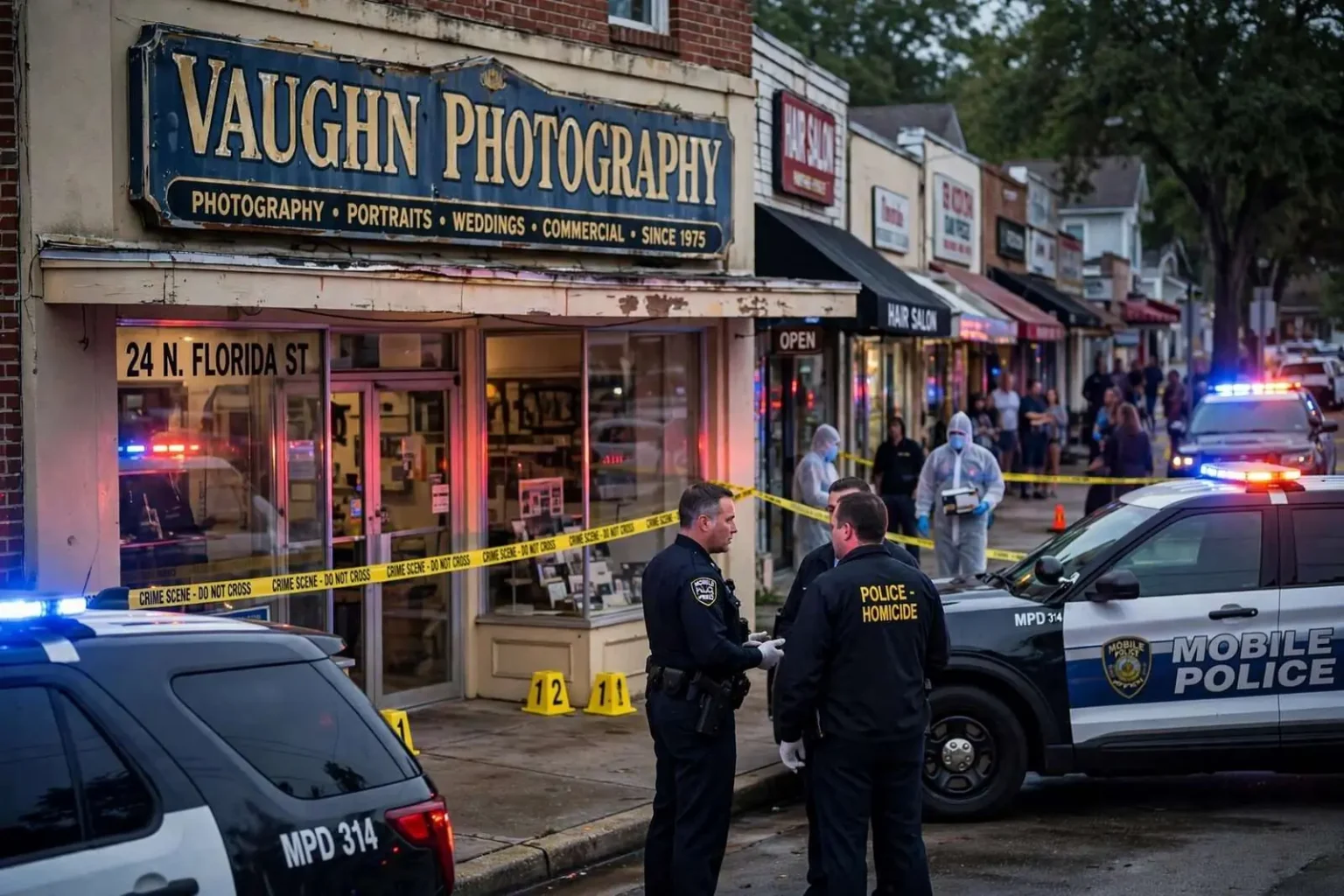
Mobile police launched a homicide investigation after two people were found dead inside a longtime photography studio on Florida Street, authorities said.
The discovery came on a Thursday evening when someone walked into Vaughn Photography, located at 24 North Florida Street, and found the two victims. Officers were dispatched to the business after a 911 call came in around 4 p.m. When they arrived, they located two deceased people inside. By early evening, investigators had classified the case as a double homicide.
What police found
Mobile Police Department spokesperson Ashley Rains said the two people who died were a man and a woman, though authorities did not immediately release their identities.
“We are actively working the scene to determine what it is that we are dealing with,” Rains said at the location. “We do have two deceased inside the business.”
The department deployed multiple specialized teams to the scene, including its assault, homicide and crime scene investigation units.
The response reflected the seriousness with which the department treats any discovery of multiple victims. The homicide unit took command of the investigation, while the crime scene unit worked the interior of the studio methodically — photographing, measuring and collecting physical evidence that would need to stand up in court months or years later. The assault unit’s presence indicated investigators were pursuing every angle from the opening hours, including the possibility that the deaths were connected to an assault reported or witnessed earlier. Patrol officers secured the perimeter, holding the scene until detectives determined how long they would need it.
As the investigation got underway, officers fanned out through the surrounding area, speaking with neighbors in nearby homes and businesses in an effort to piece together what had happened and gather any information that might help the case.
A studio that has been part of the city for decades
The studio has been a fixture in the community for decades, having operated since 1975.
In that time, Vaughn Photography has documented a wide swath of Mobile life — wedding portraits, family sittings, graduation photos and commercial work — making it the kind of business where generations of local families have walked through the same door. Establishments with that kind of history occupy a particular place in a neighborhood: they are landmarks in daily routines, places people expect to pass for years to come. The shock registered among residents and neighboring business owners on Thursday evening reflected exactly that.
The killings sent a jolt through the neighborhood, where residents and business owners were left grappling with the sudden and violent loss inside a familiar local establishment.
North Florida Street sits in Mobile’s midtown corridor, a section of the city where small storefront businesses line the roadway between residential streets. Violent crime inside a well-known storefront business is unusual there, and the sight of patrol cars and crime scene tape on a weekday afternoon drew onlookers to the sidewalk within minutes of the first responders’ arrival.
An investigation in its opening hours
Police cautioned early on that the investigation was still in its opening hours and that many questions remained unanswered. Investigators worked to determine a possible motive, establish a timeline and identify anyone who may have been involved. Authorities said they would release additional information as it became available.
In the first hours of a double homicide, detectives work a standard sequence. The scene itself comes first: nothing inside the studio moves until it has been documented and processed, because the physical evidence is the one part of the case that cannot be re-gathered. Investigators then build the timeline from the outside in — who was seen entering or leaving the business, when the victims were last known to be alive, and when the person who made the discovery walked in. The canvass of nearby homes and businesses feeds that timeline with security camera footage, doorbell cameras and the observations of people who were on the street that afternoon without realizing what they had seen.
Identifying the victims and notifying their families comes before any public release of names, which is why authorities held back identities in the hours after the discovery. In cases where the victims and whoever is responsible may have known each other, the early answer to the question of who died often shapes the direction of the entire investigation.
Double homicides are rare here
Double homicides are relatively rare in the area, and the discovery drew a significant law enforcement response as detectives sought to secure the scene and collect evidence before it could be lost.
Mobile records dozens of homicides in a typical year, most involving a single victim, and cases with two deaths at one location are uncommon enough that they draw department-wide attention. The concentration of resources visible on Florida Street that evening — patrol, detectives, crime scene technicians and command staff — was a function of that rarity and of the department’s interest in resolving the case quickly while evidence and memories are fresh.
For the neighborhood, the rarity offered little comfort. The fact that two people died inside a business that has operated since 1975, discovered by someone who simply walked in during business hours, left residents with questions no press release could settle: whether it was random, whether anyone nearby was at risk, and what had happened behind the studio’s door in the minutes before a 911 call brought the first officers to the address.
How the case will proceed
Once the scene is released, the investigation moves to the detectives’ desk. Evidence collected at the studio goes to the crime lab; tips called in by neighbors are run down; and the medical examiner’s findings will establish cause and time of death, anchoring the timeline investigators are building. Mobile police typically ask anyone with information to contact the department or Mobile-area crime stoppers, and in cases like this one — a business frequented by the public — detectives count on customers and passersby who may have seen something insignificant on its own but meaningful in combination.
The department committed to releasing additional information as it became available, and the neighborhood along North Florida Street — home to the business for nearly half a century — is waiting for those answers. What is known so far is the outline: two people found dead in a longtime local studio on a Thursday afternoon, a city’s homicide investigators working the scene, and a community confronting a rare and violent loss in a familiar place.
What the first hours mean for solving the case
Homicide detectives put a premium on the first 48 hours for reasons that experience has validated again and again. Witnesses’ memories are sharpest, security footage has not yet been overwritten, and any person responsible for the deaths has had the least time to establish an alibi or dispose of evidence. The heavy response on Thursday evening — with officers canvassing door to door well into the night — was aimed squarely at banking all of that before it fades.
The canvass itself is painstaking work. Officers knock on every house and business within sight of the studio, asking the same questions in different words: What did you see? What did you hear? Do you have a camera? Each answer gets logged, and the pattern that emerges often points investigators toward the critical window — the stretch of time between when the victims were last seen alive and when the discovery was made. In commercial corridors like North Florida Street, delivery drivers, mail carriers and regular customers become especially valuable witnesses, because they notice when something about a familiar storefront is different.
The medical examiner’s office will play a central role as well. Determining cause and estimated time of death gives the timeline its anchors, and the findings frequently narrow the range of possibilities investigators must consider. Until those results are in, police are right to hold their conclusions — and, in the opening hours of a case like this one, they almost always do.
The wider weight on midtown Mobile
Crimes inside longstanding neighborhood businesses tend to land differently on a community than crimes committed in anonymous settings. A studio that has photographed the city’s weddings and family portraits since 1975 is part of the shared history of thousands of Mobile households, and violence inside it violates the sense that some places are simply safe. Neighbors lingered on the sidewalk through the evening as technicians moved in and out of the building, trading what little they knew and waiting for the department to say more.
Business owners along the corridor will watch the investigation’s progress closely. Retail and service businesses on streets like North Florida Street depend on foot traffic and familiarity, and an unsolved double homicide at a neighboring address is the kind of event that changes how customers — and employees — feel about walking in the door. In the days after such a discovery, it is common for nearby owners to review their own security, compare notes with police and press for a quick resolution.
The department’s pledge to release more information as it becomes available sets the rhythm for what comes next. Investigators will say little until the scene work is complete and the families have been notified, and then, as leads develop, the account of what happened at 24 North Florida Street will fill in piece by piece. Until then, the neighborhood is left with the outline of a tragedy — two people gone, a fixture of midtown Mobile sealed behind crime scene tape, and detectives working to answer the questions the whole city is asking.