Citronelle High School Breaks Ground on New Campus
Mobile County school officials held a groundbreaking ceremony for the new Citronelle High School, set to open across from the current campus in 2016.
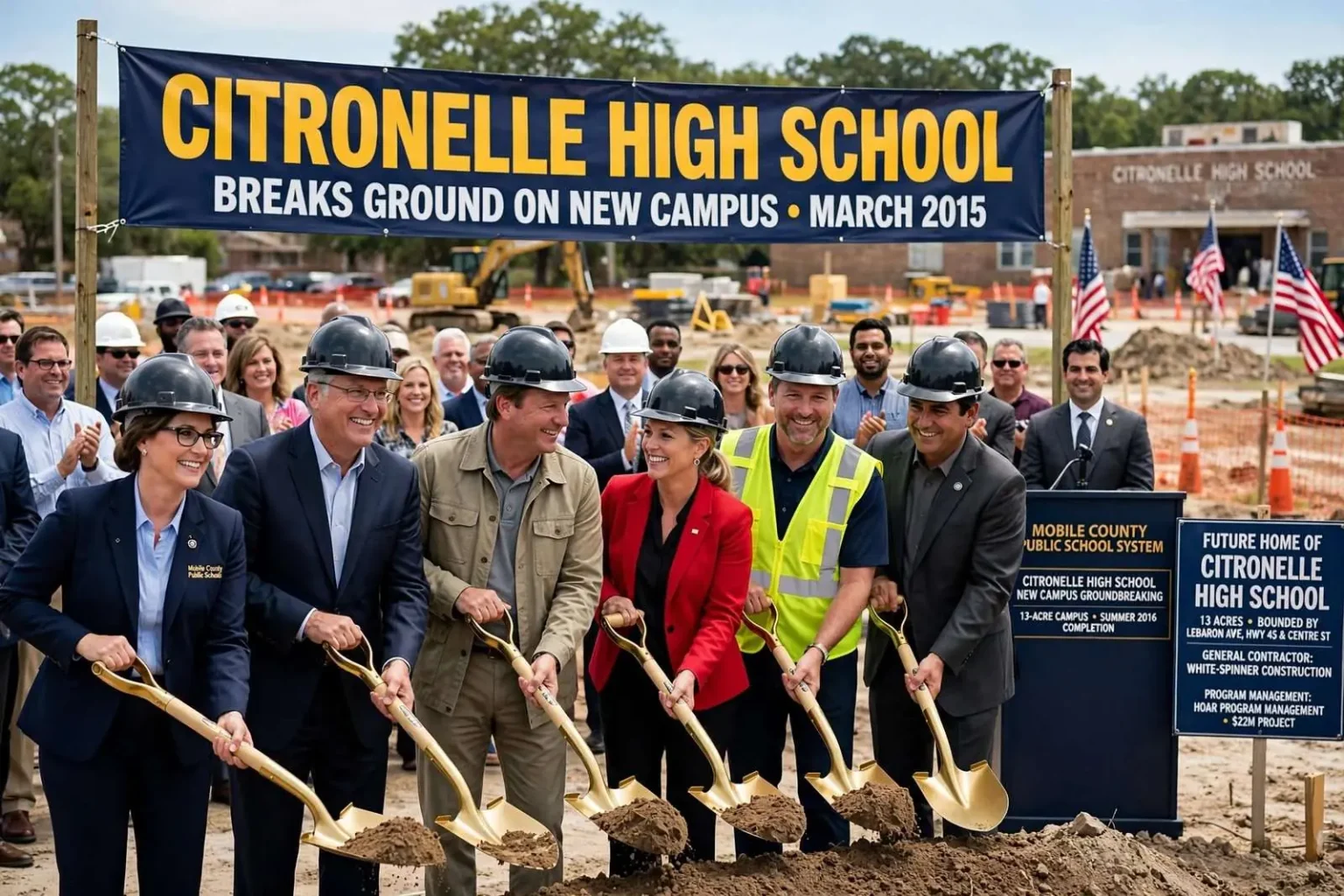
Construction officially began on a new Citronelle High School after Mobile County school officials held a groundbreaking ceremony marking the start of work on a campus that has been years in the planning.
The new school will rise on a roughly 13-acre site directly across from the existing Citronelle High School, bordered by Lebaron Avenue, Highway 45 and Centre Street. Renderings released ahead of the ceremony show a modern facility designed to replace the district’s aging building with updated classrooms and campus infrastructure.
Officials set a completion target of summer 2016, giving the district roughly a year and a half to complete the project before students would be able to move into the new building.
The Mobile County school board awarded a $22 million construction contract to White-Spunner Construction late last year to serve as general contractor on the project. The build is being overseen by Hoar Program Management, which is managing roughly $100 million in school construction projects for the district over a two-year span, part of a broader wave of facility upgrades across Mobile County’s school system.
A Community Awaiting Its New School
For Citronelle — the largest city in north Mobile County, anchored along the Highway 45 corridor — the groundbreaking represents the answer to a question the community has asked for years: when would its aging high school be replaced? The existing building has served generations of students, but its age has shown in the classrooms, mechanical systems and campus infrastructure that newer schools in the county take for granted.
The site selection across from the current school keeps the campus in the heart of the community, preserving the geography that generations of Citronelle students and families already know. The 13 acres bounded by Lebaron Avenue, Highway 45 and Centre Street give designers room to build a modern campus without the constraints that come from trying to renovate a school in place while classes continue.
Groundbreakings are political and civic milestones as much as construction ones. For the school board member representing the district, for city officials and for the families in attendance, the ceremony converts years of planning documents and budget debates into visible evidence: fences, stakes and machinery about to move onto the site.
The $22 Million Contract
The $22 million contract with White-Spunner Construction places the Citronelle project among the significant school construction investments in Mobile County’s recent history. The Mobile-based general contractor — one of the Gulf Coast’s established builders — brings local subcontractor relationships and Gulf Coast construction experience to a project whose schedule runs through hurricane season.
The 18-month window to summer 2016 is ambitious for a full campus build, and it reflects the program management discipline the district has applied across its construction wave. Design was completed ahead of the groundbreaking, permits lined up, and the site prepared so that the contract clock starts with vertical construction rather than preliminary work.
Hoar Program Management’s oversight adds a layer of professional control between the district and its contractors. The firm is managing roughly $100 million in school construction across Mobile County over a two-year span — a portfolio approach that lets the district coordinate schedules, standardize oversight and hold contractors to consistent standards across multiple campuses at once.
A District-Wide Building Wave
The Citronelle high school is one piece of a much larger campaign. The Mobile County Public School System — Alabama’s largest, serving communities from the city of Mobile to the county’s northern and southern reaches — has been working through a construction and renovation program addressing buildings that range from decades-old classrooms to overcrowded suburban campuses.
The roughly $100 million Hoar is managing over two years spans that geography, and the pace matters as much as the money. School construction programs often stall between funding authorizations and completed buildings; the district’s use of a single program manager across multiple projects is designed to keep the pipeline moving, with each groundbreaking feeding the next construction wave.
For outlying communities, the stakes are different than for the city’s schools. Citronelle’s students have no alternative modern campus nearby — the high school is the community’s school, and its condition shapes both the education students receive and the community’s ability to attract the families that keep a north Mobile County town growing. A new campus is economic development as much as education policy.
And a Second Project: Lott Middle School
Beyond the high school itself, district officials used the same week to advance plans for a second Citronelle campus project. The school board’s work session included discussion of a proposed lease agreement in which the district would rent about 9 acres from the City of Citronelle to expand Lott Middle School.
Under the terms discussed, the district would pay a nominal $1 per acre annually over a 49-year term — a lease that costs the district essentially nothing while securing the land a growing campus needs. The nominal pricing reflects the arrangement’s mutual benefit: the city provides land for the community’s schools, and the district commits to a half-century presence on it.
If approved, the arrangement would let the district combine the leased acreage with property it has already purchased near the existing middle school, consolidating everything into a single expanded campus. Consolidation solves problems that piecemeal expansion cannot: a unified campus layout, shared circulation for buses and parents, and room for future additions without another land hunt.
Local officials framed the high school groundbreaking as part of a broader investment in Citronelle’s public schools, with the middle school expansion representing a complementary piece of that plan. Together, the two projects would rebuild the community’s school infrastructure from the top of the grade span to the bottom of it — a new high school opening by summer 2016 and an expanded middle school campus taking shape alongside it.
Why Citronelle’s Schools Matter Beyond the City Limits
Citronelle sits at the far northern end of Mobile County, along Highway 45 roughly 35 miles north of downtown Mobile — far enough from the county’s population centers that its schools anchor the community’s identity. Generations of families have passed through Citronelle High School and Lott Middle School, and the towns around them — Mount Vernon, Wilmer, the crossroads communities of north Mobile County — feed the same school community.
Distance shapes everything about how the projects matter. Students in north Mobile County cannot be rezoned to a newer school across town; the facilities where they live are the facilities they get. That makes capital investment in Citronelle a direct measure of the district’s commitment to its far-flung communities, and it explains why the groundbreaking drew officials and residents who see the campus as the town’s most visible public institution.
A modern high school also strengthens the area’s hand in economic development. Families considering a move to north Mobile County — and employers weighing the area — look first at schools. The $22 million campus, and the middle school expansion alongside it, give Citronelle a concrete answer to the question every growing community faces.
What Happens Between Now and Summer 2016
The construction schedule ahead is tight and visible. Site work on the 13-acre parcel across from the existing school begins the clock; foundations, steel and building systems follow through the seasons; and the final year brings the interior finishing, technology infrastructure and campus grounds that determine when students can actually move in. The summer 2016 target sets the opening for the start of a school year — the only practical deadline for a high school transition.
The transition itself is a community event when it comes. Moving a high school into a new building reshapes daily routines — bus routes, parking, athletics and activities — and the campus across Lebaron Avenue from the old one means the change will be visible from the first day. What happens to the existing building after the move is a question the district will face once students are settled.
Program management keeps the schedule honest. With Hoar overseeing the portfolio and White-Spunner Construction on site as general contractor, the district has both a builder and a watchdog on the project — the structure that large school districts have increasingly adopted to keep multiple campus projects on time and on budget.
A Week That Set the Community’s Course
For Citronelle, the week in which the high school groundbreaking took place and the Lott Middle School lease came before the board amounts to the community’s most consequential stretch of school news in years. One project turns dirt; the other clears the land question for the next one. Together they commit the district and the city to the community’s public schools for the next half-century.
By summer 2016, if the schedule holds, Citronelle’s students will walk into a new high school built on a site bounded by Lebaron Avenue, Highway 45 and Centre Street — a $22 million campus delivered by a Mobile contractor under the oversight of a program managing $100 million across the district — while the middle school they came from expands toward a consolidated campus of its own.
For the residents at the groundbreaking, that is the measure of the day: not the shovels or the renderings, but the school their grandchildren will attend, rising across the street from the one their children did.