Mobile Residents Debate the Future of the Aging Civic Center
Mayor Sandy Stimpson's admission that the Mobile Civic Center is underperforming has sparked a citywide debate over whether to renovate or replace it.
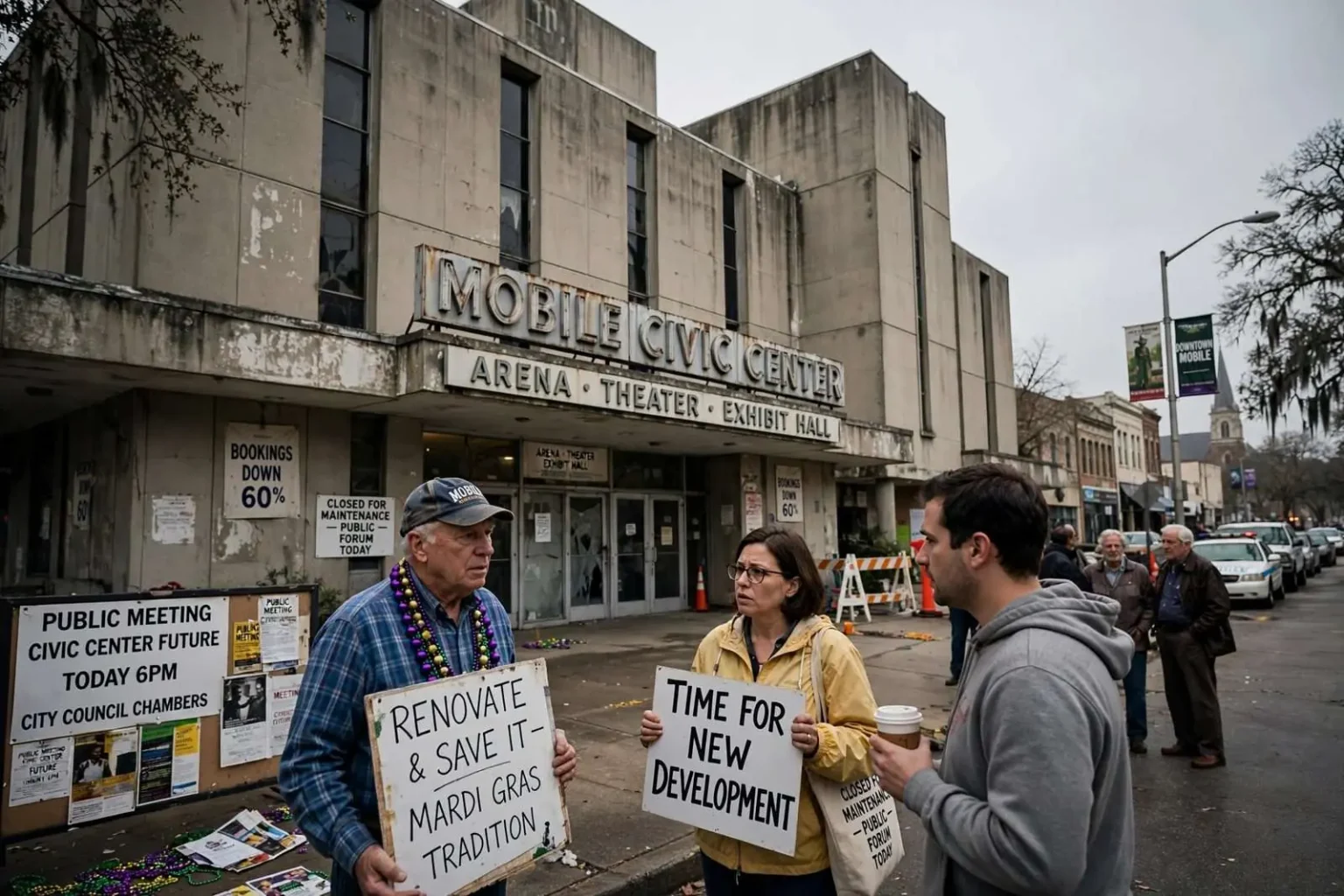
A public conversation over what to do with the aging Mobile Civic Center picked up steam after Mayor Sandy Stimpson acknowledged the decades-old facility “really does not put us where we need to be as a community.” The comment, made publicly, opened the door to a broader debate among residents over whether the venue should be repurposed or demolished entirely to make way for something new.
Stimpson laid out two general paths forward: renovate and repurpose the underperforming facility, or raze it and start fresh with a new development in its place. Neither option is simple or cheap, and the mayor’s framing made clear that city government sees the status quo — a large, aging auditorium complex consuming maintenance dollars while hosting a fraction of the events it once did — as untenable over the long run.
The question quickly became a flashpoint for residents with strong feelings about the Civic Center’s role in Mobile’s downtown identity, particularly given its long association with Mardi Gras events and other civic gatherings. For generations of Mobilians, the building has been where they attended balls, concerts, graduations, circuses and conventions, and that accumulation of memory has made the facility something more than a line item in a capital budget.
An informal reader poll gauging public opinion drew more than 1,150 responses within its first 24 hours. Roughly two-thirds of respondents said the city should let the aging facility go, while about a third favored keeping its doors open in some form, even if only temporarily while a longer-term plan is developed. Such polls are not scientific surveys and reflect only the views of those who chose to participate, but the level of engagement underscored how much interest the issue had generated across the city.
The split revealed in the poll mirrors the arguments that have played out in city hall and on social media since the discussion began: one camp focused on the bottom line and the opportunity cost of the downtown site, the other on the practical and sentimental value of a large indoor venue that has served the city for decades.
A facility showing its age
City officials have acknowledged the Civic Center has struggled for years with compliance and maintenance issues, including accessibility shortfalls under the Americans with Disabilities Act, alongside broader questions about whether the facility can attract the level of touring entertainment and events that would make it self-sustaining. Buildings of that era were constructed before modern accessibility standards, and retrofitting an old arena and theater complex to full compliance is an expensive proposition on its own, separate from any aesthetic or functional upgrades.
The competition side of the equation is just as stark. The live entertainment business has changed dramatically since the Civic Center’s early decades, with touring acts favoring modern venues that offer better rigging, acoustics, loading logistics and premium seating. Mobile’s existing theater and arena options now share that market with newer facilities in nearby markets, and booking agents make routing decisions based on what a venue can physically support and what it costs to play there.
Opened in the 1960s, the Civic Center complex brought together an arena, a theater and exhibit space under one roof, a format that made it the city’s default location for large indoor gatherings for most of its life. It hosted Mardi Gras balls and royal presentations, traveling concerts and family shows, sporting events and trade shows, functioning for decades as the commons where the city assembled.
The case for letting go
Those who favor demolition or replacement argue that the downtown site is simply too valuable to devote to a building that no longer performs. The property sits in the heart of downtown, near other civic anchors, and the land beneath a underused complex could support development that generates tax revenue and street life year-round rather than event traffic a few dozen nights a year.
The math of deferred maintenance strengthens that argument. Every year the city keeps an aging mechanical plant, roof system and structure in service adds to a repair bill that will eventually come due regardless, and spending millions to prolong the life of a facility that still cannot compete for major events is, in this view, money spent standing still.
The case for keeping a big room
At the same time, supporters of preserving some version of the Civic Center point to the cost of losing a large indoor venue entirely, especially given the number of other city-supported facilities, including the convention center, cruise terminal and sports venues, that already compete for public investment and programming. Each of those properties draws on the same pool of operating subsidies, capital attention and booking demand, and subtracting the Civic Center from that lineup does not automatically free the market for the others.
A city of Mobile’s size, supporters argue, needs a room that can hold the events that fall between a theater and an outdoor stadium: Mardi Gras associations’ largest balls, high school graduations that outgrow any school gymnasium, regional conventions, religious gatherings, and touring shows that mid-size arenas serve. Losing that capacity means those events go to other cities or disappear from the local calendar, taking hotel nights and restaurant traffic with them.
There is also the question of what replaces the building if it comes down. Urban renewal projects take years from demolition to ribbon-cutting, and the site could sit as a surface parking lot or fenced vacancy through multiple budget cycles, a fate that has befallen other civic sites in cities that moved too quickly to demolish before they had a funded plan for what came next.
What happens next
City officials have signaled that no immediate decision is imminent, and the public comment period stirred by the mayor’s remarks has given the administration a clearer read on where residents stand. Any path forward — renovation, replacement or redevelopment — would ultimately require a funding plan, likely involving a mix of city capital dollars, and possibly state, federal or private participation, depending on the scale of the project chosen.
The discussion also intersects with Mobile’s broader downtown momentum, as residential conversions, new hotels and waterfront investments have steadily rebuilt the center city’s activity levels over the past two decades. Where a rebuilt or reimagined Civic Center fits into that trajectory — as an entertainment anchor, a mixed-use development or something else entirely — is the question the debate has now put squarely on the table.
Comparisons with peer cities hover over the conversation as well. Across the Southeast, communities of similar size have in recent years faced the same reckoning with 1960s-era civic arenas, and their outcomes — some rebuilt, some replaced with multi-purpose venues, some demolished with no successor — provide Mobile’s leaders with a catalogue of cautionary tales and workable models alike. The common thread in the successful projects is a clear plan for financing and programming before the wrecking ball arrives, a sequencing many speakers in the current debate have urged the city to follow.
What it means for Mardi Gras and downtown life
The Carnival stakes give the debate particular heat in Mobile, the home of America’s original Mardi Gras. Multiple mystic societies have long used the Civic Center for balls and presentations during the season, and its arena floor and backstage capacity made it one of the few local venues able to accommodate the largest celebrations with their elaborate floats-backdrop stages, court presentations and crowds. Any plan that displaces those events without a replacement venue would force associations to scramble for alternatives during a season when every suitable hall in the city is already booked.
For the associations themselves, a venue decision during a construction window would require planning seasons in advance, since ball dates, themes and seating layouts are set far ahead of the calendar. That reality has made the Civic Center conversation a live topic in Mardi Gras circles, where leaders want assurances that their traditions will have a home regardless of what the city builds or tears down.
Everyday users of the building have their own stake. Promoters who brought concerts and family shows, organizations that relied on the exhibit halls, and residents whose graduations and milestones happened there all represent the constituency that shows up whenever a beloved public building’s future is debated. The reader poll’s split — and the passion on both sides — reflects exactly that divide between the ledger and the memory.
For now, Mobile residents are watching and weighing in, with the city council expected to take up the question as administration staff work through feasibility and funding options. Whatever decision eventually comes, the conversation itself has made one thing clear: the Civic Center, whatever its condition, still matters deeply to the people of Mobile, and its future will be decided in public, not by decree.