Mobile Leaders Map Out First Comprehensive City Plan in Two Decades
Mobile city leaders unveiled a strategy map and plans for the city's first comprehensive plan in nearly 20 years, targeting completion by August 2015.
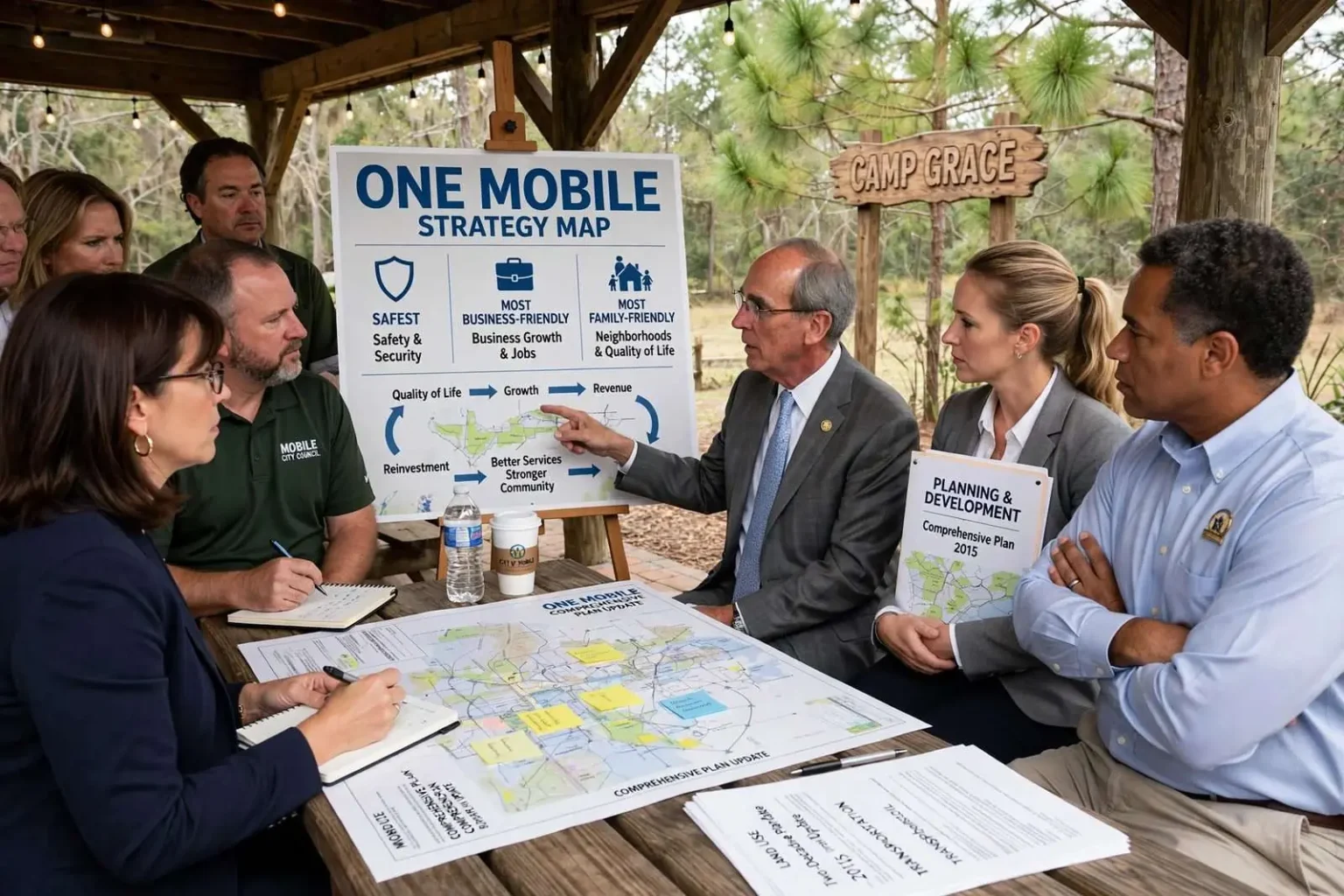
MOBILE, Alabama – City leaders spent a daylong retreat outlining an ambitious road map for Mobile’s future, with plans for the city’s first comprehensive plan update in almost two decades and a broader strategic vision meant to guide growth through the end of the decade.
Mayor Sandy Stimpson used the retreat, held at Camp Grace with city council members and executive staff, to unveil a work-in-progress strategy map tied to what his administration is calling “One Mobile.” The vision centers on a goal of making Mobile the safest, most business-friendly and most family-friendly city in the country by 2020. The retreat format — council members and department heads away from City Hall for a full day of structured discussion — was chosen deliberately, according to organizers, so that elected officials and the administrators who carry out policy could align on priorities before the new year’s budget and project schedules took shape.
A living document for city government
Stimpson described the strategy map as a living document intended to give city government clear direction while also serving as a tool to justify turning down projects or initiatives that fall outside its priorities. In city management practice, that dual function matters: a strategy map not only tells departments what to pursue, it gives the mayor and council a principled basis for saying no when a proposal does not advance the stated goals, something that has historically been difficult in a city where individual districts compete for resources.
He said the ultimate measure of success would be residents affirming three things: that they feel safe in Mobile, that the city helps local businesses thrive, and that Mobile is where they choose to raise their families. Those three affirmations — safety, business climate, and family appeal — anchor the top of the strategy map, with departmental objectives cascading beneath them. Administration officials said the structure is meant to make it plain to residents how a given program, from paving schedules to park improvements, connects to the larger vision.
The mayor framed the plan as designed to create a self-reinforcing cycle, where improvements to quality of life drive citywide growth, which in turn generates additional revenue that can be reinvested into further improvements. That loop, he argued, is how a city with constrained finances can still build momentum: better neighborhoods and safer streets attract residents and employers, a broader tax base funds better services, and better services raise quality of life again.
Learning from other organizations
Stimpson pointed to other regional organizations, including a southwest Alabama workforce development council, a national estuary program and the local United Way chapter, as examples of groups that have successfully used strategy maps to guide their work. Each of those bodies operates with limited funding and broad, ambitious missions, and each adopted structured strategy mapping to force trade-offs into the open and keep partner organizations aligned. City officials said Mobile studied those models before drafting its own version, adapting the format to municipal government’s broader service obligations.
The comprehensive plan: a two-decade gap
Separately, the city’s executive director of planning and development outlined a proposal for a new comprehensive plan, the first substantial update in roughly 20 years. The plan is expected to cost between $150,000 and $200,000 and take three to five years to fully implement once launched. If work begins in early 2015 as proposed, a completed plan could be ready for Planning Commission approval by August of that year.
A comprehensive plan is the foundational planning document for any city, establishing the long-range vision for land use, transportation, infrastructure, housing and economic development that zoning decisions and capital investments are supposed to follow. Mobile’s existing plan, dating back roughly two decades, predates major shifts in the city’s economy and geography, including the growth of the aerospace and shipbuilding industries, changes in port operations, and the ongoing reinvestment in downtown. Planning officials have long acknowledged that guiding growth without a current plan leaves the city reacting to development proposals rather than shaping them.
City planning officials said the goal is to engage residents across all of Mobile’s neighborhoods, including areas along the major corridors radiating out from downtown that have not historically been part of broader planning conversations. Those corridors — the arterial roads that carry daily traffic between the city center and its outlying districts — contain some of the city’s most visible commercial strips and some of its most persistent vacancy, and planners said resident input along them will be essential to a plan that reflects the whole city rather than a few revitalized districts.
Building on past studies
Officials emphasized that the new effort would build on, rather than discard, the patchwork of smaller area studies and plans commissioned over the past decade, many of which still contain valuable data and community input. Neighborhood plans, corridor studies and special-district documents produced in recent years would be folded into the comprehensive plan’s framework, giving earlier work a unified citywide context and saving the cost of re-collecting information that already exists.
That consolidation function is one of the practical arguments for the new plan. Over two decades, individual departments and councils have made decisions under different planning documents, some inconsistent with one another. A single current comprehensive plan gives the Planning Commission a common reference point when rezonings and subdivisions come forward, and gives residents a predictable standard for what kinds of development fit where.
Early stages, with details to come
Both the strategy map and the comprehensive plan remain in early stages, with city officials indicating that additional details on funding, community engagement and implementation timelines would be released as the initiatives move forward. The administration has not yet specified how the $150,000 to $200,000 planning cost would be allocated between the general fund and possible outside sources, nor how large the public engagement process will be, though officials indicated that both questions will be resolved before the planning effort formally launches.
What residents can expect
For Mobile residents, the practical significance of the two efforts is different even though they are related. The strategy map is an internal management tool — it shapes how the city budgets, which initiatives get staff attention, and how the administration measures its own performance year to year. The comprehensive plan is a public document — it will guide what can be built where, how streets are designed, which neighborhoods get infrastructure priority, and how the city positions itself for growth over decades.
Planning officials cautioned that a comprehensive plan is only as strong as the participation behind it. Cities that have completed recent planning processes in the region have typically used public workshops, online surveys, and neighborhood meetings to gather input, and Mobile’s planners said the engagement phase will be designed to reach residents who do not ordinarily attend government meetings, not just the civic groups that routinely follow City Hall.
A shift toward citywide coordination
The dual efforts mark one of the more significant planning pushes undertaken by Mobile city government in recent years, reflecting an emphasis on long-term, citywide coordination over piecemeal development decisions. For much of the past decade, the city’s major planning energy went into discrete projects — a downtown entertainment district, waterfront improvements, individual corridor studies — rather than a unified framework tying them together.
The timing also reflects the mayor’s broader governing approach. Stimpson, who took office after emphasizing a business-minded, metrics-driven administration, has consistently argued that city government performs best when goals are explicit and progress is measurable. The strategy map extends that philosophy from individual departments to the whole of city government, and the comprehensive plan extends it from the current budget cycle to the city’s physical future.
Observers of city government note that the hard work begins after the documents are finished. Strategy maps fade when administrations change, and comprehensive plans fail when zoning and capital budgets drift from their guidance. Mobile’s officials said the intent is to institutionalize both documents — tying the strategy map to annual budget decisions and the comprehensive plan to the Planning Commission’s review process — so that they outlast the officials who commissioned them.
The comprehensive plan process will also give the city a chance to take stock of what has changed since the last update. Population shifts between neighborhoods, the growth of West Mobile, the evolving role of the port, and the condition of aging infrastructure all need current data before the plan can set credible priorities. Officials said the technical analysis phase will run alongside public engagement, so that residents see the same data planners are working from.
As the initiatives advance, residents will have opportunities to weigh in on both. Details on the community engagement schedule for the comprehensive plan, and any revisions to the strategy map based on council feedback from the retreat, are expected to be announced as the city moves from the planning stage into execution.