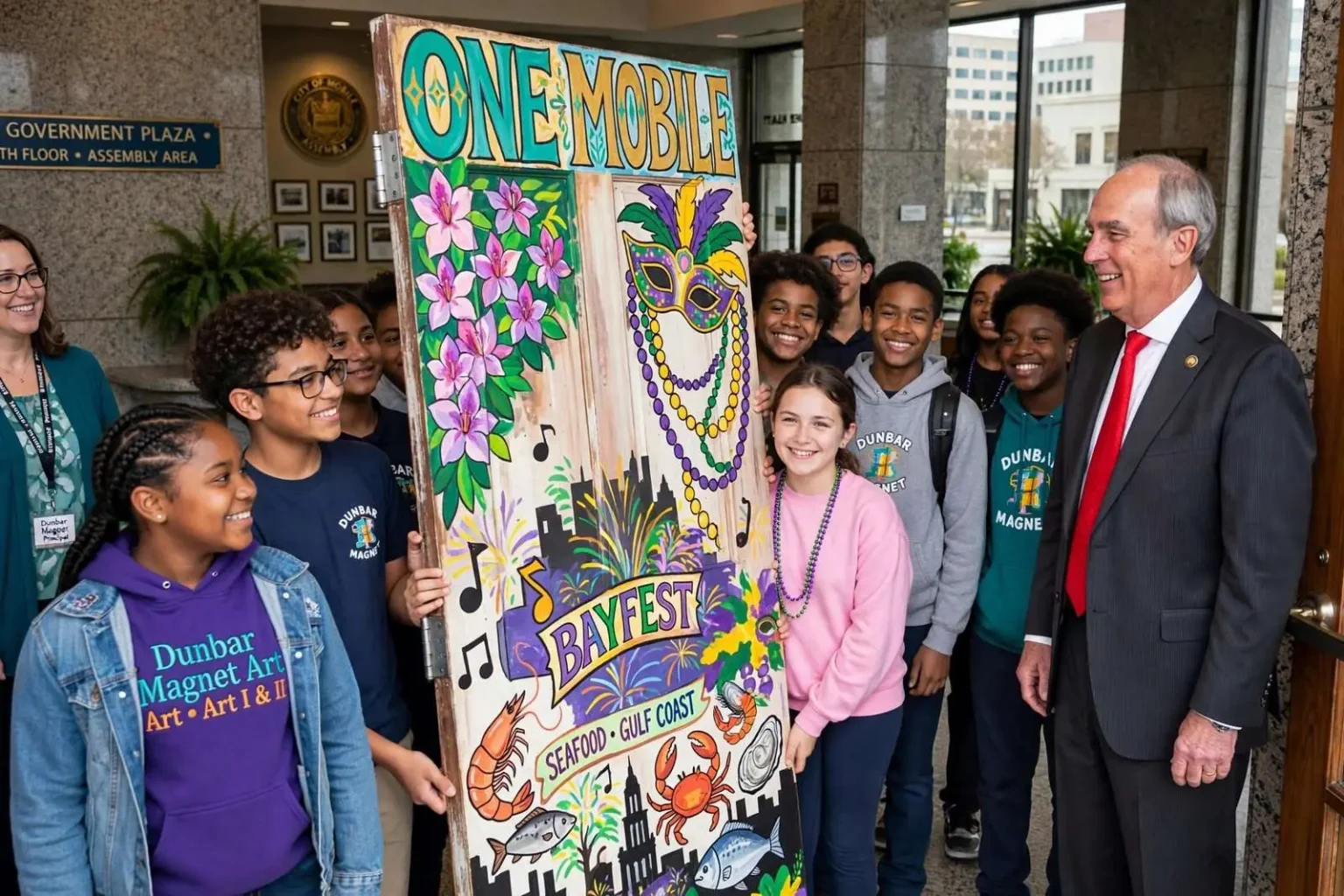
A brightly painted door mural similar to the Mobile-themed artwork created by Dunbar Magnet studentsDunbar Magnet School art students presented Mobile Mayor Sandy Stimpson with a painted "One Mobile" tribute door.

A year after Mobile Mayor Sandy Stimpson literally took the door off his office as a symbol of government transparency, that same door returned to him this week in a far more colorful form, thanks to a group of junior high art students.

Students ages 12 and 13 in the Art I and II program at Dunbar Creative and Performing Arts Magnet School presented Stimpson with the door, which they had transformed into a painted celebration of Mobile landmarks and traditions, including azaleas, Mardi Gras imagery, BayFest and the region’s seafood culture.

“I think this is incredible,” Stimpson said upon seeing the finished artwork.

Removing the door from his office had been among Stimpson’s first campaign promises during his 2013 run for mayor, framed as a symbolic commitment to greater transparency in city government. True to that promise, the door came off its hinges the day after he was sworn into office. Stimpson recalled being uncertain at the time whether the door would even come off cleanly, since one of the hinge screws had been stripped, and said he spent much of the following year wondering what to do with the door as it sat around the mayor’s administrative offices.

That uncertainty was resolved when the Dunbar art students, led by their teacher and school principal, approached the mayor’s administration with the idea of painting the door themselves. The students settled on a design built around the “One Mobile” theme, the same slogan Stimpson used throughout his campaign against former Mayor Sam Jones. The project took the students roughly a week to complete.

Stimpson said the finished piece will be put on permanent display at the front of the administration’s assembly area on the tenth floor of Government Plaza, where it will serve as a visual reminder to his administration that transparency and openness in city government should never be allowed to fade into the background.

Stimpson pointed to the city’s administration as an example of that continued commitment, citing a recent $2.2 million investment in new software intended to improve transparency in areas including city finances, budgeting and permitting, while also streamlining automation within Municipal Court and Code Enforcement. He described the technology upgrade as a significant step that ties multiple city functions together under a more transparent framework going forward.

During the presentation at Government Plaza, Stimpson also took time to pose for photos with the visiting students, capping off a project that blended a symbolic campaign promise with a hands-on collaboration between city hall and Mobile’s public school students.

See also  Mobile Police Arrest Juvenile in Connection With Stolen Car on McVay Drive

Mobile is the county seat of Mobile County in southwest Alabama and the state’s only saltwater port. Situated where the Mobile River meets Mobile Bay near the northern Gulf of Mexico, the city has long served as a commercial and cultural gateway between Alabama and the wider Gulf Coast. Founded in 1702 as Fort Louis de la Louisiane and ruled in turn by France, Britain, and Spain before joining the United States in 1813, Mobile carries a layered heritage distinct from the rest of the state.

Today Mobile anchors a metropolitan area spanning Mobile County and neighboring Baldwin County, and it remains a center for shipping, aerospace, healthcare, and higher education in the region. Its downtown and waterfront have seen sustained revitalization, while historic neighborhoods preserve architecture from its colonial and antebellum past. The city’s identity is shaped as much by its working port and industrial base as by its festivals and food culture, making it a frequent focal point for news about growth and change in southern Alabama.

Local government in the Mobile area operates through a combination of mayor-council or commission structures at the municipal level and a county commission in Mobile County, with elected officials handling budgets, public safety, infrastructure, and zoning. Baldwin County has its own commission and a collection of incorporated municipalities.

Decisions made in council chambers and commission meetings affect roads, school funding, economic development, and quality of life, which is why coverage of local government is a staple of regional journalism. The interplay between city, county, and state authorities often determines how effectively the area can address shared challenges.

Because many services residents rely on are delivered at the local level, the choices of elected officials have direct, everyday consequences. Budget priorities, in particular, reveal a community’s values and shape the trajectory of growth and public welfare for years to come.

Education in South Alabama spans public school systems in Mobile and Baldwin counties, a network of private and parochial schools, and institutions of higher learning including the University of South Alabama, Spring Hill College, and community colleges. Public-school governance rests with locally elected boards.

Boards oversee budgets, curricula, and facilities, often amid debates over funding equity and student achievement. The region’s colleges contribute not only to the workforce pipeline but also to healthcare, research, and cultural life, and education policy set in Montgomery frequently shapes what local districts can do.

See also  Mobile City Council Weighs Fate of Crichton Recording Studio's Zoning

Schools are also central to community stability. Enrollment trends, facility conditions, and graduation outcomes are watched closely by families and employers alike, making education a persistent focus of public attention and news coverage across the Gulf Coast.

Probate courts in Alabama handle matters distinct from the trial courts that hear criminal and civil cases, including wills, estates, guardianships, and involuntary commitments for mental-health treatment. In Mobile County the probate judge is an elected official with broad administrative and judicial duties.

Cases involving involuntary psychiatric commitment require the court to balance an individual’s liberty interests against concerns for their safety and the safety of others, a sensitive legal threshold that has drawn scrutiny in many jurisdictions. The procedures governing such hearings, including who must appear and testify, are set by state law and local rule.

Disputes over those procedures often surface tensions between healthcare providers, the court, and advocates for patients. Because the stakes involve both liberty and wellbeing, courts and clinicians alike face pressure to honor the law while ensuring that people in crisis receive timely and appropriate care.

Mobile lays claim to a long tradition of outdoor festivals and public celebration, most famously its Carnival or Mardi Gras season, which predates the better-known celebrations of New Orleans. Throughout the year the region hosts music festivals, food and arts events, and waterfront gatherings that draw visitors from across the Gulf Coast.

Such events are economic and cultural anchors for the area, supporting hospitality, tourism, and local artists while fostering a sense of community identity. Organizing them involves coordination among city government, business sponsors, public-safety agencies, and volunteers, and they frequently appear in local news coverage of the region’s cultural life.

For many residents, these gatherings are also a point of civic pride and a way to mark the seasons. The mix of nationally known and local performers common to regional festivals reflects the area’s dual character as both a close-knit community and a stop on broader touring circuits.

The natural environment is central to life on the Gulf Coast, where barrier islands, bays, rivers, and wetlands support fisheries, recreation, and storm protection. Coastal Alabama faces challenges common to low-lying regions, including hurricane exposure, erosion, and the management of fragile ecosystems.

The Mobile-Tensaw Delta, one of the largest river deltas in the country, is a particularly significant natural asset. Conservation efforts, fisheries regulation, and shoreline restoration are frequent points of collaboration among state agencies, federal bodies like the Army Corps of Engineers, and environmental groups.

See also  Mobile City Council Weighs Nearly $300,000 in Private Mowing Contracts

How the region plans for growth while protecting its natural assets is a recurring theme in local reporting. The tension between development pressure and ecological stewardship plays out in zoning fights, infrastructure projects, and disaster-recovery decisions that shape the coast for generations.

Baldwin County sits directly east of Mobile County across Mobile Bay and is the largest county in Alabama by land area. It encompasses the Eastern Shore communities of Daphne, Fairhope, Spanish Fort, and Foley and stretches south to the beaches of Gulf Shores and Orange Beach along the Gulf of Mexico.

Long among the fastest-growing counties in the state, Baldwin blends suburban development near the bay with tourism-driven coastal economies. Its proximity to Mobile and its position on the Eastern Shore make it a recurring subject of regional news covering growth, infrastructure, schools, and the balance between development and coastal preservation.

Mobile Bay is a shallow estuary in southern Alabama where freshwater from the Mobile, Tensaw, and other rivers mixes with saltwater from the Gulf of Mexico. It is among the largest estuarine systems in the United States and supports commercial and recreational fishing, shipping through the Port of Mobile, and wetlands that buffer the coastline from storms.

The bay’s Eastern Shore, in Baldwin County, includes Daphne, Fairhope, and Spanish Fort, while the Western Shore lies in Mobile County. Its ecology and economy have guided settlement for centuries, and the bay figures in regional debates over development, navigation, and conservation. Events on either shore are routinely covered as part of the interconnected life of the Mobile metro area.

The Gulf of Mexico borders Alabama’s southern edge and defines much of the state’s coastal identity. Alabama’s Gulf coastline, centered on Dauphin Island, Gulf Shores, and Orange Beach, supports a tourism industry built around beaches, charter fishing, and marine recreation, while offshore waters host shipping lanes and energy interests.