Sam Jones’ Winning Mayoral Campaign Spent Nearly $936,000, Year-End Report Showed
Mobile Mayor Sam Jones' 2005 campaign raised more than $832,000 in cash and spent nearly $936,000 to win a four-seat race, according to the annual year-end financial report filed in early 2006.
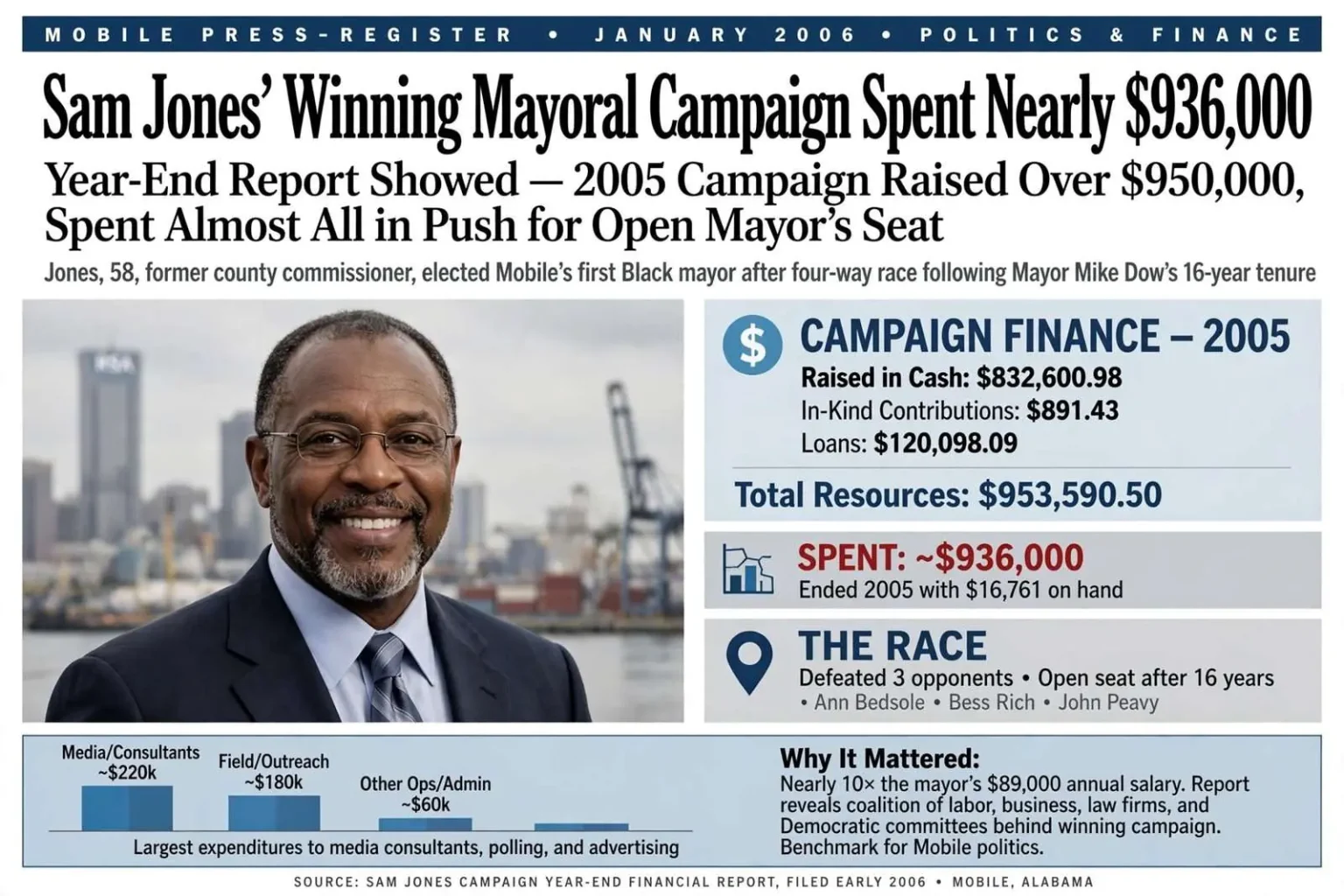
Sam Jones’ successful campaign for mayor of Mobile spent almost $936,000 in 2005, according to the annual year-end financial report filed by his campaign in early 2006, a figure that underscored how expensive the city’s top job had become.
Jones, then a 58-year-old county commissioner, opened 2005 with his campaign account empty. Over the course of the year he raised $832,600.98 in cash contributions, $891.43 in in-kind contributions and $120,098.09 in loans. The campaign closed the year with an ending balance of $16,761.
The arithmetic tells its own story. A campaign that began the year with nothing raised better than $950,000 counting loans and in-kind support, spent nearly all of it, and finished with barely enough to pay a final round of bills — in a single calendar year. Municipal campaigns in Alabama cities do not run on year-round fundraising operations the way congressional races do; they are built fast, in the months before a single election date, and the money comes in bursts from whatever coalition a candidate can assemble.
The race he won
Jones defeated three opponents to claim the mayorship: former state senator and civic leader Ann Bedsole, former City Councilwoman Bess Rich, and then-City Councilman John Peavy. The office had been relinquished after 16 years by four-term Mayor Mike Dow.
The 2005 race was one of the most consequential elections in the city’s modern history. Dow had declined to seek a fifth term after sixteen years in which downtown Mobile was remade — the RSA tower and office development, the convention center on Water Street, the renovation of historic districts and a sustained push for industrial recruitment. His departure left an open seat, drew four credible candidates into a nonpartisan field, and forced every campaign to fund a citywide operation with no incumbent to run against.
The salary for the job at the time was $89,000 a year, with a four-year term, meaning the campaign spent roughly ten times the annual pay of the office it was seeking. That arithmetic is a familiar feature of American municipal politics, and it explains why serious mayoral candidates in a city the size of Mobile must assemble a financial coalition rather than simply appeal to voters.
The comparison is worth pausing on. A candidate who spends about ten times an office’s annual salary in a single election is not buying a job in any literal sense — the salary is a rounding error against the outlay. What the spending purchases is communication: the ability to reach several hundred thousand residents repeatedly across a summer, in a media market that also carries Pensacola television and expensive Gulf Coast advertising rates. In cities of Mobile’s size, the price of the mayor’s office has consistently run far past the pay attached to it, and campaigns that cannot raise at scale tend to fade before the final stretch.
Where the money came from
The report showed a broad base drawing on organized labor, the trial bar, the business community, engineering and architecture firms, party committees and political action committees.
Party and PAC money. The State Democratic Executive Committee contributed in three separate $10,000 increments. ACE PAC gave $45,000 across filings, along with a separate $10,000 entry. Other committee support included Tennessee Valley Citizens for Economic Development at $29,500, Capital PAC at $7,500, Alabama Builders PAC at $7,500, Leader PAC at $6,500, Pride PAC at $5,000, Eagle PAC at $5,000, Mobile Auto-PAC at $5,000, Alabama Realtors PAC at $5,000, BIZPAC at $4,000 and WestPAC at $2,500.
Committee money of this kind arrives with expectations attached, and the list reads like a map of the interests that had a stake in City Hall’s next four years. Builders and Realtors care about permitting and development review. Auto dealers care about franchise and siting issues. Labor-affiliated committees track contracts and public-employee policy. A mayor who accepts committee checks accepts that those constituencies will be in his office — which is precisely why disclosure reports matter to anyone trying to understand a city’s politics.
Labor. Contributions came from the United Steelworkers of America, the United Auto Workers Alabama Political Action Account, the AFL-CIO, Plumbers and Steamfitters Local 119, the South Central Carpenters Regional Council, the ILA Benevolent Fund and the Mobile-Pensacola Building and Construction Trades Council.
The labor list reflects Mobile’s working economy. The International Longshoremen’s Association Benevolent Fund speaks to the port, which is the economic engine of the city and one of the busiest container terminals on the Gulf. The building and construction trades councils speak to a constant cycle of public and private construction. Steelworkers and auto workers accounts reflect the industrial employment base of the greater region, including the paper, chemical and manufacturing operations scattered along the Mobile River and out toward the state line. For a Democrat running in Alabama, organized labor was both a funding source and a field operation — union halls turn out voters.
Business and professional firms. Volkert & Associates, Goodwyn Mills and Cawood, Johnston Barton Proctor & Powell, Cunningham Bounds, Adams and Reese, Regions Financial’s government affairs committee, Norfolk Southern, ConocoPhillips, Buffalo Rock, Budweiser-Busch Distributing and Atlantic Marine were among the corporate and firm contributors.
That roster is a who’s-who of the firms whose fortunes track City Hall’s decisions. Volkert and Goodwyn Mills and Cawood are engineering and architecture practices whose work flows through public projects. Johnston Barton Proctor & Powell, Cunningham Bounds and Adams and Reese are among the city’s major law firms — one holding the corporate and municipal side of the docket, another built on the Gulf Coast’s plaintiffs’ bar. Norfolk Southern and ConocoPhillips have freight and industrial stakes in the port region. Buffalo Rock and the beer distributor are household-name businesses with local payroll, and Atlantic Marine anchored the ship repair and fabrication business on the river. All of them had reasons to want a working relationship with the next mayor.
Large individual gifts. Matthew Metcalfe gave $15,000. Mr. and Mrs. J. William Lewis gave $10,000. C.W. Wilcox, Sanford P. Brass, John Miller Jr. and Alexis Herman each appeared at $5,000, with George E. Williams, William M. Lyon and B. White-Spunner at $4,000.
Fellow Democrats. The campaigns of state Sens. Vivian Figures, Roger Bedford and Gary Tanner all contributed, as did U.S. Rep. Sanford Bishop’s campaign.
Transfers from other candidates’ committees are a quiet but telling category. State senators representing Mobile — Figures most prominently, from a district centered on the city’s southern neighborhoods — had both motive and means to back a friendly mayor. Bedford and Tanner were powerful figures in north Alabama’s Democratic delegation, and a contribution from their committees signaled that Jones’ candidacy was noticed well beyond the Gulf Coast. Bishop, who represented neighboring southwest Georgia in Congress, added a cross-border Democratic endorsement in check form.
The loans
The campaign also borrowed. A $99,500 loan from Compass Bank was guaranteed by Riley Boykin Smith, Larry Wettermark and Clarence Ball Jr. Ball extended an additional $12,000 loan individually. Wettermark, the Mobile County attorney, would move to City Hall as city attorney in the new Jones administration.
The Compass Bank facility was the campaign’s bridge financing — the money that keeps advertising on the air and pollsters on the payroll while large contributions are still being collected. Bank loans to campaigns in Alabama require personal guarantors, and the three men who stood behind this one were prominent figures in the city’s legal and civic circles. Wettermark’s subsequent move to the city attorney’s office illustrates how the relationships disclosed in a finance report can translate directly into an administration’s personnel.
Where the money went
The expenditure side shows a modern, consultant-driven operation. The single largest reported outlays were $96,619 to Message Audience & Presentation and $48,000 to Magic Box Editorial, followed by $40,000 to LUC Media, $37,453 to Direct Communications, $36,425 to Southeast Research and $24,862 to The Parker Group. Media buying, polling and production, in other words, consumed the bulk of the budget.
That pattern — six-figure sums to consultants before anything else — is the signature of a campaign that understood the race would be decided on television and radio, in a four-way field where name recognition was the whole game. Jones was a well-known county commissioner, but a countywide office does not translate automatically into citywide favorability, and his three rivals all carried their own name identification from council service and a state Senate career. Message Audience & Presentation, among Alabama’s best-known media consultancies, produced and placed the advertising; the research firms tested messages and tracked the field through the summer and into the September runoff period; Magic Box Editorial and the production shops turned the footage into finished spots.
Smaller items filled in the picture of a citywide campaign: $9,863.40 to the daily newspaper, $5,365 to Cumulus Broadcasting, $6,179.52 to Image PRM, $3,101 to B&I Trophies, $3,043.95 to a Mobile caterer, and several thousand dollars across two entries at a local lounge.
The small-dollar entries are the texture of a real campaign. Print and radio buys reached voters the television schedule missed. Trophies and catered food speak to the fundraiser circuit — fish fries, ticketed events and community meetings that a mayoral candidate must work one by one — and the lounge entries suggest the informal events where local politics has always actually been done. A campaign that spends nearly a million dollars is mostly a media operation, but it is also, underneath, hundreds of hours of handshaking.
Why the report mattered
Jones’ election made him the first Black mayor of Mobile, and the finance report offers a granular look at the coalition that put him there: Democratic Party institutions and organized labor, joined by a substantial share of the city’s business, legal and engineering establishment.
That blend deserves emphasis. Mobile’s white business establishment had spent the Dow years building downtown and courting industry, and it did not withdraw from the 2005 race simply because its preferred continuity ended. The disclosures show engineers, lawyers, bankers and industrial employers writing checks to a Democratic county commissioner — a reflection of how Gulf Coast civic money operates pragmatically, backing relationships over party labels in municipal races.
At the same time, the Democratic Party committees, the union contributions and the support from Black and white Democratic officeholders across the state show the candidate’s base was not merely an establishment accommodation. Jones won with the full breadth of the city’s Democratic coalition behind him, in a race where his opponents split the rest of the field’s support. The combination proved decisive in a city where the mayor’s office had been held for sixteen years by a white moderate Republican-leaning administration.
Campaign finance disclosures are the least glamorous documents in politics and often the most revealing. Read nearly two decades on, this one is a map of who held influence in Mobile at the moment the city changed hands.
It also stands as a benchmark. The nearly $936,000 total set the scale against which later Mobile mayoral campaigns would be measured, and the coalition it documents — party institutions, labor councils, the port and construction economy, the professional firms whose work runs through City Hall — is the same coalition any successful candidate for the office has had to assemble since. Every year-end report tells the same underlying truth: the mayor of Mobile is chosen not only by voters at the polls but by a financial alliance assembled months earlier, block by block, check by check, in the pages of a disclosure most residents never read.