Jones Campaign Reports Strong Finances Before Mobile Election
Sam Jones' mayoral campaign reported spending $155,584 and raising $78,520 in the final reporting period, closing with nearly $114,000 on hand ahead of Mobile's Aug. 23 election.
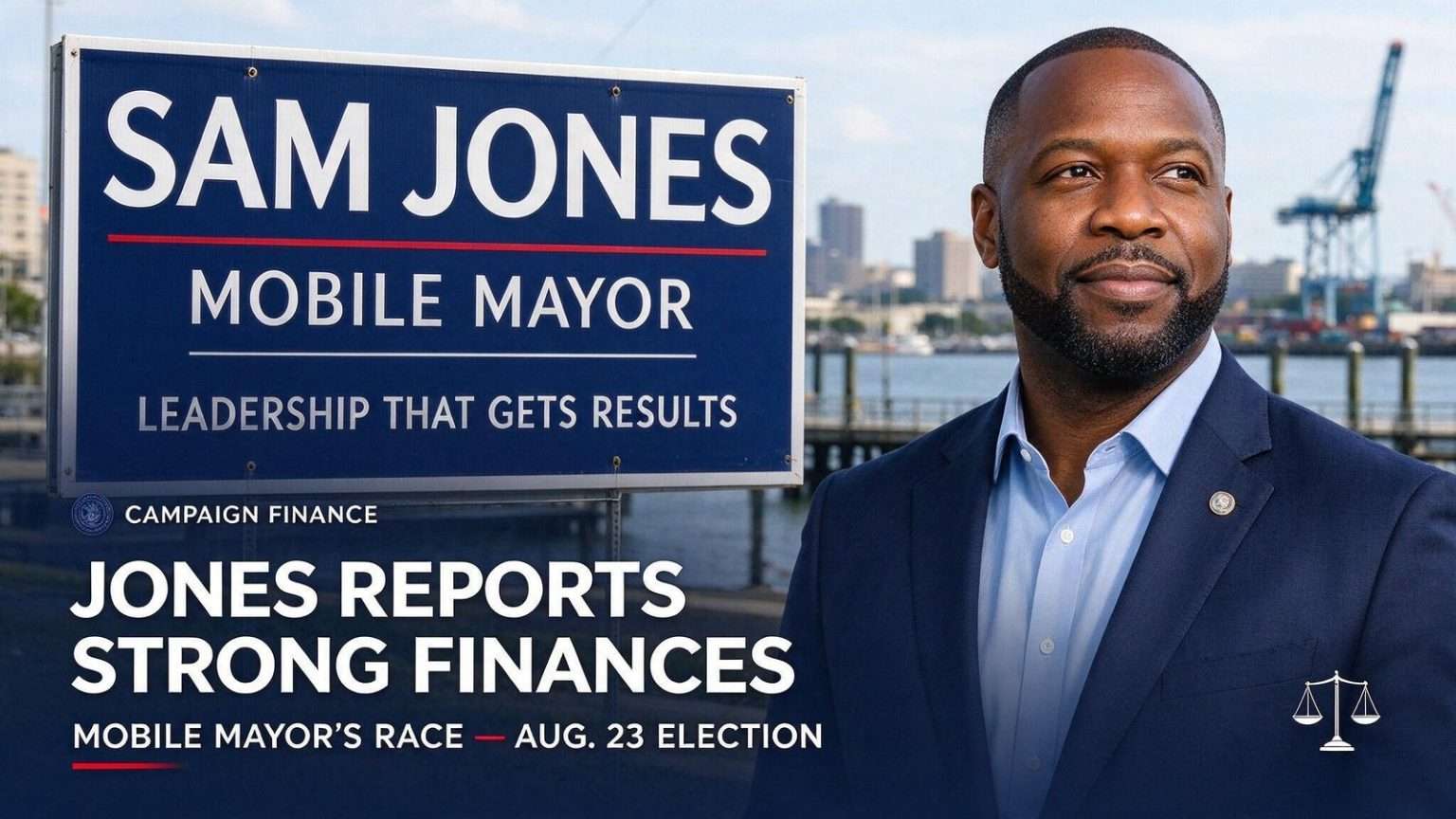
Sam Jones entered the last days of Mobile’s mayoral campaign with the healthiest bank balance in the field, according to his final pre-election financial disclosure — a report that underscored the county commissioner’s standing as the front-runner in the race to succeed Mayor Mike Dow. The filing, submitted in the closing stretch before the Aug. 23 election, offered the fullest picture yet of how the Jones campaign had raised, spent and banked its money during the summer’s stretch run.
For voters trying to read the race, the numbers carried weight beyond simple arithmetic. A campaign finance report filed this late in an election cycle is a snapshot of momentum: it shows who is still writing checks, whether donors who gave early are giving again, and whether the candidate is spending faster than the money is coming in. In Jones’s case, the disclosure described a campaign that had spent heavily on television and radio but had still managed to end the period with a six-figure balance.
The Numbers
Between the 45-day pre-election filing and the 5-10 day pre-election report, the Jones campaign spent $155,584.85 and raised $78,520. The campaign opened the period with $184,569.20 on hand and closed it with $113,983.41. In plain terms, Jones outspent what he took in during the final weeks by roughly $77,000, drawing down the reserves he had built earlier in the race — the usual pattern for a front-runner pushing hard through the last month of a campaign.
That closing figure mattered. In a four-way race widely expected to end without an outright winner, money left in the bank on election night was money available for a runoff campaign — a three-week sprint that would demand another round of television, radio and mail. Alabama municipal elections, including Mobile’s, require a candidate to win a majority of the vote; a candidate who falls short of fifty percent plus one must face the runner-up in a runoff three weeks later.
Most observers expected Jones to lead the field on Aug. 23 while falling short of the majority threshold needed to avoid a Sept. 13 runoff. Under that scenario, the $113,983.41 closing balance would be the war chest for the runoff, and no rival entered the final stretch with anything close to it. A candidate who wins the first round outright can shut down spending immediately; a candidate headed to a runoff has to fund a second, compressed campaign with almost no time to raise new money. Jones’s balance meant he would not have to start the runoff from zero.
Why the Runoff Mattered
The structure of the race shaped every spending decision. With three credible opponents splitting the opposition vote, the practical question for the Jones campaign was never simply winning on Aug. 23 — it was positioning to win decisively three weeks later if the field held. Runoff electorates are smaller, more engaged and often demographically different from first-round electorates, and campaigns must re-contact voters who already received one round of mail and television.
A three-week runoff in a city the size of Mobile leaves little room for error. Television time in the Mobile-Pensacola market must be bought and paid for in advance, direct mail takes days to design, print and deliver, and radio buys need lead time. Every dollar in the bank at the end of the first round translated directly into reach during the sprint, which is why political watchers in Mobile treated the closing balance as the single most telling number in the report.
Where the Money Came From
The contributor list showed a coalition assembled from organized labor, trial lawyers, engineering and construction firms, political action committees, Black civic and business leaders, and elected officials’ own campaign funds. The breadth of the list was as notable as any single entry: few Mobile mayoral campaigns had drawn simultaneously from the port’s maritime unions, the region’s largest engineering firms, Montgomery-based PACs and neighborhood-level donors.
Among the largest contributions were $5,000 each from state Sen. Zeb Little and from Andre V. Duggin. At the $2,500 level, the campaign received money from the Environmental Campaign Fund, Westpac, Preston Hughes, Frederick R. Meyer, the Alabama Builders Political Action Committee and Mobile County Vote. Eligie L. Boatman contributed $2,000.
A long roster of $1,000 donors included 21STCEN PAC, Tom Coker & Associates, ALABEZ PAC, Richard D. Horne, Herbert E. Long Jr., E. Andre Petties, Edgar G. Rios, Mary S. Austen, Cleosie Kirkland, Andrew R. Oliver, Larry Evans PTN, Margaret S. Ryan, James Maloney, JRB Special, Brenda Kennedy, Wandalyn P. Wright, Doris J. Ladd, Ocie E. White, Mobile Auto-Pac, Alpha M. Richard and the Greater Mobile Port Maritime Council AFL/CIO. Jeffrey White Sr. gave $1,500.
The maritime council’s presence underscored the campaign’s strength in organized labor, a reflection of the port’s central place in Mobile’s economy and of Jones’s long tenure in county government, where he had worked on infrastructure questions touching the waterfront. The appearance of the Alabama Builders Political Action Committee pointed to the same constituency from the construction side, since building trades and port interests frequently align in Mobile County politics.
The $500 Level and the Business Base
Contributions of $500 came from a broad list of businesses and professionals, including Volkert & Associates, Goodwyn, Mills & Cawood, Southern Earth Sciences, Geotechnical Engineering-Testing, Banks, Finley, White & Co., Budweiser-Busch Distributing, Regions Financial Corp., Mobile Lumber & Building Materials, the Mobile Lounge Owners Association and Cut-Rate Pharmacy, along with numerous individual donors.
That list read like a cross-section of the firms that build, finance and supply the Gulf Coast. Volkert and Goodwyn, Mills & Cawood are among the region’s best-known engineering and architecture firms; Southern Earth Sciences and Geotechnical Engineering-Testing sit at the foundation of nearly every major construction project in the area; Regions Financial and Mobile Lumber represent the banking and materials supply that keeps local commerce moving. Candidates for countywide and municipal office in Mobile have long relied on this circle of professional-services donors, who evaluate candidates on infrastructure, permitting and economic development.
Notably, the campaign funds of state Rep. Yvonne Kennedy and state Rep. James Buskey each gave $500, and the Alabama Democratic Conference Election Trust Fund contributed $600. Transfers from sitting legislators’ campaign committees signaled institutional backing within Mobile’s legislative delegation, while the Alabama Democratic Conference — the state’s oldest and largest Black political organization — extended support through its trust fund. For a candidate whose coalition depended on turning out Black voters across every council district, those endorsements of money carried symbolic weight as well.
Where the Money Went
The bulk of the spending went to media. The largest single expenditure in the period was $83,710 to LUC Media, followed by $18,757 and $5,999 to Message Audience & Presentation, $6,937.22 to Cunningham Harris & Associates, and $3,205 and $829 to Cumulus Broadcasting.
Those figures traced a media strategy aimed squarely at the airwaves. LUC Media, the largest line item, accounted for more than half of everything the campaign spent in the period — a sum consistent with a sustained television or production-heavy buy in the Mobile-Pensacola market. Message Audience & Presentation, a firm associated with direct mail and targeted communications, received separate payments totaling nearly $25,000, indicating a parallel mail program running alongside the broadcast effort. Cumulus Broadcasting, whose local cluster of stations reaches commuters across Mobile and Baldwin counties, drew two payments totaling just over $4,000 for radio time.
Other outlays included $3,815 to ABC Signs, sums to New Contemporary Sportswear for campaign apparel, and smaller administrative costs. Signage and apparel are the visible furniture of a municipal campaign — yard signs along Springhill Avenue and Government Street, shirts for poll workers and parade walkers — and their modest share of the budget showed a campaign that had already built its ground operation and was spending the final dollars where they reached the most voters.
The Candidate and the Field
Jones was an eighteen-year veteran of the Mobile County Commission seeking to become the city’s first Black mayor in a city with a three-hundred-year history and a long, complicated record on race. He faced City Councilman John Peavy, former City Councilwoman Bess Rich and former state Sen. Ann Bedsole. All four were running to succeed Dow, who was stepping aside after four terms.
The composition of the field shaped the race’s dynamics. Peavy, a veteran councilman, drew from a base in the city’s Black community that overlapped in part with Jones’s own; Rich, known for her attention to budgets and fiscal detail, ran strongest with reform-minded and west Mobile voters; Bedsole, a former legislator with deep establishment ties, carried support in the business community and among older voters. Dow’s retirement after four terms — sixteen years in office — opened the first truly open mayoral seat in Mobile in years, and each candidate pitched a different vision for a city whose downtown was mid-restoration and whose port was expanding.
Jones’s county tenure gave him a distinctive argument: he had governed the whole county, not just the city, and had worked through the commission on roads, drainage and economic development projects that crossed city limits. His finance report reflected that reach — donors from across the county’s professional and business establishment, not solely from within city neighborhoods.
Reading a Finance Report
Campaign disclosures filed in the final days before an election are, in practical terms, the last public accounting voters get before they cast a ballot. They reveal the shape of a coalition — which industries, which unions, which neighborhoods and which fellow officeholders have decided a candidate is worth backing — and they reveal strategy, in the form of what a campaign is willing to spend and what it is holding back.
By both measures, the Jones filing described a campaign that had built an unusually broad base of support and that had preserved the resources to keep fighting after Aug. 23 if the voters sent the race into overtime. Whether that balance would prove decisive depended on the only poll that counted, but the report itself answered the question every runoff calculation begins with: the front-runner would have the money to run a second campaign, and his rivals, at least by this measure, would not.