St. Patrick’s Day, 1952: How a Mobile Sportswriter Wandered Into the Brokerage Business
The first installment of a serialized memoir of a bygone Mobile recalls a 31-year-old juggling three jobs who walked into a downtown brokerage office next door to the liquor store.
The first installment of a memoir of Mobile in an earlier era begins where a great many Mobile careers began: downtown, in a small office, on a day when nobody was quite sure what to do with the new man.
Its author, a retired stockbroker writing under an initial and recalling events of the early 1950s, opens with what he calls a late start. He was a month shy of his 31st birthday when he first walked through the doors of a brokerage firm that held memberships on the New York Stock Exchange and the principal stock and commodity exchanges.
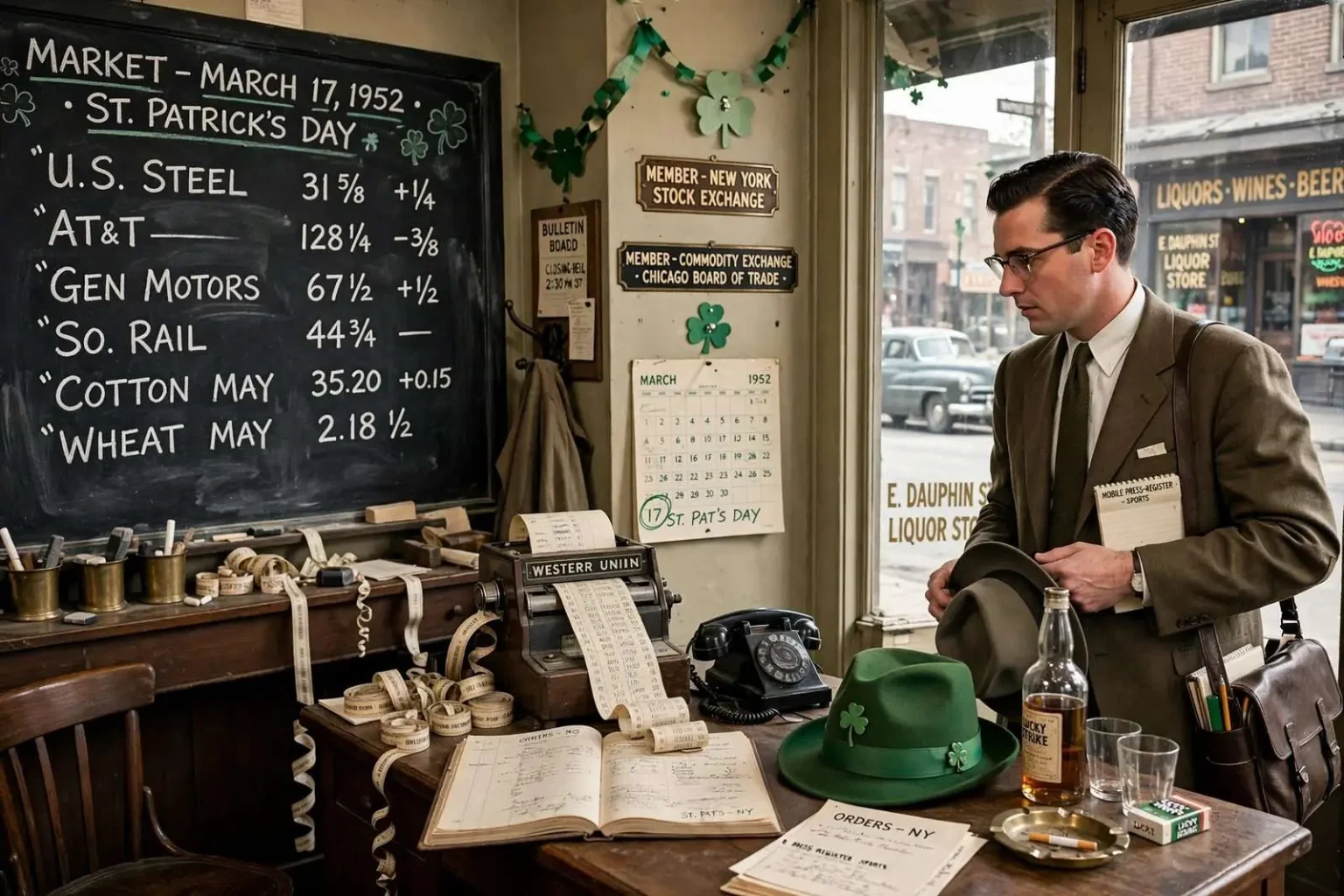
The date was March 17, 1952 — St. Patrick’s Day — and, as he notes with some relish, the office sat next door to the downtown liquor store.
Coming to the brokerage business at 30 was, by the trade’s standards, genuinely late. The branch offices of big-city member firms recruited account executive trainees young, often straight out of college, and put them through licensing study while they learned the office trade. A man of 30 arriving with a decade of other work behind him was an anomaly — and, as the memoirist tells it, an advantage, because he brought to the desk a set of skills the firm had not thought to ask for.
A first day that ended at 2:30
The Mobile manager who hired him was a lifelong Mobilian of Irish descent, enormously proud of the fact and, in the memoirist’s phrase, possessed of an extreme weakness for the “creatur.”
The new account executive trainee spent his first day the way most people spend a first day: waiting out the slow minutes, watching colleagues perform with ease tasks that looked impossibly complicated, and wondering whether he had made a mistake.
The closing bell in New York rang at 2:30 p.m. Mobile time, as it did in those years. The other account executives and the dozen or so “tape-watchers” who spent their afternoons in the office vanished, leaving the manager, the new man, two board markers and a wire operator.
The manager, wearing an outrageous green beaver hat for the occasion, motioned him into the small front room, produced a pint of whiskey and two glasses from a desk drawer, and poured.
Several toasts to Ireland’s patron saint later, the manager announced he was leaving for Callaghan’s Irish Bar and Grill and invited his trainee along. The invitation was declined — wisely, the memoirist suspects, given the company likely to be packed into the place that evening.
The manager was back at his desk the next morning, somewhat the worse for wear.
Three jobs and a stock market itch
By the time he took the brokerage job, the memoirist had already built a working life out of multiple trades. He had spent years as a sportswriter at a Mobile newspaper, filing game stories on deadline and learning the city’s athletic landscape the way sportswriters do — from dugouts, gymnasiums and press boxes. He had worked in the city’s recreation department, organizing athletic programs for children and adults, a line of work he had been doing in one form or another since he was 12 years old.
The itch that pulled him off the newspaper desk was the market itself. Like many newspapermen of the era, he had watched the quotations cross his desk in wire summaries and developed a reader’s fascination with the exchanges — the vocabulary of issues, averages and positions, and the sense that the ticker was a narrative being written in real time. A brokerage office, where that narrative arrived live, held an appeal no rewrite desk could match.
The office he joined was a southern branch of a northern member firm, one of several such outposts that gave Mobile investors direct access to the New York and commodity exchanges. In an era before electronic quotation, the branch’s equipment defined its staff: a ticker wire, a telephone exchange to the firm’s order desk up north, a quotation board kept by hand, and the “tape-watchers” — customers, many of them retired businessmen, who came downtown every afternoon to watch the tape move and trade talk flow.
The board markers were the office’s visible heartbeat. They transcribed the incoming quotations from the wire onto a large chalkboard facing the customer area, letter by letter and figure by figure, keeping the day’s market visible to everyone in the room. It was a job for a quick hand and a calm head — the tape did not pause — and the memoirist counted himself lucky to be watched over by men who made it look, as he put it, impossibly complicated.
The wire operator ran the telegraph link that carried orders out and confirmations back, a post that made him, in practice, the office’s connection to Wall Street. Between the four of them — the manager, the markers, the operator, and a trainee learning what every machine did — the office reproduced, in miniature, the mechanical geography of the national market.
A third job, and a city on the edge of change
The civil rights movement was gathering strength across the South, and the city’s recreation director, aware that integration of recreational activities might come and anxious about it, urged him to stay on part time doing the same work he had done full time.
He was reluctant. He had already asked for one accommodation and did not want to ask for another. In the end he took the job and said nothing about it to his new employer, reasoning that a full-time successor would be hired within a few months.
The recreation work — organizing sports programs for children and adults — came easily to a man who had been doing that sort of thing since he was 12. Much of it, he admits, got done during idle minutes at the newspaper.
The arrangement tells something about Mobile in 1952 that the brokerage memoir does not belabor: the city’s public life was running on overlapping part-time jobs and personal loyalties, and the coming change in the city’s recreational landscape was already an administrative worry at the recreation department. The director’s anxiety — that integration, whenever it arrived, would reshape the programs he ran — was a quiet early signal of the transformations the 1950s and 1960s would bring to Mobile’s public institutions, from parks to schools to downtown business itself.
Mobile in that season was a city between eras. The port town that had grown rich on cotton exports was settling into its postwar form — new suburbs spreading west along Government Boulevard, industrial employment anchored by the Brookley airfield and the paper mills, and a downtown business district where brokerage, insurance, cotton and shipping offices sat within a few blocks of one another. The office next to the liquor store, with its tape-watchers and chalkboard, belonged to the older downtown that the coming decades would remake.
Learning the trade
What the first installment leaves out, and later ones carry forward, is the trainee’s path from watching machines to working them. Account executives in 1952 earned their keep by telephone solicitation and customer cultivation — cold calls, referrals, and the patient accumulation of accounts small enough to be opened by anyone with savings and large enough to matter. The trade rewarded memory and conversation, skills the sportswriter had sharpened for years.
The market he was entering was quiet by later standards. The 1950s opened with the Dow Jones industrial average in the low 200s, a level it had first touched a generation earlier — Wall Street had spent the 1930s and 1940s in regulation and retreat, and the great postwar bull market was only beginning. A southern branch office of a member firm in 1952 was a small business in a small market, which is one reason its manager could close the books at 2:30, toast the day, and leave.
The memoir’s opening day also sketches the social world of the branch office. Tape-watchers came for companionship as much as for quotations; account executives worked the room between phone calls; and the manager’s St. Patrick’s Day rituals — the hat, the pint, the invitation to Callaghan’s — were the office’s way of marking that its business, for all its New York connections, lived in Mobile’s own civic calendar.
The decline of that world came slowly and then completely. Quotation boards gave way to electronic displays, tape-watchers gave way to home terminals, and downtown branch offices gave way to suburban ones. By the time the memoirist retired, the office he joined — two markers, a wire operator, a pint in the desk drawer — had no counterpart anywhere in the industry. His first installment, written with an old man’s ear for detail, preserves it: the hour the bell rang, the hat the manager wore, and the day a 30-year-old sportswriter walked in off a St. Patrick’s Day sidewalk to learn a trade from a man full of the creature.
_Next in the series: What have I gotten into?_