Spring Hill College Says Embezzlement Case Was Isolated Incident
Spring Hill College says a former employee's guilty plea to embezzling about $186,000 from the school was an isolated incident. Officials say no other college
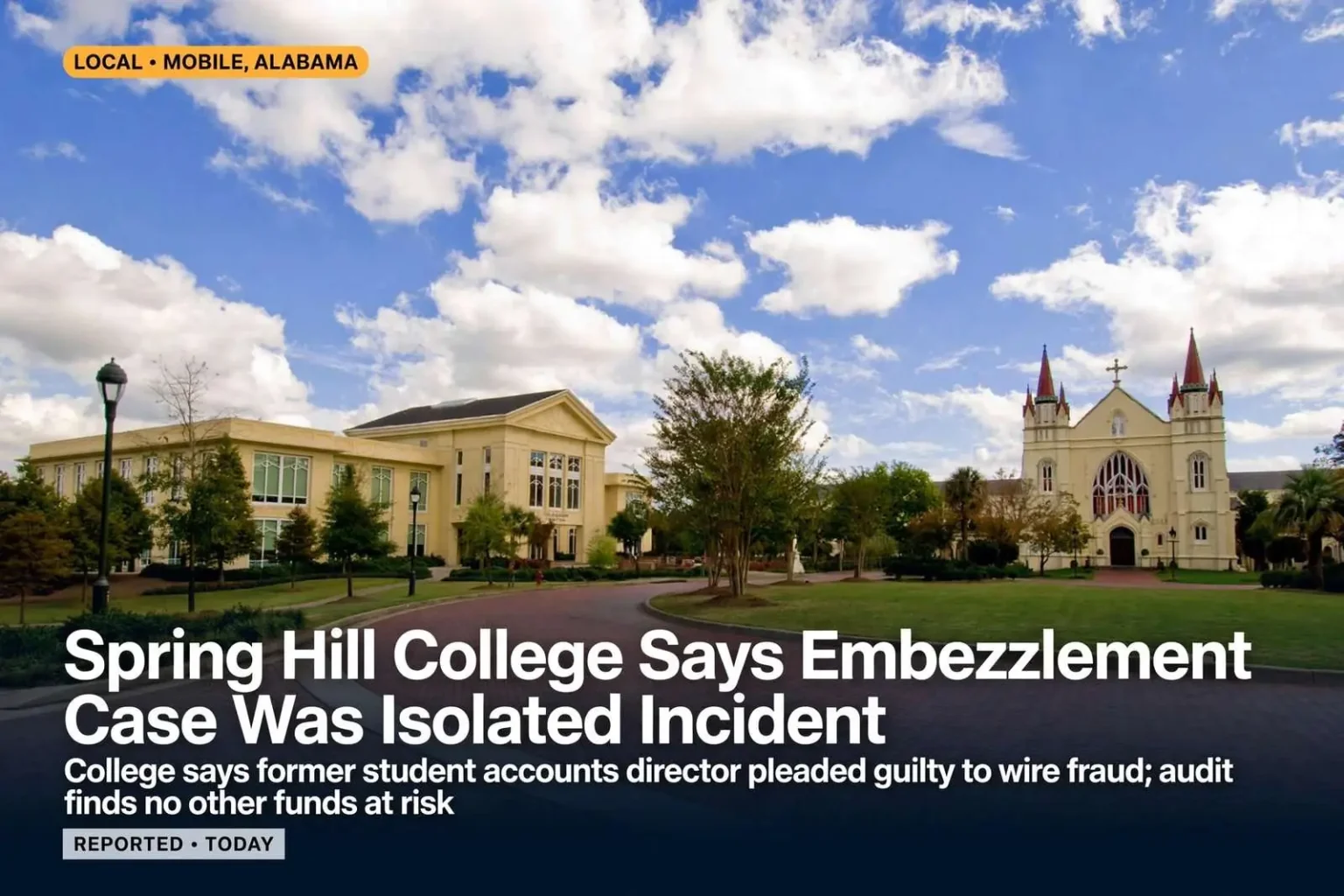
Spring Hill College officials say a recently uncovered embezzlement case involving a former employee was an isolated incident and that no other college funds are believed to be at risk.
The Mobile college issued a statement after court records showed that Tracie Lawrence, who previously served as the school’s student accounts director, pleaded guilty to wire fraud in connection with the theft of roughly $186,000 from the college. According to court records, Lawrence electronically transferred the funds from college accounts into her own bank account over a period spanning from January 2010 to June 2014.
The duration of the scheme — more than four years of repeated transfers from the office that handles student payments — raised the questions that college administrators have spent recent weeks answering: how the transfers went undetected for so long, and whether other accounts could have been touched.
What the college says it found
Fred Salancy, Spring Hill College’s vice president of advancement, said in a statement that an internal audit of the college’s accounts uncovered the discrepancies, prompting a broader investigation.
“An internal audit of accounts at Spring Hill College recently revealed some discrepancies in our accounts,” Salancy said. “We have determined that the irregularities are isolated and not on-going. It was further determined that current security measures concerning the institution’s funds and accounting are entirely adequate.”
Salancy added that the college’s cooperation with law enforcement helped bring the case to its current resolution, and that insurance provisions in place at the college mean no Spring Hill College funds are ultimately at risk from the theft. That last point carries practical weight for a private institution: fidelity and crime insurance policies exist precisely to cover employee theft, and a successful claim can make an institution whole even when the stolen money is long gone.
The college’s statement emphasized that the security review conducted in the wake of the case found no evidence of additional vulnerabilities, and that the isolated nature of the scheme meant no structural changes to the college’s accounting practices were deemed necessary beyond continued monitoring.
How schemes like this work
Embezzlement from a student accounts office follows a pattern that auditors and campus finance officers know well. The office sits at the junction of student money and college accounts — tuition payments, fees, refunds — and an insider with authority over electronic transfers can move funds in increments small enough to avoid attention, disguise them as legitimate disbursements, or redirect refunds to accounts under their control. Detection usually comes not from a single dramatic discovery but from an audit that notices a pattern: transfers that do not match documentation, round-number movements, or balances that reconcile only after adjustments.
The wire fraud charge itself reflects how the scheme was executed. Federal prosecutors use the statute whenever a crime crosses state lines by electronic means, and repeated electronic transfers from college accounts to a personal bank account fit squarely within it. A guilty plea resolves the case without trial, with sentencing to follow and restitution typically ordered — though recovery in embezzlement cases often depends on insurance rather than the defendant’s ability to pay.
For colleges, the case type is common enough that professional associations publish checklists for it: separation of duties so no single employee initiates and approves transfers, independent audits on a regular cycle, and monitoring of refund addresses against student records. Spring Hill’s statement that its existing measures are “entirely adequate” will be tested against exactly those standards by anyone reviewing how the four-year scheme went unnoticed.
A campus with a long history
Founded in the 19th century and located in midtown Mobile, Spring Hill College is one of the oldest Catholic colleges in the country and has long played a prominent role in the city’s higher education landscape. Established in 1830, the Jesuit institution predates many of the nation’s best-known universities and remains the oldest college in Alabama, its tree-shaded campus a landmark of the midtown district it anchors.
That history shapes the community’s reaction to news of financial scandal. Spring Hill’s identity rests on more than academics; it is an institution woven into generations of Mobile families, Catholic and otherwise, whose children have walked the same campus avenues for nearly two centuries. News of the embezzlement case drew attention from alumni and current students concerned about the security of the college’s financial systems, prompting administrators to move quickly to reassure the community.
The speed of the college’s response reflects both the era and the institution’s stature. Nonprofit colleges operate under intense scrutiny from accreditors, donors and federal financial aid regulators, and an unresolved question about internal controls can ripple into every conversation with a donor or a prospective family. A statement that the problem is isolated, insured and resolved is the shortest path back to normalcy — and, administrators clearly calculated, the truth of the case as their review found it.
The financial controls question
The guilty plea to wire fraud closed out the criminal side of a case that had raised questions about internal financial oversight at the private college. What remains is the quieter institutional work: ensuring the monitoring the college promised continues, and confirming that the combination of audit cycle, separation of duties and insurance coverage would catch a recurrence.
For the campus community, the reassuring arithmetic is straightforward. The audit caught the discrepancies, the insurance covers the loss, the guilty plea resolves the criminal matter, and the review found no other funds at risk. The uncomfortable lesson embedded in the same arithmetic — that a scheme can run for more than four years inside a small, trusted office before any of that machinery engages — is the part audit committees and campus finance officers across the country will recognize, and the reason institutions of every size periodically re-examine who can move money and who is watching.
Spring Hill’s size is part of the story here. A small college runs lean administrative offices where staff know one another and trust runs deep, an environment that is a strength in most respects and a vulnerability in exactly this one. The college’s answer — that its current measures are adequate and its monitoring will continue — sets the standard against which its next audit cycle will be judged by everyone who read the court records.
The investigation and the plea
The path from an internal audit to a federal guilty plea runs through several agencies and many months. Once Spring Hill’s auditors flagged the discrepancies, the college referred the matter to law enforcement, where federal investigators took over because of the wire fraud dimension — tracing electronic transfers, documenting the account they landed in, and building a record of the scheme’s duration from bank records that preserve every transaction with a timestamp.
That documentary trail made the case unusual in its clarity. Embezzlement prosecutions often hinge on ambiguous authority — whether a defendant had permission for a transaction, whether a payment was a loan or a theft — but repeated electronic transfers from institutional accounts to a personal account across four years leave little interpretive room. The decision to plead guilty rather than contest the charge reflected that record, and it spared the college the exposure of a public trial stretching out the story through another news cycle.
Restitution and sentencing will follow in the ordinary course, with the insurance recovery already ensuring the college’s actual loss is covered. Federal sentencing in wire fraud cases weighs the loss amount, the duration of the scheme and the abuse of a position of trust — factors that, in a case like this one, all point in the same direction. The former student accounts director’s position overseeing student payments is precisely the trust the scheme exploited.
What student accounts offices handle
Understanding the office at the center of the case explains both the opportunity and the risk. A student accounts director oversees the money side of enrollment: tuition payments arriving by check, card and electronic transfer; financial aid disbursements arriving from federal and state programs; refunds issued when aid exceeds charges; and the reconciliation of all of it against the college’s general ledger. The volume of transactions at even a small college runs into thousands per term, and each one is a place where a mismatched record can hide.
The office also sits close to the student experience — the staff who answer a family’s question about a bill or process a refund request — which is why news of the case landed with students and parents as much as with accountants. Families trusting the college with tuition money want to know the path that money travels is watched; the college’s statement, and the insurance behind it, is aimed squarely at that audience.
The four-year window of the scheme also illustrates why audit frequency matters. Annual audits review a year at a time, and cleverly disguised transactions can pass a single-cycle review while the pattern repeats. Regular reconciliation reviews — monthly or quarterly checks comparing disbursement records against bank activity — are the control most likely to catch an insider scheme within months instead of years, and they are the standard most college business offices now advertise as their baseline.