Spring Hill College and the University of Mobile Earn National Recognition in U.S. News Rankings
Two Mobile-area institutions, Spring Hill College and the University of Mobile, landed on the U.S. News & World Report Best Colleges lists in 2014, with leaders crediting mission and tradition.
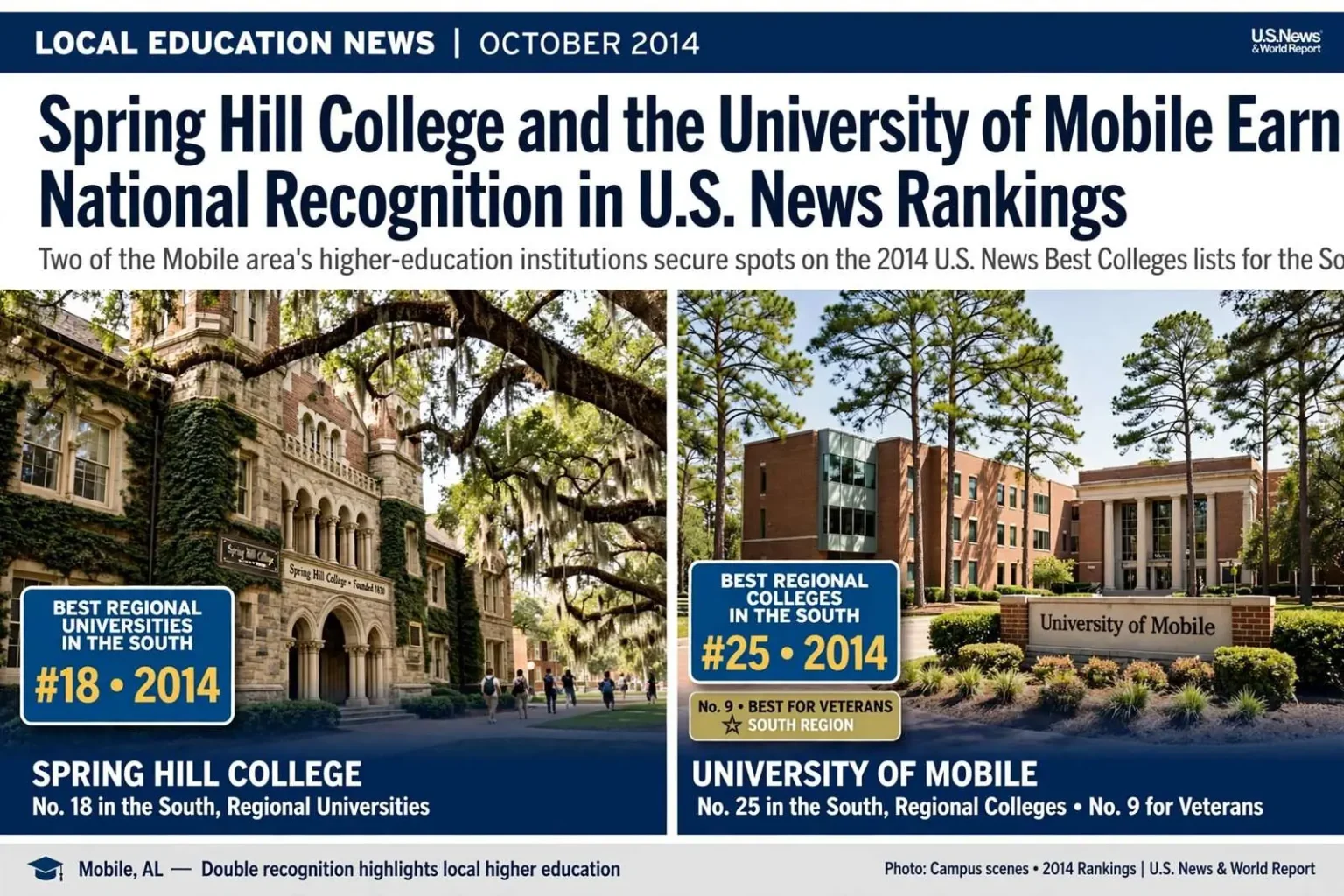
Two of the Mobile area’s higher-education institutions earned national recognition in 2014, as both Spring Hill College and the University of Mobile secured spots on the U.S. News & World Report Best Colleges lists. The annual rankings, consulted by prospective students and their families across the country, placed the two private schools among the South’s leading regional institutions and gave the Mobile area a rare double showing in the same release.
Spring Hill College, the Jesuit institution long associated with the Spring Hill community in Mobile, came in at No. 18 in the Best Regional Universities in the South category. The regional-university tier gathers schools that offer a full range of undergraduate programs and some master’s degrees but few if any doctoral programs — a fitting description of Spring Hill’s model of small classes and liberal-arts focus. College leaders framed the ranking as a reflection of the school’s longstanding identity.
Pride at Spring Hill
“We’re very pleased to be on the list and to be recognized as one of the best regional universities in the south,” Spring Hill College Provost Dr. George Sims said. “It reflects the Jesuit education here, it reflects the tradition and reputation the school has earned over a period of years,” Sims said.
Founded in the 19th century, Spring Hill has been one of the oldest Catholic colleges in the South, and its placement in the regional rankings underscored the reputation it had built over generations of graduates. The college traces its roots to 1830, when it was established on a plateau west of the city by the first Catholic bishop of the region, making it older than most institutions of any kind in Alabama and the oldest college in the state in continuous operation.
The Spring Hill campus — oak-shaded, historic and instantly recognizable to generations of Mobilians — has produced alumni across the region’s professions: teachers, attorneys, physicians, clergy and business leaders. Its Jesuit mission emphasizes rigorous academics alongside service and ethical formation, and the college has long argued that its approach shows up in outcomes rather than marketing. The U.S. News listing, school officials said, offered outside confirmation of that argument.
Movement at the University of Mobile
The University of Mobile, a Baptist-affiliated institution, ranked No. 25 in the Best Regional Colleges in the South and No. 9 in the South Region for Regional Colleges for Veterans. The showing represented an improvement for the school, which had previously been listed at No. 30 in the Best Regional Colleges in the South, according to a news release from the university.
The five-place climb reflected steady gains in the metrics the rankings weigh — class size, faculty resources, graduation and retention, and the assessments of peer institutions. The veterans category, built around benefits and support for military-connected students, carried particular meaning in a region dotted with military installations and filled with veterans from a decade and more of conflicts overseas. Placing ninth in the South put the school among the region’s best at serving that population.
The news release from the university framed the veterans ranking as a distinctive honor, and the college’s placement gave Mobile two institutions on the regional lists — a showing city officials and education boosters noted with pride during a season when national attention rarely turns toward Gulf Coast academia.
University of Mobile President Dr. Mark Foley said the recognition was welcome but not the driving force behind the school’s work. “I’m focused on our mission and what we do, and making us better and better at what we do, and it’s really nice to be recognized for that,” Foley said. “I’m very pleased that we are in the mix and moving up in the mix, but it doesn’t drive what we do,” he added. “Our mission drives what we do and how to do it better.”
Foley’s remarks reflected a standing debate in higher education about the influence of the rankings themselves. Colleges have been accused of reshaping admissions, spending and even data reporting to climb the lists, and administrators across the country increasingly frame their public comments about U.S. News with the same caution Foley showed — welcoming the recognition while insisting the institution’s mission, not the metric, sets direction. At a school of the University of Mobile’s size, where the president knows students by name, that framing comes easily.
The university, located on a wooded campus in west Mobile County, has grown over its decades into a comprehensive institution with programs in nursing, business, education, worship leadership and the arts, alongside a deep athletic tradition. Its faith-based identity shapes campus life from chapel services to curriculum, and its leaders have positioned the school as an alternative for students seeking a private Christian education close to home.
A boost for the local higher-education scene
The dual recognition offered a point of pride for Mobile, a city whose colleges have played a significant role in shaping the region’s workforce and civic life. Between Spring Hill, the University of Mobile, the University of South Alabama and Bishop State Community College, the area offers residents a fuller menu of higher education than most cities of its size, and the institutions together employ thousands and enroll a combined student body in the tens of thousands.
The strong showing in the veterans category at the University of Mobile also spotlighted the growing emphasis area schools placed on serving military-connected students, a meaningful constituency in a region with deep ties to the armed forces and the defense industry. South Alabama’s coastline economy — from the shipyards and aviation plants to the National Guard and Coast Guard presence — draws and produces veterans continuously, and schools that serve them well become fixtures in the region’s military community.
For prospective students and their families weighing where to enroll, the U.S. News lists have served as one of the more widely consulted benchmarks. Critics note the methodology’s limits and colleges chafe at the reduction of campus life to a formula, but the lists nonetheless shape perceptions in thousands of living rooms each fall, and a strong placement travels far in recruitment materials.
For both Spring Hill College and the University of Mobile, the 2014 rankings reinforced their standing among the South’s regional institutions and provided a measure of external validation for the education they offered close to home. One school celebrated a heritage nearly two centuries in the making; the other, a steady climb upward through the ranks. Both gave Mobile reason to note that, in the competition for students and reputation, its homegrown institutions were holding their own on a national stage.
The two schools’ paths to the list differed in almost every respect, which is part of what made the shared recognition notable. Spring Hill is urban-adjacent, Catholic and centuries old; the University of Mobile is suburban, Baptist and a product of the postwar boom in Christian higher education. One draws strength from tradition and place, the other from growth and mission. Yet both compete for the same regional pool of students, and both have built their identities around small classes, personal attention and faith-informed education — the very qualities the regional rankings attempt to capture.
The regional designation also matters practically. Schools in the regional categories are compared against peers with similar missions and resource levels rather than against national research universities, giving smaller institutions a fairer field. For Mobile’s private colleges, the category placement means the relevant competition is the schools a Mobile family might also consider — in New Orleans, Birmingham, Jackson or the Florida panhandle — rather than the flagship giants of the national list.
Enrollment economics hang on these perceptions. Private colleges live on tuition, and a family’s short list is assembled from reputation, cost, aid and geography in roughly that order of visibility. A ranking placement does not enroll a student by itself, but it arms recruiters with a third-party credential when they visit high schools across the Gulf Coast, and both institutions have historically cited such listings in their viewbooks and admissions materials.
The 2014 lists also arrived amid a broader conversation about college value. Families were scrutinizing cost and outcomes with new intensity in the years after the recession, and Gulf Coast institutions leaned on their employment pipelines — teaching, nursing, business, ministry — as evidence that a degree close to home pays off. Mobile’s colleges have long sent graduates into the region’s hospitals, schools and firms, and the rankings period found them pressing that case harder than ever.
For the city itself, the recognitions were a modest but genuine marker. Higher education is one of Mobile’s quiet economic engines — payroll, construction, cultural events and the retention of young talent who arrive as freshmen and stay as professionals. When two of its private colleges make the national lists in the same year, the city gains not just bragging rights but a small confirmation of the ecosystem it has spent generations building.