In the Dog Days of Summer, Mobile’s Officials Introduce Their Pets
With the summer heat settling in, area officials past and present shared the boxers, hounds, cats and rescues that keep them company, a warmer counterpoint to the city's debates over animal welfare.
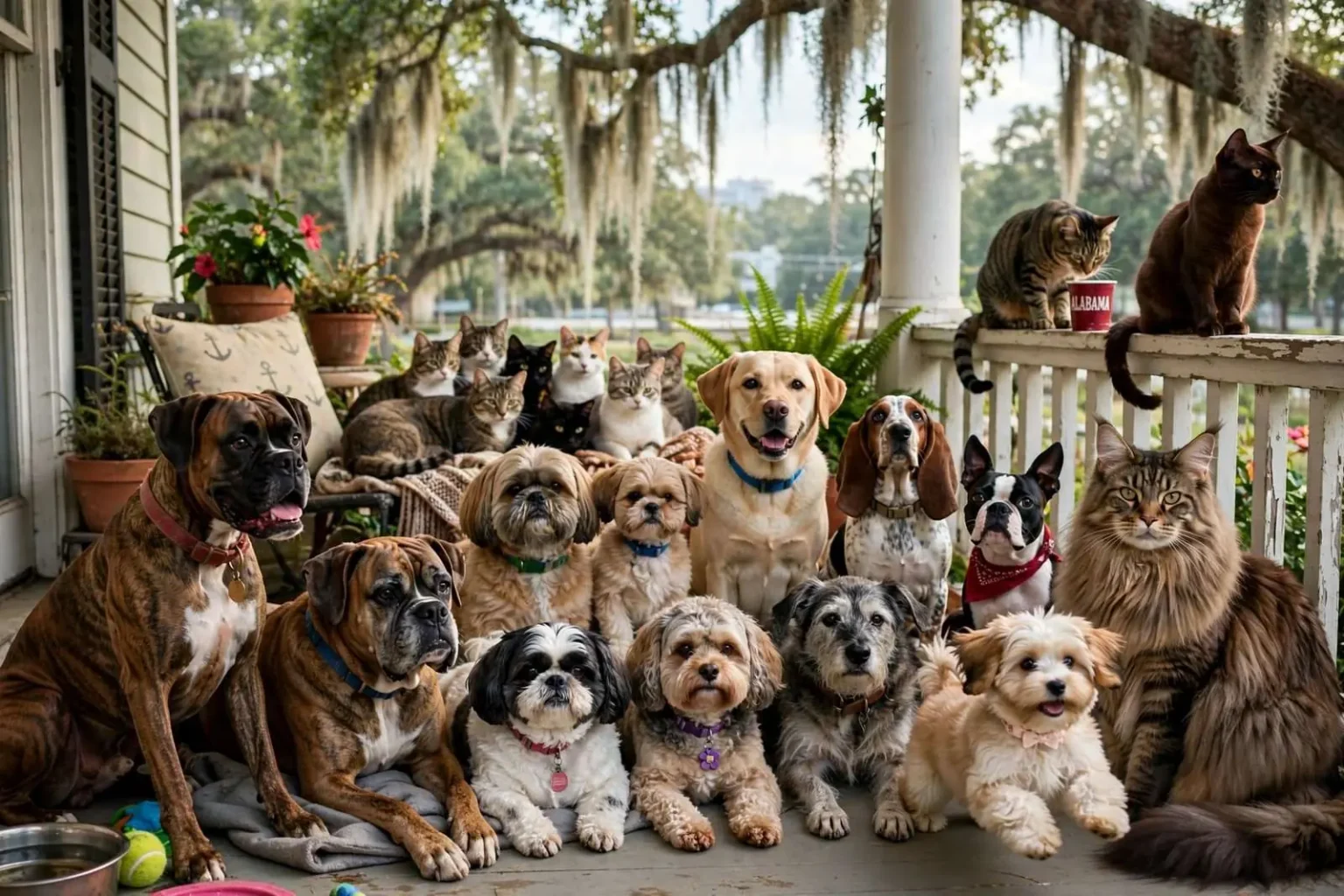
The summer heat had settled over Mobile, and with it a quieter, gentler kind of Dog Days. After a stretch in which the city’s treatment of animals had drawn unflattering attention, a survey of area officials past, present and aspiring set out to pair a pet with a person and remind readers that plenty of Mobile’s four-legged residents are dearly loved.
The idea was simple: ask the men and women whose names appear on ballots, council agendas and courthouse dockets what kind of animals share their homes, and print the answers. What came back was a menagerie — boxers and hounds, tabbies and rescues, a gentle giant of a Maine Coon and a Havanese puppy with springs for feet — and a portrait of public figures off duty.
Dogs of Every Temperament
City Councilwoman Gina Gregory introduced Scarlett and Rhett, brindle boxers who are brother and sister from different litters. Scarlett, the older and more energetic of the two, serves as the household’s self-appointed guard dog and tireless retriever of tennis balls and Frisbees, while the laid-back Rhett prefers his blanket and the air conditioning, offering an occasional supportive bark.
Any household with two dogs will recognize the arrangement. One takes the job of patrol and play; the other supervises from the nearest cool spot. In an Alabama summer, Rhett’s strategy arguably makes him the more sensible of the pair.
Former councilwoman Jane Conkin confessed to spoiling two overweight senior dogs, a Shih Tzu named Oreo and a Peekapoo named Tara, the latter adopted after the passing of an elderly friend. “I am a sucker for a cute dog,” she said. The admission will ring true to anyone who has ever promised a new pet would follow the rules and quietly abandoned the plan within a week.
State legislator Spencer Collier described a pair of Shih Tzus, father and son, named Chin and Gizmo, recommended to his family as a good breed for children. The breed’s reputation for patience and its small size have long made it a favorite of families with young kids, and Collier’s pair apparently upheld it.
Councilman Ben Brooks, then a candidate for the state Senate in District 35, offered a fuller roster: Penni, a part-yellow-lab matriarch who loves long swims and joining the family on runs; Ellie-Mae, a young Blue Tick and Basset hound mix whose bark is far worse than her bite; and Walt, short for “Walterina,” the family’s beloved first dog, a complete mutt who lived some 15 to 17 years.
Three dogs, three personalities and one familiar arc — from the tireless puppy to the hound with opinions to the mixed-breed veteran who held the household together for more than a decade and a half. Brooks’s roster read like a timeline of a family’s life with dogs, from the first pet that taught the children what losing one feels like to the newcomers who filled the yard again.
Cats, and One Very Particular Burmese
Not everyone kept dogs. District Judge Judson Wells described Bama, a three-year-old tabby who drinks water from an Alabama cup. The detail is a small one, but it is the kind that sticks: a courthouse presence by day, and at home a cat that insists on crimson dishware.
Vivian Beckerle, the Democratic nominee for Congress, reported a household of 18 rescued cats, “all dearly loved.” Eighteen is not an accidental number; it is what happens when a soft heart keeps answering the door. Her household stood as perhaps the survey’s clearest statement about the region’s stray population — and about the people who do something about it one animal at a time.
Restaurateur and council candidate Mead Miller offered a small essay on his pedigreed Burmese, Shan, tracing the breed to a female found in Burma in 1930 and praising the Burmese as the “dog cat” for the affection it shows its owners. The history is accurate as far as the breed’s American story goes, and the description fits: Burmese are known for following their people from room to room, less a resident cat than a small, opinionated companion.
Chris Pringle, a runner-up in the District 34 Senate race, kept a four-year-old Boston terrier named Otty who “all he wants is to be loved and scratched.” The Boston terrier’s tuxedo markings and comic seriousness have endeared the breed to city dwellers for generations, and Otty’s single-minded request — love and scratches — made him perhaps the easiest animal in the whole survey to understand.
Karen Outlaw Atchison of the Mobile Convention and Visitors Bureau introduced Emma, a six-month-old Havanese with “springs for feet,” especially when food is left on the counter. The breed, small and silky-coated, is a relative newcomer to the ranks of America’s popular pets, and Emma’s vertical ambitions suggested the puppy stage was in full, gravity-defying swing.
Former Supreme Court Justice Champ Lyons Jr. named Samson, a Maine Coon he called a gentle giant. Maine Coons are among the largest of domestic cats, often tipping the scales well beyond ordinary house cats, and the name Samson — for strength — paired neatly with the justice’s description of a big animal with an easy temperament.
Loss, Too
A few responses carried a note of sorrow. State legislator and Senator-elect Rusty Glover recalled a black Lab who died suddenly in the summer of 2003; his daughters, he said, still had not recovered, and the family had since removed the backyard fence, unable to bring themselves to keep another dog.
It was the starkest answer in the collection, and it acknowledged something every pet owner eventually learns: the love comes with a built-in ending, and the grief that follows a dog is not a small thing. The empty yard — no fence, no dog, no replacement on order — said as much as any paragraph in the survey.
Taken together, the menagerie of boxers, hounds, tabbies and rescues offered a warm portrait of the people behind the region’s public offices, and a reminder that, whatever the headlines, Mobile is home to a great many well-tended pets.
It was also, quietly, an argument. A city judges itself in part by how it treats animals that cannot vote, speak or testify, and the officials who answered the survey — some with one spoiled Shih Tzu, one with eighteen rescued cats — had made their own position plain. In the hottest weeks of an Alabama summer, that was a story worth telling.
There is a practical side to the Dog Days as well. Late summer in south Alabama is hard on animals, and the survey’s publication was a natural moment to remember the basics. Veterinarians across the Gulf Coast repeat the same advice every July and August: pets need shade and fresh water at all hours, walks belong to the early morning and the evening, and pavement hot enough to fry an egg will burn a dog’s paws in seconds. If the ground is too hot for the back of a human hand, it is too hot for a paw.
Heat is only half the danger. Heartworms, carried by the mosquitoes that thrive in Mobile’s humidity, remain a year-round threat along the Gulf Coast, and prevention is far easier — and far cheaper — than treatment. Fleas and ticks flourish in the same climate, and regular protection saves animals and owners a season of misery.
The survey’s mix of purebreds and mutts, pedigreed Burmese and backyard rescues, also reflected the way most households in the region actually acquire their pets. Animal shelters and rescue groups across Mobile and Baldwin counties place thousands of dogs and cats in homes each year, and adoption has become the default choice for many families. The animals featured in the survey ranged from carefully documented show breeds to a complete mutt named Walt, and the affection they generated did not appear to depend on their paperwork.
The city’s recent scrutiny made the timing matter, too. Debates over animal shelters, cruelty cases and enforcement have a way of turning abstract in a council chamber; a page of photographs and pet stories does not. Readers who had followed the headlines saw the same officials as dog people and cat people, and that recognition counts for something in a community deciding how seriously it takes animal welfare.
For the officials themselves, the exercise required no policy position and no vote. It asked only who waits by the door when they get home, and the answers — from a guard-dog boxer to a cat with a football allegiance expressed in dishware — suggested that along the Gulf Coast, at least, the office and the household have more in common than either side of the front door usually admits.
And as anyone who has loved an old dog knows, the days are numbered from the start. That is the other lesson of the survey: the boxers and basset hounds and senior Shih Tzus now sprawled across Mobile’s living rooms will not be there forever, and the people who answered so freely about them understood that better than most.