Satsuma Schools Put 90 Old Televisions Up for a Sealed-Bid Sale
The Satsuma school system cleared 90 outdated televisions from an old elementary building and invited the public to submit sealed bids for the entire lot in September 2014.
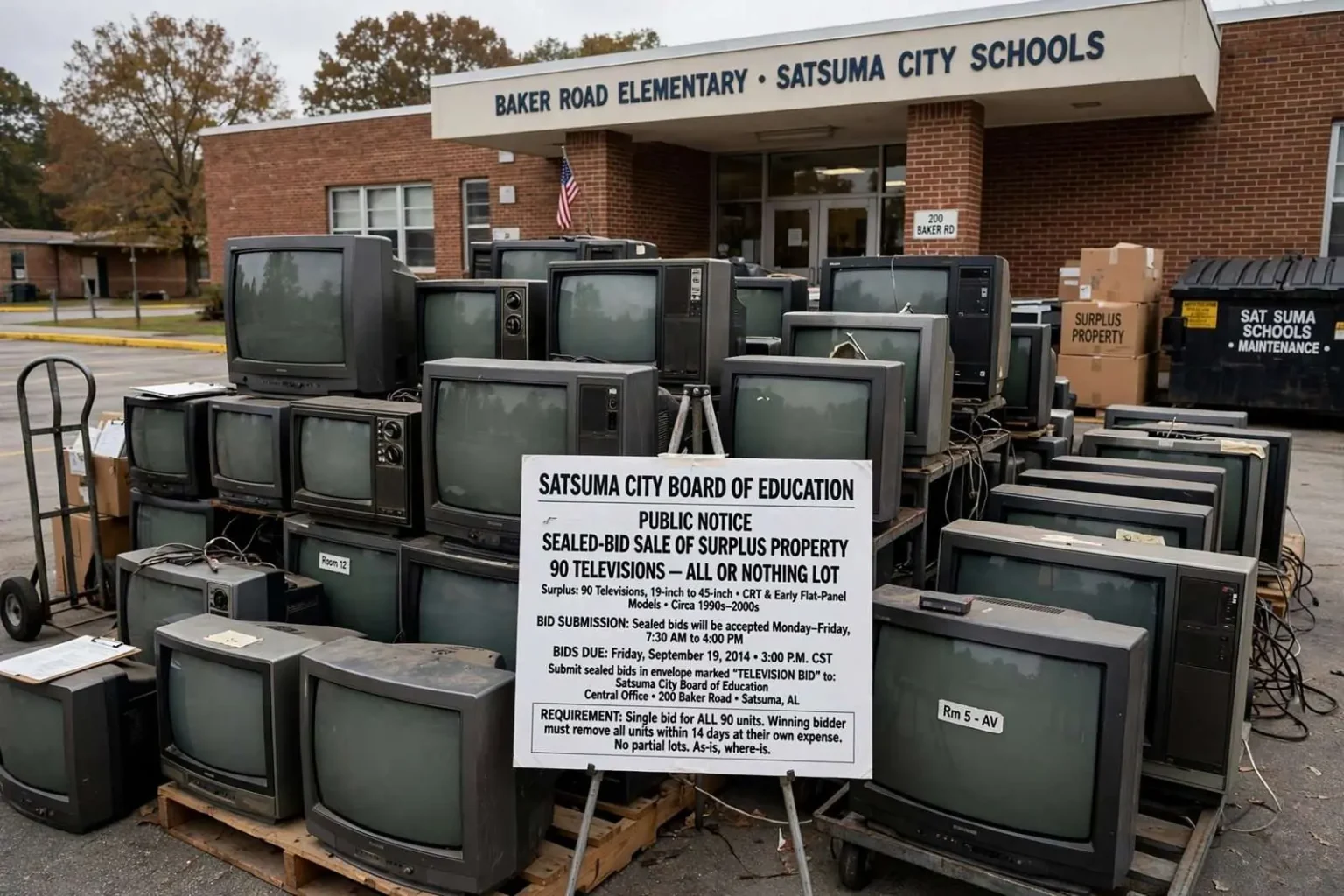
The Satsuma school system found itself with an unusual surplus in September 2014: a batch of 90 outdated televisions, and a plan to sell every last one of them through a sealed-bid sale. School officials collected the sets while clearing out unused classrooms in the former elementary school on Baker Road. The televisions ranged in size from 19 inches to 45 inches, a snapshot of the bulky cathode-ray and early flat-panel era that classrooms across the region were steadily leaving behind.
The sale notice read like a relic itself. Ninety televisions, taken together, represented more than a decade of classroom technology purchases, gathered from room after room of a building that no longer needed them. For a small district, moving that much equipment out the door at once required a process — and Satsuma chose one of the oldest in the government handbook: the sealed bid.
How the Sale Worked
Potential buyers were invited to view the televisions and submit sealed bids from 7:30 a.m. to 4 p.m., Monday through Friday, at the central office at 200 Baker Road. Bids had to be delivered in a sealed envelope marked “television bid” before 3 p.m. on Friday, Sept. 19. After that deadline, officials planned to open the envelopes and notify the high bidders.
There was one important condition attached to the offer. Bids had to be submitted as an “all or nothing” proposal — in other words, a bidder had to be willing to take the entire lot of 90 sets rather than cherry-pick a few favorites. The school system also stipulated that removal of the televisions would come at no cost to the Satsuma City Board of Education, meaning the winning bidder would be responsible for hauling the equipment away.
The all-or-nothing structure served the district in two ways. It guaranteed that the school board would not be left holding the odd dozen sets nobody wanted — the small screens, the heavier tubes, the units with worn cabinets — and it simplified the transaction into a single envelope, a single winner and a single payment. For prospective buyers, the flip side was risk: a bid covered everything, working or not, and there was no inspection period once the envelopes were opened.
Sealed-bid sales of surplus property are standard practice for Alabama school boards, which are required to dispose of public property in a way that returns value to the system and stands up to public scrutiny. Advertising the sale, taking all bids at once and opening them on a stated date keeps the process transparent — no back-room deals, no favoritism, and a paper trail for every dollar the district collects.
Two Weeks to Collect
Winning bidders were given a two-week window to collect their sets once the sale was complete. For anyone with a use for a large quantity of secondhand televisions — a resale operation, a repair shop or simply someone with an appetite for a bargain — the arrangement offered a straightforward path to a considerable haul of screens.
The two-week deadline mattered as much as the price. Satsuma officials wanted the Baker Road building cleared, not converted into a warehouse for equipment the district no longer used. A buyer who could not remove the sets in time would find the deal slipping away, and the district would have to start the process over.
Ninety televisions are not light. The older cathode-ray sets in the lot could weigh well over a hundred pounds each, and even the early flat panels required two hands and a careful grip. Anyone planning to bid had to think about trucks, dollies and muscle before thinking about resale profit — which is exactly why the district wrote removal costs into the terms.
The sale reflected a common challenge for small school systems during those years. As districts modernized classrooms with interactive whiteboards, projectors and networked computers, older audiovisual equipment quickly piled up. Rather than let the televisions sit idle in a shuttered building, Satsuma officials chose to move them out through a transparent, publicly advertised bidding process that returned at least some value to the school board.
A Small City’s Practical Housekeeping
Satsuma, one of the smaller municipalities in northern Mobile County, had operated its own school system for only a few years at that point, having launched the district earlier in the decade. Managing an inherited inventory of aging equipment was part of the everyday work of standing up an independent system, and the television sale was a modest but telling example of that behind-the-scenes housekeeping.
When a community separates from a county school system, it inherits more than buildings and buses. It takes on custodians of decades of accumulated materials — furniture, textbooks, athletic gear and, in this case, a room-by-room census of audiovisual equipment that had outlived its usefulness. Sorting what to keep from what to sell is unglamorous work, but it shapes how quickly a new district finds its footing.
Satsuma’s split from the larger Mobile County system followed a path that other north Mobile County communities had begun to wear smooth. Creating a city school system meant new administration, new policies and new budgets, all funded by the tax base of a town of a few thousand residents. Every dollar recovered from surplus property, and every square foot of building space reclaimed, counted toward the bottom line.
The former elementary school on Baker Road sat at the center of that effort. Buildings that no longer house students still cost money to maintain, and an unused building full of unused televisions was a double expense. Clearing the classrooms made the space easier to repurpose, lease or simply keep in better condition for whatever the district decided next.
A Reminder of How Fast Classrooms Changed
For residents, the notice was also a reminder of how quickly technology in schools was changing. The 90 televisions gathered from the old Baker Road elementary building represented years of classroom viewing — morning announcements, instructional videos and the occasional rainy-day movie — now bound for new owners as the district looked ahead.
A generation earlier, a television on a rolling cart was the height of classroom technology, wheeled between rooms for filmstrips’ successors and educational broadcasts. By 2014, the interactive whiteboard and the classroom projector had taken over, and teachers increasingly pulled content from networks rather than tapes and discs. The cart-era television went from marvel to clutter in roughly a decade.
That pace of change is hard on school budgets. Equipment purchased with public money loses usefulness faster than buildings do, and districts are left holding assets with little resale value but real disposal costs. Satsuma’s sealed-bid approach — take it all, haul it yourself, bid in writing — was a pragmatic answer to a problem every Alabama district of the era recognized.
For the winning bidder, the 90 sets would go wherever secondhand televisions went in 2014: resale lots, repair benches, community centers, families stretching a budget. For the district, the sale closed a chapter on the Baker Road building and turned ninety pieces of obsolete equipment into something a small school system can always use — revenue, space and a process it can point to.
By the time the envelopes were opened after the Sept. 19 deadline, the outcome was predetermined in one sense: the televisions were leaving. The only open question was which bidder would haul them away, and what the lot would bring for a district still writing the early chapters of its independent history.
Surplus Rules and Public Money
Alabama school boards do not simply give public property away. State law and State Department of Education guidance direct local boards to account for the property they hold, to declare items surplus when they are no longer needed, and then to dispose of them through methods designed to protect the public interest — competitive bids, public auctions or, for items of trivial value, documented disposal. The point is that assets bought with tax dollars should return something to the taxpayers who bought them.
A sealed-bid sale of ninety televisions is a small-scale example of that machinery in motion. The board advertises, the public can inspect, the bids are opened together, and the highest responsible bid wins. Documentation from the sale — the notice, the envelopes, the final tally — becomes part of the district’s records, available to anyone who wants to know how the district handled its surplus.
The alternative is the slow leak: equipment stacked in corners, quietly given away or hauled to the dump, with no record and no return. For a young district working to establish public trust, doing the housekeeping by the book was worth as much as the money the sale would bring in.
The two-week removal window also protected the district from a familiar surplus-sale headache — the winning bidder who never shows up. When buyers fail to collect, districts are left storing the property, re-advertising it or scrapping it, all of which costs time and money. Setting a firm deadline, with the terms spelled out in advance, keeps the transaction moving to completion.
None of this is headline material, and Satsuma officials did not present it as such. It was the routine work of a small administration keeping its inventory honest: a shuttered school on Baker Road, ninety televisions that no longer had a job, a notice posted at the central office, and envelopes due by 3 p.m. on a Friday. By the following week, the building was lighter and the books balanced a little better than before.
For the buyers, the arithmetic was different. Ninety televisions at a bulk bid price could pencil out for a reseller with storage space, or for an outfit that shipped working units to markets where older screens still had years of life in them. The sealed-bid format asked each of them to decide what the whole lot was worth to them — and to put that number, and nothing else, in the envelope.