Mobile Lands Bloomberg Grant to Build City Innovation Team
Mobile was selected among 14 cities worldwide for a Bloomberg Philanthropies grant worth roughly $1.65 million to fund a city innovation team.
A Major Award for City Hall
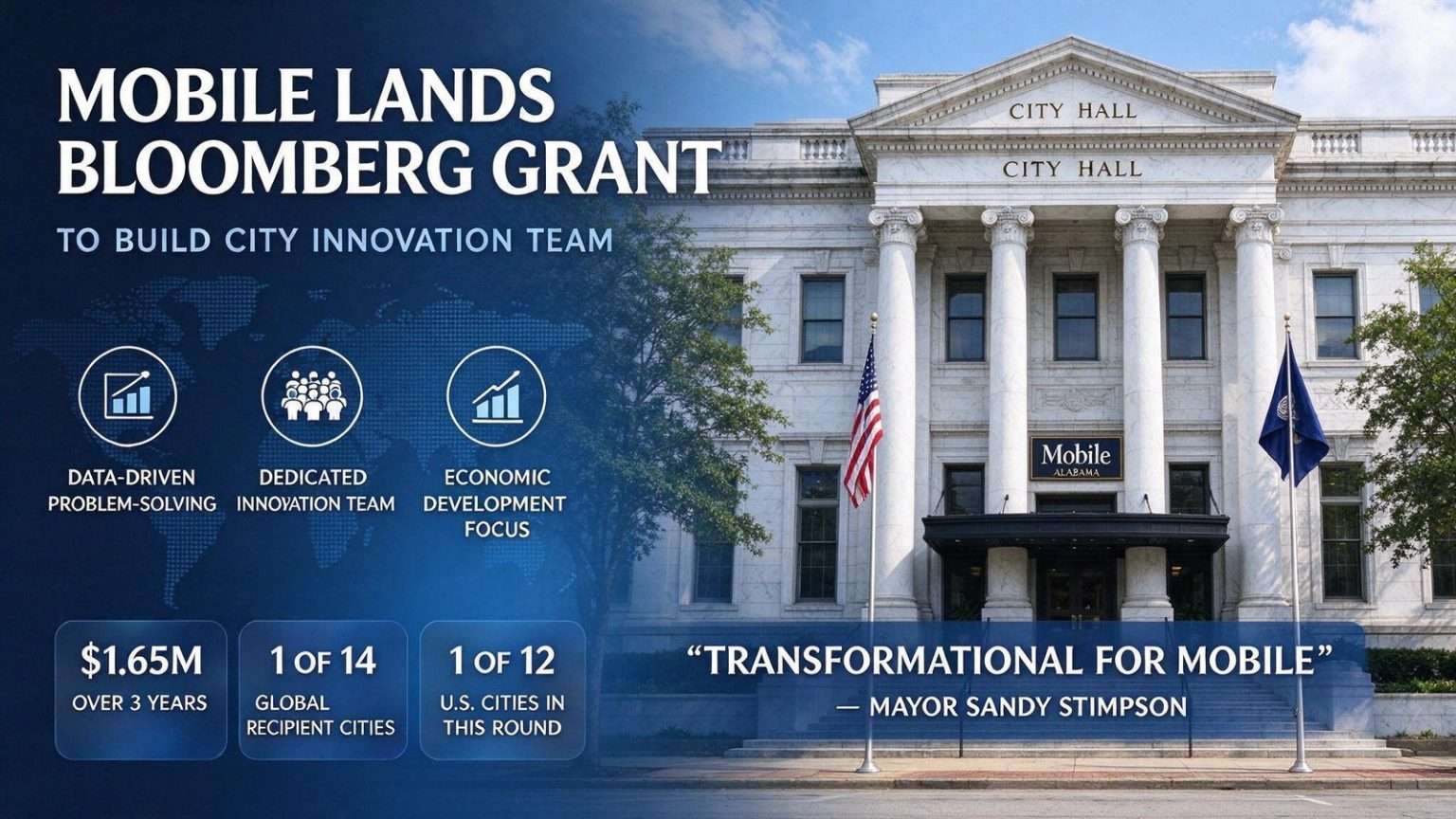
MOBILE, Alabama – City Hall is set to receive a multimillion-dollar boost after Mobile was chosen as one of 14 cities around the world, and one of 12 in the United States, to receive a Bloomberg Philanthropies grant aimed at building a dedicated municipal innovation team. The grant, expected to total around $1.65 million spread over three years, will allow the city to hire and fund a small team of staff dedicated to tackling persistent social and economic challenges using data-driven methods.
Mayor Sandy Stimpson referenced the pending award as “transformational” during a December city council and executive staff retreat, before the source and scope of the funding had been publicly confirmed. A spokesman for the mayor’s office later confirmed the total figure once the announcement became official, ending weeks of speculation among council members and city staff about the size of the prize the administration had been hinting at.
The funding comes from Bloomberg Philanthropies, the charitable foundation established by former New York City Mayor Michael Bloomberg, as part of an expansion of its “i-team” program. Twelve U.S. cities in this funding round are splitting a combined $45 million, alongside two international cities added to the program for the first time.
How Mobile Was Chosen
Mobile was one of just five U.S. recipients whose funding is specifically earmarked for economic development initiatives, a group that also includes Albuquerque, Long Beach, Los Angeles and Seattle. Sharing a funding category with cities many times Mobile’s size underscored how competitive the selection process was — and how directly the foundation saw economic development as Mobile’s central challenge.
According to Bloomberg Philanthropies, cities were selected from a pool of more than 30 applicants that each had populations of at least 100,000 residents and mayors with at least two years remaining in their terms. The term requirement reflects the program’s design: innovation teams need years, not months, to change how a city government approaches its hardest problems, and the foundation wanted mayors committed enough to see the work through.
The innovation teams are designed to give mayors a dedicated internal unit that can identify problems, design new interventions, build partnerships across city departments and outside organizations, and track measurable outcomes over time. Rather than replacing existing departments, an i-team is meant to cut across them — taking on problems like blight, workforce gaps or service delivery that no single department owns and that traditional bureaucratic structures handle poorly.
What an Innovation Team Does
The i-team model has its roots in the approach Bloomberg pioneered in New York City Hall during his twelve years as mayor, where an Office of Long-Term Planning and Sustainability and other cross-cutting units were used to attack problems that spanned agencies. After leaving City Hall, Bloomberg exported the idea through his foundation, funding teams in cities that committed to the same discipline: define a problem precisely, gather data before acting, prototype interventions quickly, and measure honestly whether they work.
In practice, a Mobile team of the kind funded by this grant would be a handful of specialists — researchers, project managers, data analysts — embedded at City Hall and directed by the mayor’s office. Their first year is typically spent picking the right target. Foundation guidance to i-teams stresses choosing a small number of high-impact problems rather than spreading across everything at once, then building the partnerships with departments, nonprofits and the business community needed to move them.
A Bloomberg Philanthropies official overseeing the foundation’s government innovation programs said the initiative exists because city halls often lack reliable tools for pursuing measurable progress on their toughest challenges — the kind of work that fits no department’s existing job description and rarely survives a budget cycle without dedicated funding and a mandate from the top.
Why Economic Development
For Mobile, the economic development focus points the team’s energy at the questions that have defined the city’s recent debates: how to connect residents to the jobs arriving with the region’s industrial expansion, how to stabilize struggling neighborhoods so they share in growth, and how to keep the momentum of downtown revitalization spreading beyond a few blocks. The port city has landed major industrial wins in recent years, but converting big investments into broad-based opportunity has remained the harder problem.
Being grouped with Albuquerque, Long Beach, Los Angeles and Seattle in the economic development cohort also gives the city a set of peer cities working on parallel problems. The foundation deliberately builds networks among its grantee cities, flying team leaders together for training and pairing them so that a solution tested in one city can be adapted in another without starting from scratch.
What Happens Next
The three-year clock shapes everything about how the team will work. Grant funds cover the team’s staffing and operations, with the expectation that the city will institutionalize what proves effective by the time the money ends. Foundation officials have described the funding as seed money for a permanent change in how a city operates — the goal is not three years of projects but a lasting capacity for data-driven problem-solving inside City Hall.
For the Stimpson administration, the grant arrives as external validation of an agenda the mayor has pursued since taking office: running the city with more attention to measurement, customer service and the basics of government performance. The mayor’s use of the word “transformational” before the award was confirmed signaled how central the team was expected to become to the administration’s second-half agenda.
Council members, who were briefed as the announcement approached, are expected to weigh in on how the team’s priorities align with district-level needs across the city. The grant itself does not require the council’s appropriation, since the funding is external, but the team’s success will depend on cooperation from every department the council funds.
Recruitment for the team’s leadership typically comes first, with the foundation assisting in the search for a director experienced in both public administration and data analysis. From there, the first months are spent listening — inside departments, in neighborhood meetings and among the business and nonprofit partners who will carry much of the load of any successful intervention.
A National Program With Local Stakes
The expansion round that brought Mobile in marks the program’s biggest test yet: a dozen American cities at once, plus the first international participants, all attempting to prove that the innovation-team approach can be replicated beyond the biggest cities. The foundation’s bet is that the method — problem definition, data, rapid testing, honest measurement — transfers anywhere city government is willing to use it.
Mobile’s residents will judge the result the practical way: whether problems that have lingered for years start moving, whether the city’s economy works better for the people who live in it, and whether a City Hall with a dedicated team of problem-solvers actually behaves differently than one without. The $1.65 million buys the chance to find out.
Learning From Peer Cities
The first generation of i-teams funded by the foundation in earlier rounds offered lessons about what success and failure look like. Teams that thrived tended to have a mayor who used them, directing real problems to the team and defending it when departments pushed back; teams that struggled were often left to generate reports nobody acted on. The foundation’s training program for new grantees dwells on that lesson, telling incoming directors that the hardest work is political and organizational rather than analytical.
Mobile’s placement in the economic development cohort will also shape its early wins. Concrete, visible projects — a vacant-lot program that moves faster, a permitting process that stops losing businesses, a job-matching effort that reaches neighborhoods that have been skipped — are the kinds of targets innovation teams elsewhere have chosen first, precisely because residents can see the difference within the grant’s three-year window.
The announcement closes out weeks of quiet anticipation at City Hall, where staff had known something significant was coming since the mayor’s December retreat remarks but could not say what. Now the work of hiring, targeting and delivering begins, with Mobile carrying the expectations of a national program and the hopes of a city that has spent a decade trying to turn big economic news into everyday improvement for its neighborhoods.
The money itself, while substantial by local philanthropic standards, is only part of the prize. The grant comes with access to the foundation’s network of former i-team directors, its training curriculum and the collective experience of cities that have run these teams for years — resources that would otherwise be out of reach for a city of Mobile’s size. City officials have described that support system as, in some ways, more valuable than the check, since it compresses years of trial and error into briefings and site visits.