Mobile Federal Judge Strikes Down Alabama’s Same-Sex Marriage Ban
A federal judge in Mobile ruled Alabama's constitutional ban on same-sex marriage unconstitutional in a case rooted in a local adoption dispute.
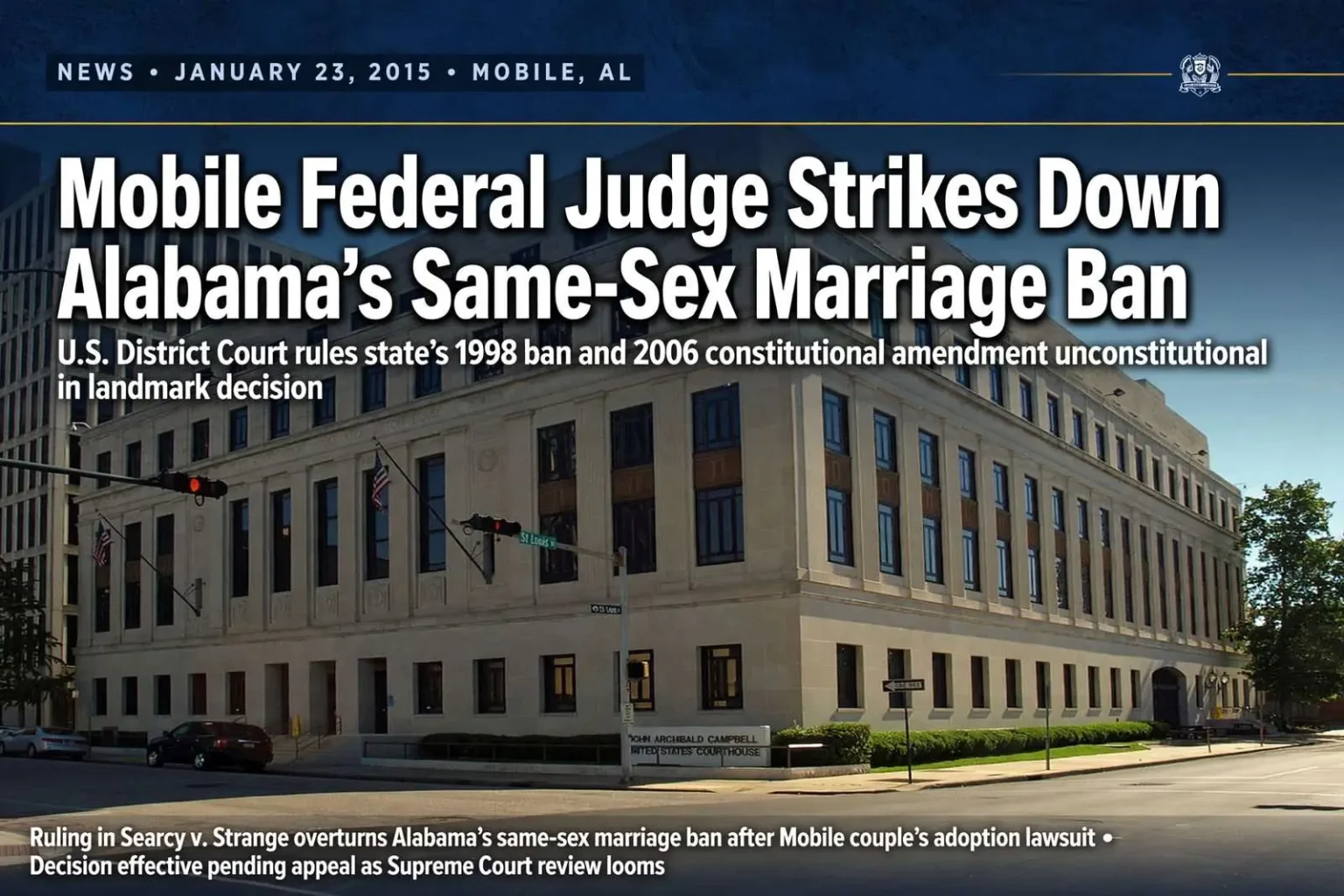
A federal judge sitting in Mobile issued a landmark ruling in January 2015, striking down Alabama’s constitutional ban on same-sex marriage in a case that began with a local couple’s fight to legally adopt a child they had raised together for years. U.S. District Judge Ginny Granade found that both the state’s 1998 Alabama Marriage Protection Act and the later constitutional amendment enshrining it were unconstitutional.
The ruling concluded that marriage is a fundamental right protected under the U.S. Constitution, and that Alabama had failed to show a compelling state interest sufficient to justify restricting that right for same-sex couples.
The case originated when two Mobile-area women sued after a Mobile County probate judge rejected a second-parent adoption petition, citing the state’s marriage ban. The women, who had legally married in California, argued that one of them should be allowed to formally adopt a young boy she had helped raise since birth. Both sides in the litigation agreed the adoption petition would have been approved as a routine matter had the couple been married under Alabama law as a heterosexual pair.
The court’s reasoning
In her 10-page order, Granade, a Mobile-based judge appointed by President George W. Bush, rejected the state’s argument that the marriage ban served to protect biological family ties. She wrote that the state offered no real explanation for why prohibiting same-sex couples from marrying would help keep children connected to biological relatives, and found the law worked against its own stated purpose by denying children of same-sex parents the same legal protections afforded to children of heterosexual couples.
That child-centered framing put the opinion in line with a series of federal rulings nationwide, which had increasingly reasoned that excluding same-sex couples from marriage harms the children already being raised in those families. Granade’s order applied the established constitutional test for infringements on fundamental rights, asking whether Alabama could show that its ban was necessary to serve an important governmental interest, and found that it could not.
The Mobile ruling arrived amid a wave of federal court decisions on same-sex marriage across the country, most of which had sided with same-sex couples in the years leading up to a pending U.S. Supreme Court review. Granade’s decision specifically noted she found the reasoning of several appellate courts favoring same-sex marriage more persuasive than a contrary ruling from the Sixth U.S. Circuit Court of Appeals that had upheld bans in several other states.
The Sixth Circuit’s decision, issued the previous autumn, had broken a string of lower-court victories for same-sex couples and created the circuit split that made Supreme Court review all but inevitable. Granade’s opinion aligned Mobile with the majority of federal courts, while the pending high court argument loomed over every branch of the litigation.
Immediate reaction and next steps
The plaintiffs’ attorney said he intended to ask the court not to delay the ruling, citing years of waiting his clients had already endured. The Alabama Attorney General’s Office signaled it would continue defending the state’s ban and asked the court to put the decision on hold pending further review, while acknowledging the case would likely be shaped by the outcome of the Supreme Court’s own upcoming marriage ruling.
News of the decision drew a mix of celebration and criticism locally, with reaction spilling out in downtown Mobile among both supporters and opponents of same-sex marriage. The ruling marked the first of several pending Alabama same-sex marriage cases to be decided at the time, and it set the stage for a chaotic several weeks in which Alabama probate judges across the state grappled with conflicting guidance on whether to issue marriage licenses to same-sex couples.
How the case began
The lawsuit’s origins in a Mobile County probate office gave the national marriage debate an intensely local starting point. The couple, having wed in California where same-sex marriage was legal, returned to Mobile and filed the same second-parent adoption petition any married couple could bring, seeking to secure both parents’ legal relationship to the boy one of them had raised from birth. The probate judge’s refusal, grounded in Alabama’s ban, left one of the two women without legal standing as a parent, a status with consequences for everything from school decisions to emergency medical care.
Lawyers for the couple structured their challenge around precisely that gap. Rather than beginning with an abstract attack on the marriage amendment, the case reached the courts through an adoption denial, letting the judge consider what the ban did to a specific Mobile family. Both parties agreed at trial that the adoption itself was uncontroversial; the only obstacle was the state’s refusal to recognize the couple’s out-of-state marriage.
Alabama’s marriage restriction had been built in two layers. The Legislature passed the Alabama Marriage Protection Act in 1998, and voters then wrote the same policy into the state constitution in 2006, making the ban both statute and supreme state law. Over the years that followed, the amendment became one of the most durable of the state bans nationwide, surviving challenges in state court until the federal litigation reached Granade’s docket.
Alabama in the national marriage fight
By January 2015, the map of same-sex marriage recognition had shifted dramatically in less than a year and a half. Federal judges had struck down marriage bans in state after state, most rulings had been left in place by the Supreme Court pending appeal, and the number of states recognizing same-sex marriage had more than doubled. Alabama stood among the remaining states whose bans were still enforced when Granade’s order landed.
The ruling’s timing mattered as much as its reasoning. Oral argument at the U.S. Supreme Court on the marriage question was weeks away, and the high court’s decision was expected before the end of the term in June. Every motion in the Mobile case, from the plaintiffs’ request for immediate effect to the attorney general’s request for a stay, was written with that calendar in mind, each side trying to position Alabama to fall on whichever side of the ruling came first.
Granade, a 1990s state prosecutor appointed to the federal bench by President Bush in 2001, was not widely known for high-profile rulings before the marriage case. Her appointment history, though, became part of the story, undercutting any suggestion that the decision reflected a liberal judge overriding a conservative state. The order was short by federal standards, its 10 pages devoting most of their length to the question Alabama’s lawyers could not answer: what interest does excluding same-sex couples from marriage actually serve?
The chaos that followed
Granade’s order put Alabama’s 67 probate judges, who issue marriage licenses in their home counties, at the center of a dispute no state manual had anticipated. The federal ruling bound the parties before her court, but it did not automatically command every probate office in the state, and the attorney general’s public guidance warned judges that issuing licenses to same-sex couples could expose them to the state’s own laws. Some counties opened their windows to all couples; others closed the marriage license office entirely; many simply waited for a clearer answer from a higher court.
The confusion drew national attention to courthouses across Alabama, as couples drove county to county in search of licenses and advocates on both sides crowded the probate offices that did issue them. State Supreme Court intervention, emergency filings in Granade’s own courtroom, and then the U.S. Supreme Court’s eventual marriage ruling all reshuffled the ground rules within a matter of months, transforming a question of local discretion into one settled national constitutional law.
For the Mobile couple whose adoption fight started the case, the stakes remained more personal than constitutional. A legal parent-child relationship cannot wait out a Supreme Court term, and the years the family had already spent raising their son without full legal recognition were the reason their lawyers pressed the court to let the ruling take effect immediately rather than waiting out a stay.
What the ruling changed and what it did not
The January order did not, by itself, rewrite Alabama’s marriage laws off the books. Federal court decisions declaring a law unconstitutional typically await the resolution of appeals before taking full effect, and the attorney general’s request for a stay meant the state’s position would continue to be defended in Granade’s courtroom and, if necessary, in Atlanta. The practical effect on individual couples therefore unfolded in stages rather than overnight, county by county, as the conflicting instructions worked themselves out.
The ruling also did not resolve the separate questions surrounding recognition of same-sex couples’ out-of-state marriages, adoptions and parentage judgments, which flowed through different statutes and different judges. Those follow-on cases, several of them also pending in Mobile’s federal court, would inherit the reasoning of the January order and build on it as the year went on.
What the decision did establish, at minimum, was where Alabama’s federal bench stood on the constitutional question. The fundamental-right analysis Granade applied mirrored the framework federal courts had used nationwide, and her conclusion that the state had offered no compelling justification closed off the arguments state lawyers had relied on. When the Supreme Court ruled on the broader question months later, the Mobile opinion’s place in the timeline was already secure: it was the decision that first brought Alabama into the national current, issued from a courthouse downtown, in a case that began with one family’s adoption paperwork.