Bess Rich Makes It Official, Filing Papers in a Bid to Lead Mobile
Former Mobile City Councilwoman Bess Rich formally filed for mayor in March 2005, promising sales tax relief, stronger core services and a more transparent City Hall.
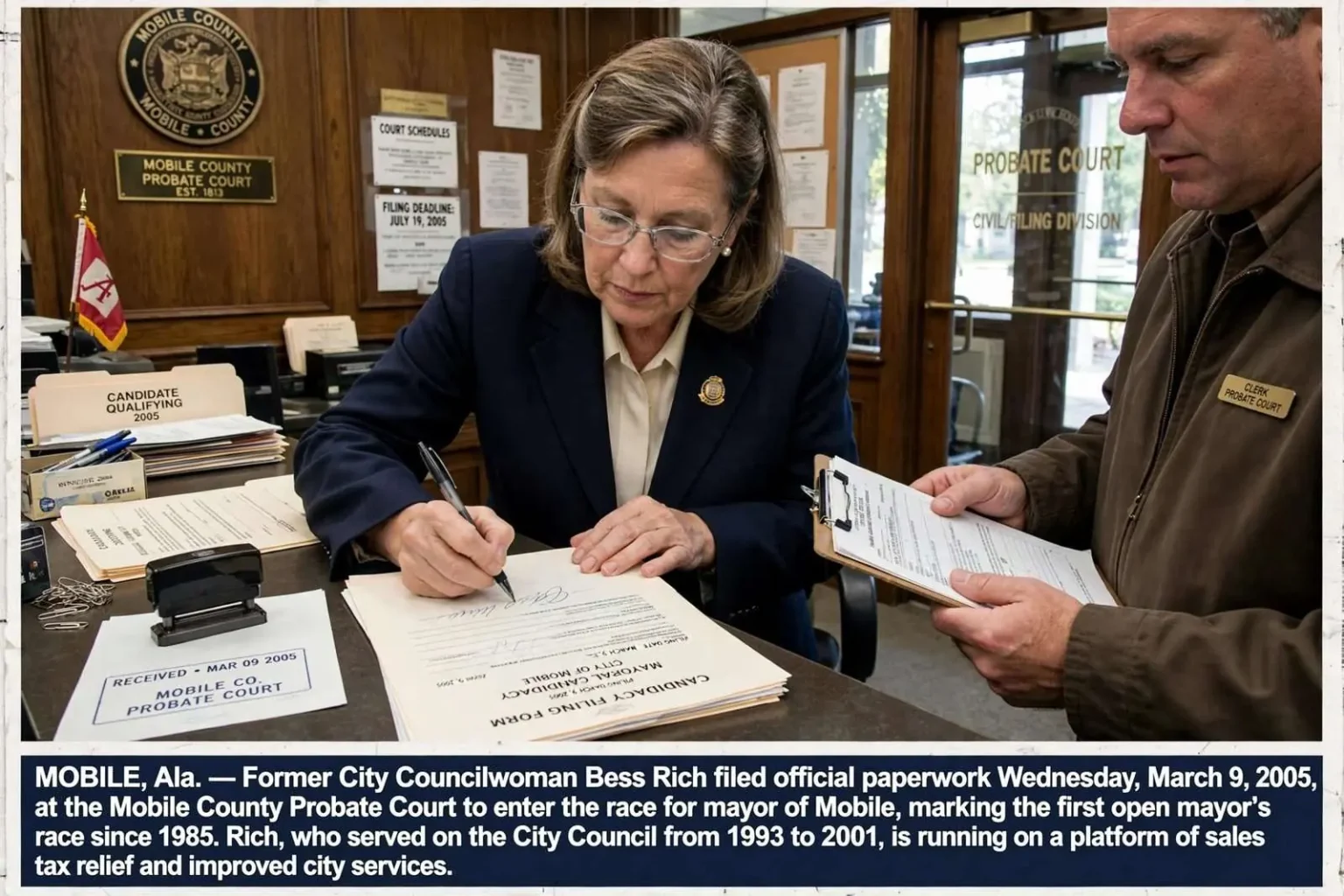
MOBILE — Former City Councilwoman Bess Rich filed the required paperwork in Mobile County Probate Court on Wednesday, March 9, 2005, formally entering the race for mayor of Mobile and converting weeks of confirmed intent into an official candidacy.
Rich, who represented District 6 on the City Council from 1993 to 2001 and who lost to Mayor Mike Dow in the 2001 mayoral race, entered a field that had grown crowded following Dow’s decision not to seek a fifth term. Her return had been widely anticipated among the city’s fiscal conservatives, who had long treated her as their standard-bearer at City Hall.
With Dow stepping aside after two decades at City Hall, the 2005 contest was the first open mayor’s race Mobile had seen since 1985, and it drew candidates from nearly every corner of local politics — a former state senator, a county commissioner, a sitting councilman and a two-term councilwoman turned gubernatorial… turned mayoral hopeful, all convinced the city was ready for a change in direction.
A campaign built on the tax bill
Rich made clear from the outset that the centerpiece of her platform would be the sales tax. She proposed beginning with sales tax holidays and a tax abatement on building materials, arguing that a lower rate would help Mobile grow and retain local businesses rather than watch them drift to outlying areas of Mobile County.
Her argument drew on a familiar pattern in the metro area: shoppers and developers weighing a trip into the city against an easier, cheaper stop in unincorporated Mobile County, where the city’s sales tax levy does not apply. Every percentage point of difference, Rich argued, mattered to the small retailers who anchored neighborhood shopping strips from West Mobile to Tillman’s Corner.
“Putting people first and helping them increase their quality of life” would be the hallmark of her administration, she said, framing tax relief less as an abstraction than as a way to keep families and employers inside the city limits.
She paired that with a promise to rebuild what she called strong core services. “Our city government will move in a new direction through enhanced basic services such as improved public safety and competitive salaries for all city employees,” Rich said. “The need to retain our workforce is essential. Neighbors will want to incorporate/annex when they see our level of services which will uplift our quality of life.”
The argument tied together two of the era’s persistent municipal frustrations: the difficulty of holding on to trained police officers and other public safety workers at Mobile’s pay scale, and the steady migration of residents and businesses into unincorporated county territory.
On the first point, Mobile had watched trained officers leave for suburban departments and higher-paying municipal jobs elsewhere on the Gulf Coast, forcing the city to keep retraining replacements for officers it had already invested in. On the second, annexation had stalled in part because city services did not always seem worth the city tax bill — a calculus Rich proposed to flip by making the services demonstrably better.
Parks, playgrounds and an open door
Rich pointed to her council record on quality-of-life projects, particularly her leadership of the city’s first community-built playground committee, a volunteer effort that produced the Playground Express project and that she said thousands of families had since enjoyed. She pledged to extend that approach to city parks and recreational facilities across Mobile.
The Playground Express effort, which relied on volunteer labor and community fundraising rather than a conventional construction contract, became a model Rich cited whenever she argued that city government could accomplish more by mobilizing residents than by simply spending more of their money. It was, in miniature, the pitch of her entire campaign: civic energy plus fiscal discipline.
On transparency, she cast the trust of citizens in their elected officials as the foundation of good government. As a councilwoman she had sponsored the resolution that put council meetings on television. As mayor, she said, she would hold open-door meetings in each council district, one-on-one sessions intended to let her hear directly about everyday concerns, plus monthly open-door meetings for city employees who wished to raise workforce issues.
The employee meetings were an unusual pledge for a mayoral candidate, and they reinforced her recurring theme that the city’s own workforce — police officers, firefighters, sanitation crews, clerks — was both a constituency and a barometer of how well the city was run.
The people around her
Rich also introduced a campaign organization that leaned heavily on long-tenured Mobilians rather than outside consultants:
Sheri Weber, campaign chairperson — a Mobile resident of 25 years, site coordinator for Out-Reach Services at Providence Hospital and a board member of the Child Advocacy Center.
Chester C. Feagin Jr., treasurer — a retired military officer who served in World War II and the Korean Conflict, working as a public accountant at McKean and Associates.
Caroline “Lea” Ashbee — a Mobile resident since 1959 and retired vice president of Altus Bank, active in the sanctuary choir at Spring Hill Baptist Church.
Wesley Young — a native Mobilian with 27 years in Public Works who had served 14 years as president of the Mobile Sanitation Workers, the largest African-American employees group in the city.
Ed Berger — a U.S. Navy submarine service veteran who retired from Mobile Fire Rescue after 34 years, the last decade of them as chief of the department.
The roster was itself a message. By surrounding herself with a retired fire chief, a sanitation workers’ leader and a hospital outreach coordinator, Rich underlined the argument that her campaign was about the practical machinery of city services rather than the marquee downtown development projects that had defined the outgoing administration.
The team also carried symbolic weight in a city where coalition-building across neighborhoods and employee groups has historically decided mayoral races. A chairwoman from the hospital and child-advocacy world, a treasurer whose service record stretched back to World War II, a bank vice president from Spring Hill, a longtime sanitation union president and the city’s most recent fire chief together signaled a campaign that intended to speak to west Mobile, downtown, the churches and the city’s workforce at the same time.
What came next
Rich said she would announce the opening of a campaign headquarters and the launch of a website in the coming weeks. The city’s municipal elections were set for Aug. 23, 2005, with qualifying closing July 19 and a $500 fee for mayoral candidates.
She joined a field that already included former state Sen. Ann Bedsole, Mobile County Commissioner Sam Jones and District 7 City Councilman John Peavy — a contest that veterans of local politics were predicting would become the most expensive municipal race in the city’s history.
Each of those rivals arrived with a distinct base. Bedsole, a veteran of decades in the Statehouse, brought name recognition and a network built in Montgomery. Jones, a west Mobile county commissioner, carried ties to the fast-growing unincorporated areas Rich hoped to win back into the city. Peavy, the new District 7 councilman, represented downtown-adjacent neighborhoods and had just finished his own campaign for the council seat.
Rich’s lane was the fiscal-conservative wing — the voters who had applauded her council fights over spending, her insistence on televised meetings and her skepticism of big-ticket development incentives. Her challenge was to broaden that base beyond District 6 and the tax-conscious precincts of west Mobile without diluting the message that made her candidacy distinctive.
Political observers expected the sales-tax question to hang over the entire race. Whoever won would inherit a budget that, like most growing Sun Belt cities of the era, leaned heavily on sales tax collections that rose and fell with retail activity — and every candidate would be pressed to explain how the city could fund better pay for police, fire and public works while simultaneously promising relief at the register.
The Aug. 23 vote would require a runoff between the top two finishers unless one candidate cleared 50 percent, meaning the March-through-July stretch of the campaign was largely about building the coalitions — neighborhood associations, employee groups, business circles and church networks — that would decide who advanced to the fall.
Qualifying itself carried its own hurdles. Candidates had to file with the Mobile County Probate Court, pay the $500 fee by the July 19 deadline and assemble the petition paperwork that formalized their slates. Rich’s Wednesday filing checked every box weeks ahead of the deadline, giving her organization the longest runway of the announced field to raise money, print materials and lock down endorsements before the summer push.
For Rich, the March filing was the moment weeks of speculation became an actual campaign: headquarters to open, a website to launch, a payroll of volunteers to organize and a crowded field of heavyweights to outlast. The fiscal conservative standard-bearer was back on the ballot, and this time the mayor’s chair she had chased in 2001 was genuinely open.