Armed Robbers Hit Food Mart Steps From Mobile Police Headquarters
Two armed men robbed a Government Street food mart located diagonally across from Mobile Police headquarters in an early-morning holdup.
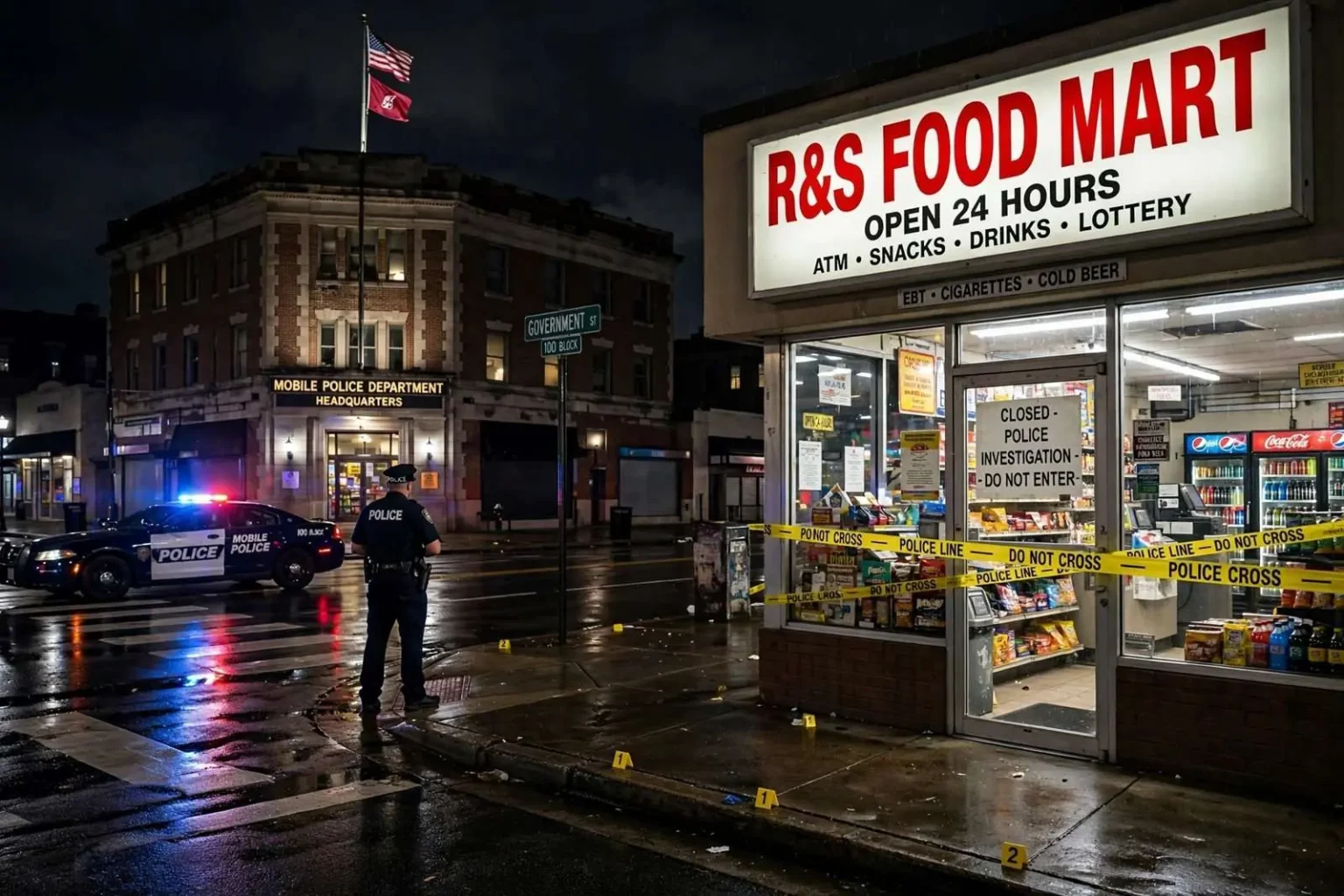
An early-morning armed robbery at a Government Street food mart drew attention in Mobile largely because of its location: the store sits diagonally across the street from Mobile Police Department headquarters.
Officers were called to R&S Food Mart around 2:12 a.m. after a report of a robbery in progress, according to a Mobile Police spokesman. Despite the store’s proximity to headquarters, officers still had to respond to the call like any other in the city.
That detail — a holdup minutes from the department’s main office — quickly became the story’s hook, and it is easy to see why. The image of an armed robbery unfolding within sight of police headquarters sounds like a contradiction, but the reality of patrol work is more mundane: headquarters buildings house administrators, detectives and support staff rather than a rapid-response force watching the street, and a 911 call from across the street is dispatched through the same channels as a call from across the city. Response time depends on where the nearest unit happens to be, not on the address of the department’s front door.
According to police, two unidentified men armed with handguns entered the store and demanded cash from the register before fleeing the scene. No injuries were reported in connection with the robbery, and police continued gathering information in the hours after the incident.
The fact that no one was hurt is the closest thing to good news in the incident, but the mechanics of the crime — two armed suspects, a late-night retail target, a fast exit into the dark — describe the pattern police in cities across the country know well. Convenience-style stores, open late with limited staff and cash on hand, have long been among the most frequently targeted businesses for armed robbery, and the hours around 2 a.m. are among the highest-risk.
The robbery echoed a similar incident from roughly a year earlier, when two men robbed a fast food restaurant located across the street from the same police headquarters building. That earlier case highlighted a pattern of robbers targeting businesses in the immediate vicinity of the department’s main office, despite the obvious law enforcement presence nearby.
Two similar crimes in the same small footprint within a year suggests something more deliberate than coincidence, or at least something structural. Businesses clustered near a police headquarters sit on busy, well-lit corridors with steady overnight traffic of their own — customers leaving late shifts, drivers passing through downtown — and robbers may count on the same traffic for escape as well as opportunity. Proximity to police, in other words, cuts both ways, and the merchants around headquarters live with both sides of that equation.
The 2:12 a.m. call also falls in one of the most vulnerable windows of the retail day. Stores open around the clock or into the small hours typically run with a single clerk overnight, and the hours between midnight and dawn combine thin staffing, cash accumulation from the evening’s sales and minimal legitimate foot traffic — conditions that armed robbers have exploited for as long as such stores have existed. The clerk at R&S Food Mart faced two handguns in a matter of seconds, and handing over the register’s cash was, as police always advise in such encounters, the choice that meant everyone went home uninjured.
The investigation
Mobile police asked anyone with information about the robbery to come forward, a standard request in cases where suspects flee before officers arrive and description details remain limited.
Those public appeals are more than ritual. In commercial robberies where the suspects wear their faces covered and the encounter lasts only minutes, the evidence trail often runs through the community — a resident who saw two men running from the store, a driver who noticed a car idling behind the building, a worker on an early shift who noticed something out of place. Investigators in cases like this routinely ask neighboring businesses and overnight regulars for anything they noticed, because a robbery that lasts two minutes still has to begin and end somewhere visible.
Investigators typically review any available surveillance footage from the business and surrounding area as part of the follow-up investigation. By the time of this robbery, camera coverage along commercial corridors like Government Street had become a standard part of virtually every retail security setup, and footage from the store itself — plus any cameras on nearby businesses or residences facing the street — forms the backbone of the early investigation. Detectives use those images to establish the suspects’ route in and out, the direction of flight, and any vehicle involved, all of which narrow the search even when the store’s own cameras never get a clear look at a face.
The Government Street corridor near police headquarters includes a mix of retail and food service businesses that serve both nearby residents and employees working in and around downtown Mobile. Overnight robberies at convenience-style stores remain a recurring challenge for retailers that operate late hours in the area.
For the merchants themselves, each incident restarts the same calculations. Storeowners weigh the revenue that late-night hours bring against the risk, adjust their cash-handling practices, add cameras or lighting, and in some cases shorten their hours altogether. Industry data consistently shows that visible security measures and limited accessible cash reduce a store’s appeal as a target, but no measure eliminates the risk entirely — which is why retailers along the corridor follow each arrest in the neighborhood’s robbery cases with particular interest.
Police response to commercial robbery is built around speed first and reconstruction second. The first officers on scene secure the store, check for injuries and broadcast a description of the suspects to units in the surrounding area, since a pair on foot or in a vehicle can put several blocks between themselves and the scene within minutes of a 2 a.m. getaway. Canvassing starts immediately: officers knock on doors of neighboring businesses and residences, and the department’s night-shift units are alerted to watch for anyone matching the description. Only after that immediate net comes up empty does the slower work of detectives and surveillance footage take over the case.
Mobile Police continued investigating the robbery in the days that followed, with the department’s proximity to the crime scene prompting renewed conversation among residents about safety along that stretch of Government Street.
Those conversations are part of a longer story. Government Street is one of Mobile’s oldest and most storied corridors, running east from downtown through historic neighborhoods that have seen decades of change in their commercial strips. The blocks around police headquarters sit at the western end, where government buildings, offices and small businesses share the street, and the character of the corridor shifts block by block. When crimes cluster there — even minor ones, even without injuries — residents and business owners notice, and the question that surfaces is always the same: what does safety on this street actually look like?
For the neighborhood, the location of the robbery also became a lesson in how law enforcement presence actually works. Residents who assumed the headquarters functioned as a kind of security umbrella learned what officers know: the building is an office, not an outpost, and patrol coverage of any street depends on the units assigned to the area rather than the address of the department’s administration. That gap between perception and reality is part of what the renewed conversation about the corridor has been about — not whether police care about Government Street, but what resources the businesses there can count on between the hours when these crimes happen.
Police departments generally answer that question with a mix of patrol presence, business outreach and follow-up investigations rather than a single fix. Increased visibility around the corridor in the weeks after a high-profile robbery is typical, as is direct contact between officers and the stores most at risk — reviewing camera angles, lighting, cash practices and reporting habits. The department’s own location on the street is, ironically, an asset in that work: supervisors and detectives pass the businesses daily, and the store that was hit sits within sight of the people investigating who hit it.
What the two cases a year apart actually demonstrate is less about police failure than about the persistence of armed robbery as an economic crime. The suspects in this case, like the pair in the earlier restaurant robbery, chose a target for its cash and its hours, not for its address on the map. The irony of the location will drive the headlines, but the investigation will proceed the way all of these cases do — camera by camera, witness by witness — until the description of two unidentified men with handguns becomes the name and picture of whoever held up the register at R&S Food Mart at 2:12 in the morning.