Alabama Music Box Responds to Eviction Notice, Vows to Stay Open
Alabama Music Box owner Dave Mathews reassured fans that the downtown Mobile live music venue would stay open despite an eviction notice.
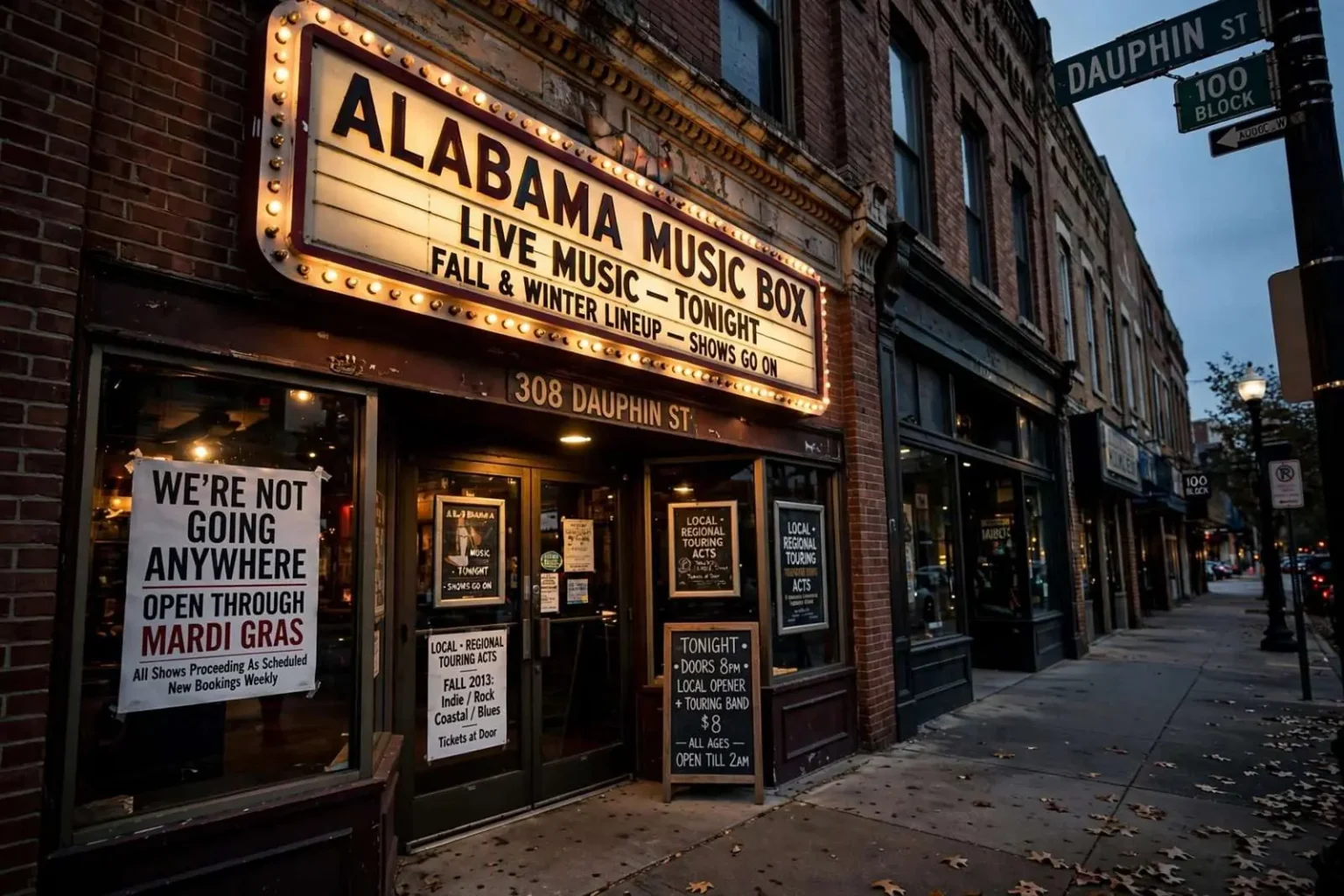
The Alabama Music Box, a beloved live music venue on Dauphin Street in downtown Mobile, addressed reports in September 2013 that the establishment had been served with an eviction notice, with owner Dave Mathews moving quickly to reassure patrons and performers that the venue would remain open and fully operational.
News of the eviction filing had raised immediate questions about the future of one of the anchors of Mobile’s downtown entertainment district, where the venue had built its reputation hosting local, regional and touring acts in the heart of the city’s nightlife corridor. Mathews’ response, delivered within days of the reports, was aimed squarely at stopping any speculation that the music would stop.
Business as usual despite eviction filing
In a statement responding to the eviction notice, Mathews said the situation was far less dire than it might have appeared. According to Mathews, a buyer was in the process of purchasing the building and intended to keep the Alabama Music Box in place until it could transition to a new location. “We’re not going anywhere,” Mathews said, adding that the venue planned to remain at its Dauphin Street location through at least Mardi Gras.
He emphasized that all scheduled shows would go on as planned and that the venue was continuing to book new acts, signaling that the legal wrangling over the building would not disrupt the calendar that performers and fans had come to rely on. For touring bands routing shows through the Gulf Coast and for local acts counting on a dependable stage, that assurance carried real weight — a mid-season venue closure can strand bookings across an entire region’s circuit.
The promise to stay through at least Mardi Gras tied the venue’s future to Mobile’s most demanding stretch of the calendar. The Carnival season fills downtown Dauphin Street with revelers night after night, and for music venues along the corridor the weeks of parades and balls represent some of the highest-traffic dates of the year. Committing to remain open through that period was, in effect, a commitment not to abandon the season that sustains downtown nightlife.
An ambitious fall and winter lineup
Rather than scaling back operations, Mathews indicated that the Alabama Music Box was doubling down on its programming. He described the upcoming fall and winter lineup as “incredible” and “getting better by the week,” with additional announcements expected in the days ahead. The posture was deliberate: rather than retreating while the building’s ownership sorted itself out, the venue would compete for audiences as if nothing had changed.
The Alabama Music Box had established itself as a key part of Mobile’s live music scene, hosting a wide range of local, regional, and touring acts in the heart of the city’s downtown entertainment district. Venues of its kind serve as incubators as much as concert halls — the rooms where a local band plays its first full sets, opens for passing regional tours and builds the following that carries it to bigger stages.
Dauphin Street itself has long been the center of gravity for downtown Mobile nightlife, a stretch of blocks where bars, restaurants and music rooms sit within walking distance of one another and feed off the same foot traffic. A disruption at a long-running venue ripples through that ecosystem, affecting not just the club’s own bookings but the after-show crowd at neighboring businesses and the habits of musicgoers who plan their nights around the street.
What the eviction filing meant — and didn’t
Eviction notices against commercial tenants are more common than the headlines they generate, and they do not always end in a locked door. A filing can be the opening move in a lease dispute, a negotiating position during a change of ownership, or a technical step taken while a sale is being finalized. Mathews’ account — that a buyer was acquiring the building and wanted the venue to remain until a new location was ready — suggested the notice sat in exactly that category: a piece of a real estate transaction rather than the beginning of the end.
Still, the episode illustrated how fragile a music venue’s footing can be. Clubs operate on thin margins and short leases, and when the property beneath them changes hands, the music business rarely controls the real estate business. A venue’s survival through an ownership change depends on the goodwill of buyers, the flexibility of landlords and the venue’s own ability to relocate — a costly prospect for a room whose character is built into its walls.
For Mobile audiences, the immediate takeaway from Mathews’ statement was practical: shows already on the calendar would proceed, and the venue would keep adding dates. For performers, it meant contracts made with the Alabama Music Box could still be counted on through the fall, winter and Carnival season, the most valuable booking window on the downtown calendar.
Why downtown venues matter to Mobile’s music community
The venue’s response to the eviction notice reflected a determination to continue serving as a gathering place for the Mobile music community even as it navigated an uncertain real estate situation. That community — players, sound engineers, booking agents and the regulars who come out on weeknights — depends on a small number of rooms that will take a chance on original music, and every one of them that closes takes years of accumulated scene-building with it.
Downtown venues also play a role in the broader revitalization story that Mobile has pursued along Dauphin Street and the surrounding blocks. Live music draws crowds after dark, and after-dark crowds support the restaurants, bars and parking operations that make a downtown viable in the evening hours. Cities that lose their music rooms tend to see the effect first in the quieting of the streets around them, which is why the fate of a single club can matter well beyond its own doorway.
By promising continuity — through Mardi Gras and into whatever new location the future held — Mathews framed the eviction notice as a chapter rather than a conclusion. Whether the venue ultimately moved or stayed, the message to Mobile’s musicians was that the stage would still be there, and that the bookings on the fall and winter calendar were safe. In the economy of a local music scene, that kind of predictability is often the difference between a scene that thrives and one that scatters.
How Mobile’s club circuit has evolved
The Alabama Music Box arrived in a city whose live music infrastructure had thinned and rebuilt itself repeatedly over the decades. Mobile’s nightlife history runs from the big-band ballrooms of the mid-twentieth century through the rock clubs of the 1980s and 1990s to the present-day mix of bars, theaters and dedicated music rooms concentrated downtown. Each era leaves behind a handful of rooms that defined it, and each generation of musicians has depended on whoever kept the doors open at the time.
Clubs on Dauphin Street and nearby blocks compete for acts with venues across the Gulf Coast, from Pensacola to Biloxi, and bookers in the region operate as an informal circuit: a band that plays Mobile on a Thursday can often be routed through the coast on Friday and New Orleans on Saturday. That geography is part of what makes a downtown Mobile room valuable to touring acts — the city sits squarely on the route between Florida Panhandle college towns and the New Orleans market, and a well-run venue with a dependable sound system and a drawing crowd becomes a regular stop on regional tours.
For local bands, the value runs the other direction. A room that hosts original music four or five nights a week gives homegrown acts the stage time they need to develop — to learn how to hold a crowd, to test new material and to build the mailing list and social following that turn a hobby into a career. Scenes with fewer such rooms produce fewer working bands; that arithmetic is well understood by everyone involved in booking live music on the Gulf Coast.
Reading a real estate fight from the outside
For the average patron, disputes over a venue’s lease are invisible until they aren’t. The paperwork — notices, filings, sale agreements — happens in offices and courtrooms, while what the public sees is whether the marquee still lists shows. That gap is why an owner’s public statement carries so much weight in these situations: it is the only channel through which the venue can explain that the noise over its head does not signal silence inside.
Mathews’ decision to address the reports directly, and to pair reassurance with specifics — a buyer in the works, a commitment through Mardi Gras, a growing lineup — followed the pattern that serves venues best in a real estate crisis. Silence invites rumors, and rumors in a music community can empty a calendar faster than any landlord. The statement also served the buyer’s interest, since a venue that keeps operating keeps a building’s street-level space productive during the transfer.
The September reports and the response to them captured a recurring tension in downtown revitalization: the same rising property values that signal a district’s health can price out the very establishments that made the district worth visiting. Music venues are frequently among the first casualties when a neighborhood’s buildings change hands, because their business models depend on affordable rents and late-night hours that new owners may not welcome. Whether the Alabama Music Box ultimately stayed on Dauphin Street or found a new home, the episode was a reminder that a city’s cultural life depends on more than buildings — it depends on the people willing to fight to keep the music playing through the disruption.