Reward Offered in Search for Mobile Armed Robbery Suspect
Mobile police are offering up to $1,000 reward for information identifying a man suspected in a string of armed commercial business robberies.
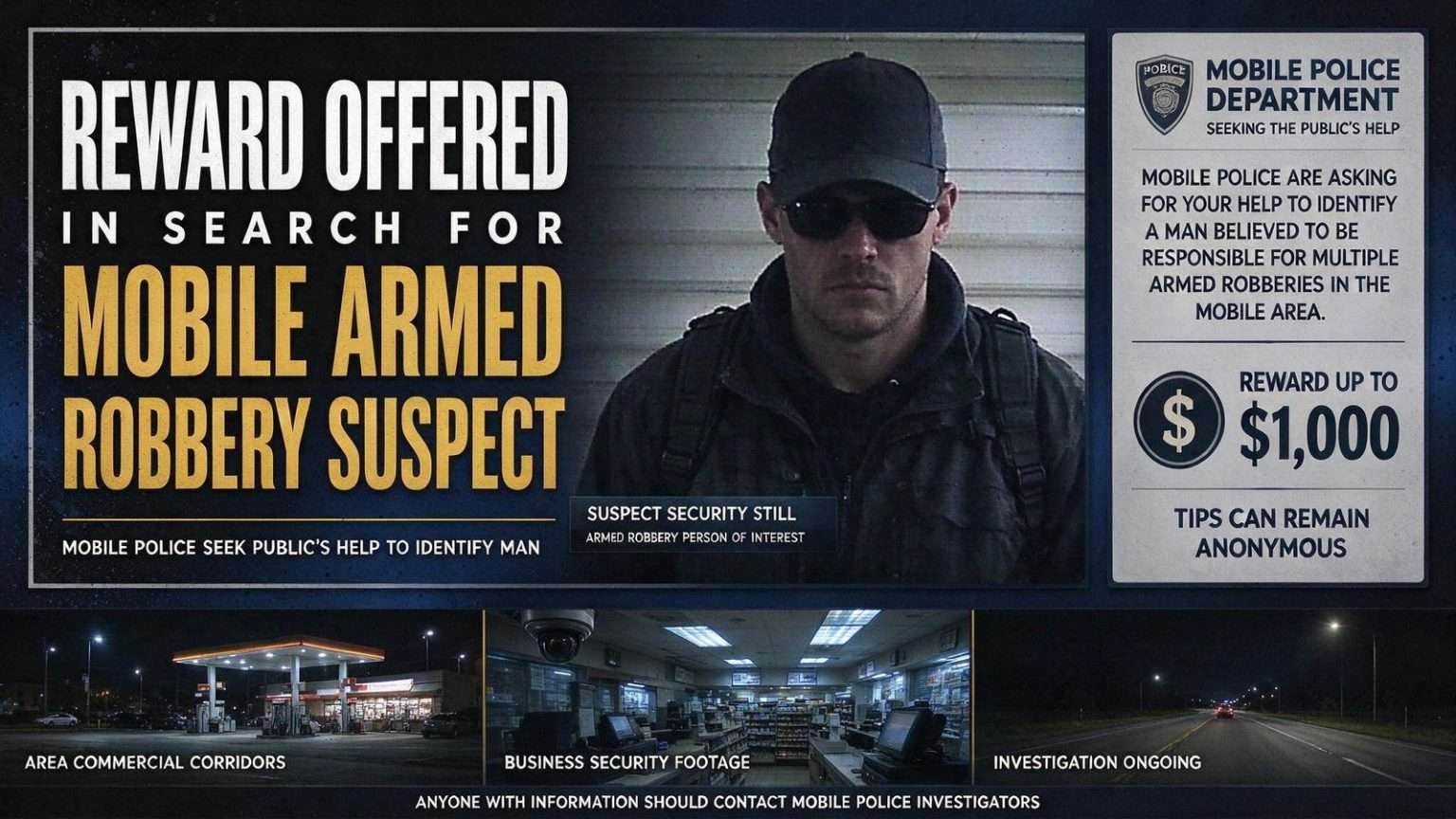
Mobile police are asking the public for help identifying a man suspected of robbing multiple businesses at gunpoint, and they’re offering a reward of up to $1,000 to anyone who can provide his identity. The appeal marks the department’s latest effort to enlist residents in tracking down an armed suspect who has remained at large despite an active investigation.
Investigators released a still image showing a man wearing a hat and sunglasses, believed to be connected to at least three armed robberies of commercial businesses in the Mobile area. The image, drawn from security camera footage, is the kind of evidence that often anchors an armed-robbery investigation: grainy, partial, and dependent on someone recognizing a face, a build or a set of clothing that a camera cannot identify on its own.
Police spokesman Officer Terence Perkins said detectives have tied the same suspect to each of the incidents, though authorities have not publicly disclosed which specific businesses were targeted. Investigators frequently hold back details like locations and exact dates in the early stages of a serial-robbery case, both to protect the integrity of the investigation and to avoid compromising the accounts of witnesses who may still come forward.
How the investigation is running
The Mobile Police Department said anyone with information about the man’s identity or whereabouts should contact investigators directly. Officials emphasized that tipsters can remain anonymous, a common practice in cases involving an at-large armed suspect. Anonymity matters: people who recognize a suspect often know him from the neighborhood, the workplace or the family circle, and the promise that their names will not surface lowers the barrier to calling.
Anonymous tip programs have become a staple of Gulf Coast law enforcement for exactly this reason. Rewards are typically paid only when a tip leads to an arrest or a credible identification, and tip lines are set up so that callers receive reference numbers rather than identities on file. The $1,000 ceiling on the Mobile reward is in line with amounts typically offered in commercial robbery cases, where the goal is generating leads rather than compensating risk.
Detectives working a string of armed robberies generally pursue several tracks at once: canvassing the area around each targeted business for cameras and witnesses, comparing timestamps and suspect descriptions across cases, checking whether similar robberies have been reported in neighboring jurisdictions, and running the released image through the channels most likely to produce a name. Each new tip either advances that work or eliminates a possibility, which is why investigators describe even partial information as useful.
What businesses are up against
Commercial armed robberies remain a persistent concern for small business owners across Mobile, who often bear both the financial loss and the safety risk of an armed confrontation during a robbery. For a neighborhood convenience store, gas station or late-night restaurant, a single robbery can mean thousands of dollars in losses, employee trauma and a customer base that stays away long after the incident is over.
Police have periodically used public reward offers in similar cases as a way to generate leads when physical evidence alone hasn’t been enough to identify a suspect. Guns leave little trace in a robbery unless they are recovered, and a suspect who covers his face defeats even good camera systems — leaving the public, which may include someone who recognizes the man’s walk, build or clothing, as the most promising source of identification.
Investigators have not said whether they believe additional businesses may have been targeted by the same suspect beyond the incidents already under investigation, and the case remained open as detectives continued working leads generated by the release of the suspect image. Serial robbers frequently escalate or repeat their patterns until they are caught, which is why police treat each new armed robbery report as potentially connected until evidence says otherwise.
What business owners can do
Business owners in the area are encouraged to review their own security camera footage from recent weeks and report anything suspicious to police, even if it seems unrelated to the specific robberies under investigation. A customer lingering outside during closing hours, a vehicle that appears in footage near several separate incidents, or a face caught at a different angle than the released image — all of it can matter when detectives are trying to connect or distinguish cases.
Mobile police have said in the past that patterns in armed robbery cases often only become clear once multiple business owners compare notes. A robber tends to work a familiar geography — the same commercial corridors, the same times of night, the same type of register — and the businesses he hits may be blocks apart, each assuming its incident was isolated. Sharing information through merchant associations, neighborhood watch groups and precinct meetings is how those dots get connected.
Security consultants who work with small retailers generally recommend a handful of measures that cost little but matter in an armed robbery: keeping cameras trained on entrances and registers with timestamps set correctly, maintaining good exterior lighting, keeping cash on hand limited with posted notices saying so, and training employees to comply rather than resist during a holdup. None of it prevents every robbery, but it protects workers and improves the evidence investigators have to work with afterward.
Why the public’s role matters
Armed robbery is among the most serious property crimes in Alabama, and convictions carry lengthy prison exposure because of the weapon involved. That severity cuts both ways: it gives suspects a strong incentive to keep avoiding identification, and it gives residents a strong reason to help police end the pattern before someone is hurt. In commercial robberies, the most common path to an arrest is not a forensic breakthrough but a phone call — someone in the suspect’s orbit recognizing the image and tipping off detectives.
The department’s appeal also reflects the realities of modern policing volumes. Detectives carry multiple open cases at once, and a string of robberies with no injuries competes for attention with crimes that do leave victims hurt. A well-publicized image and a reward concentrate the public’s eyes on the problem in a way no amount of detective work alone can match.
For now, the suspect remains unidentified, the businesses involved have not been named, and detectives continue to process tips as they come in. Anyone who recognizes the man in the released image — the hat, the sunglasses, the build — is asked to contact Mobile police investigators directly. Callers can remain anonymous, and a tip that produces an identification could be worth up to $1,000, along with the removal of an armed man from the streets of the city.
The landscape of commercial crime in Mobile
Armed robbery of businesses is not a new problem in Mobile, and the city’s commercial corridors — the stretches of Government Street, Airport Boulevard, Spring Hill Avenue and the arterials around them where small stores and late-night operations cluster — have long been the settings for such crimes. Police district commanders regularly list commercial robbery among the offenses they watch most closely, because it combines direct financial harm with the ever-present risk of violence to clerks and customers who happen to be behind the counter when a gunman walks in.
The timing of robberies tends to follow predictable rhythms: late evenings and early mornings, when cash has accumulated and staffs are thinnest. Stores open around the clock, convenience stores, and businesses near highway interchanges are frequent targets precisely because they are accessible when few witnesses are around. That predictability is also what helps police, since concentrating patrols on the hours and corridors where robberies cluster has repeatedly proven effective at interrupting a suspect’s pattern.
The release of a suspect image to the news media and the department’s social channels is now a standard step in Mobile robbery investigations. Videos and stills that once circulated only among detectives now reach thousands of residents within hours, and the comments and shares that follow routinely produce the first usable leads. Investigators balance that reach against the risk of misidentification, asking the public for tips rather than confrontation — leave the identifying to police, the department’s guidance makes clear, and do not approach the suspect.
What happens after an arrest
If a tip produces an identification, the case will move through the standard machinery: an arrest warrant or apprehension, an interview in which detectives seek confessions linking the suspect to each of the connected robberies, and presentation of the cases to the district attorney’s office for prosecution. Because the suspect has been tied to at least three separate incidents, prosecutors could bring multiple counts, a structure that increases potential prison time and strengthens their hand in plea negotiations.
Victims — in these cases, the businesses and their employees — are typically kept in the loop as the case progresses, since witness identifications and employee testimony remain central even in a camera-recorded robbery. Store owners whose shops were hit often report that the legal process’s slow grind is its own burden, another reason investigators emphasize catching a repeat offender quickly.
Until then, the case stays open, and the $1,000 reward stays on the table. Residents with any information are urged to come forward, anonymously if they prefer, and business owners to keep reviewing their footage. A serial armed robber is only as safe as his anonymity, and Mobile police are asking the public to take that away.