Overnight House Fire on Mobile’s Poplar Street Leaves One Dead
A fire at a makeshift dwelling on Poplar Street in Mobile left one person dead overnight, with fire officials awaiting an autopsy to confirm the victim's identity.
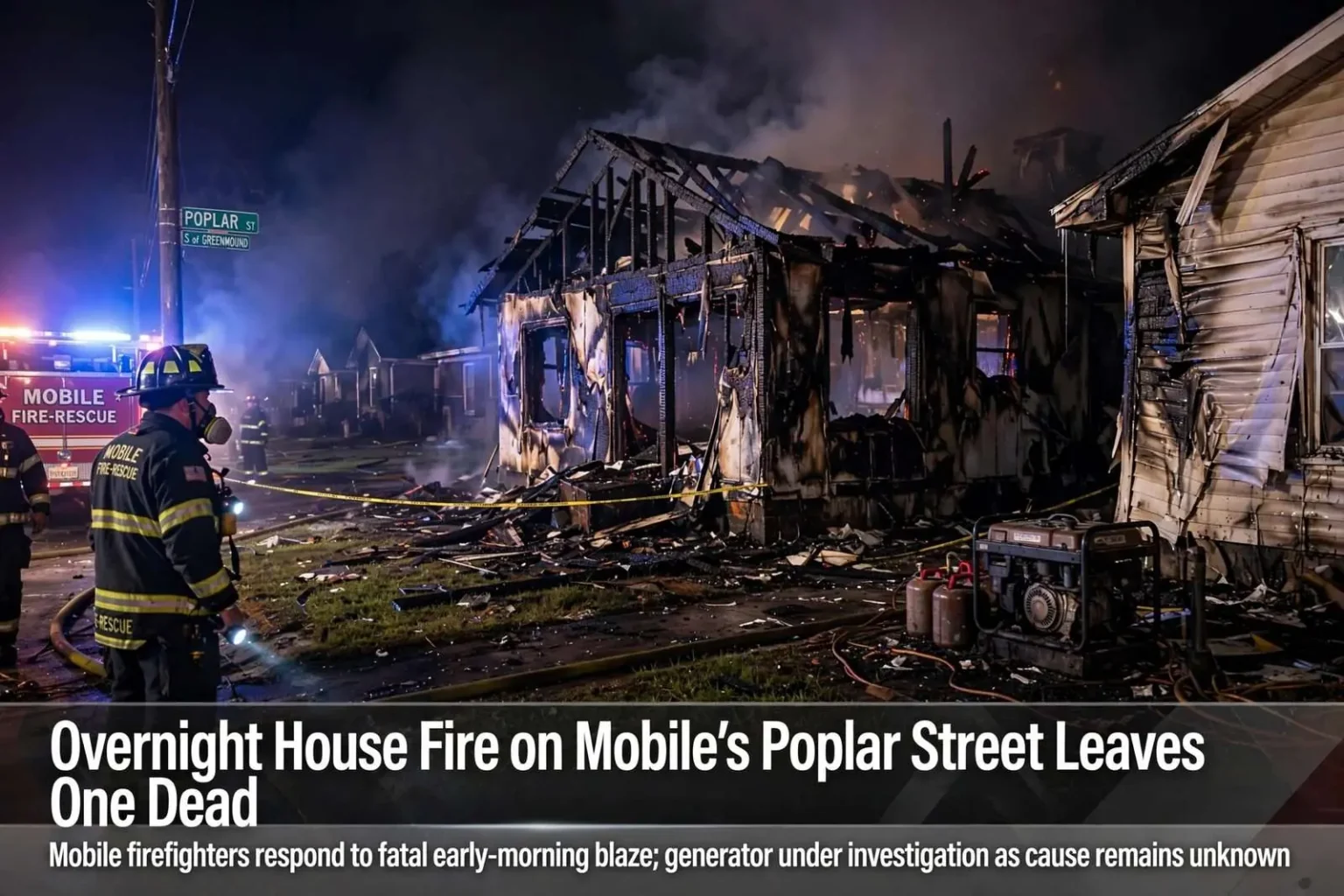
Mobile firefighters responded to a fatal house fire in the early morning hours on Poplar Street, south of Greenmound, after neighbors reported hearing someone trapped inside as flames spread through the structure. The call came in just after 1:30 a.m., according to a Mobile Fire-Rescue Department spokesman, sending crews to a residential block where the darkness was broken by fire coming through the home.
Neighbors told fire investigators they were alerted to the blaze and could hear a person inside the dwelling before firefighters arrived. By the time crews reached the scene, the fire had grown intense enough that flames burned hot and fast, and officials said the heat melted siding on a neighboring house, underscoring just how hot the blaze burned by the time the first engines arrived.
One person was found dead inside the home. An autopsy was planned to formally confirm the identity of the victim, and the cause of the fire remained unknown as investigators began their work.
A home with no utility connections
The home had no utilities connected, and investigators later found a generator on the property that the resident had likely been using to power the house. That detail has become a central thread of the investigation, because portable generators bring their own hazards: fuel storage, hot exhaust, electrical connections that are never designed for long-term use, and carbon monoxide that can build up quickly in enclosed spaces.
According to fire officials, the homeowner had been in the process of rebuilding the structure following an earlier fire that damaged the property about a year before. The dwelling described by neighbors as makeshift reflected that ongoing rebuilding effort, complicating both the firefighting response and the aftermath investigation. Makeshift construction can hide void spaces where fire travels unseen, and it can leave crews without the floors, walls and exits they expect when they push into a burning structure.
The combination of an off-grid power source and a structure still under reconstruction is exactly the scenario fire officials warn about most. A house without connected electrical service will not have wired smoke alarms, and battery-powered alarms only help if they are maintained. In the pre-dawn hours, when residents are asleep and visibility is low, a fire that starts near a generator or a fuel can can reach the interior before anyone inside knows it has started.
How the investigation will proceed
Mobile Fire-Rescue crews worked to determine how the fire started and whether the generator or another source played a role. Investigators typically examine burn patterns, electrical connections and any fuel sources on scene when determining a fire’s origin, a process that can take days or weeks to complete, particularly when a fatality is involved. The autopsy is expected to help establish whether smoke inhalation or another cause led to the death, which in turn narrows the timeline investigators must reconstruct.
Origin-and-cause work is methodical by design. Investigators map where the fire burned hottest and longest, look for the telltale V-shaped patterns that point back toward a point of origin, and rule out accidental causes one by one before they consider anything else. When a generator is present, they will examine its placement relative to the structure, the condition of any cords or connections, and where fuel was stored. Findings are rarely announced in the first days, and officials caution against conclusions drawn before the physical evidence has been fully documented.
A nighttime response
Fighting a house fire at half past one in the morning presents challenges that daytime calls do not. Darkness slows every step, from spotting the seat of the fire to moving hose lines across unfamiliar yards, and the closed-up conditions of a sleeping household mean the fire breathes the moment a door or window is opened. Crews arriving on Poplar Street would have had to account for all of that while working a structure already described by neighbors as makeshift, with an active rebuilding effort inside that no responding firefighter could know in advance.
The fact that neighbors could hear a person inside speaks to how quickly the situation escalated. Residential fires double in size in a matter of minutes, and modern furnishings burn hotter than older materials did. Crews arriving to heavy fire with reports of someone trapped face the hardest calculus in the fire service, balancing an aggressive interior attack against the structural conditions in front of them.
The wider problem of generator safety
Fire officials across the Gulf Coast have spent years warning residents about the risks that come with portable generators, which become common after hurricanes and outages and sometimes never leave the property once they arrive. The basic guidance is consistent: run a generator outdoors, well away from windows, doors and vents; never refuel a hot engine; keep fuel in approved containers away from the house; and use heavy-duty cords rated for the load rather than daisy-chained household extension cords.
The warnings matter most for residents who rely on generators not as storm backup but as everyday power, as investigators believe was the case on Poplar Street. Structures without standard utility connections also tend to lack the wired smoke alarms and updated breaker panels that give occupants early warning and that limit electrical fires before they spread. Safety advocates urge anyone living that way to keep battery-powered smoke alarms on every level, to store fuel away from sleeping areas, and to have an escape plan that works in the dark.
A string of residential fires
The Poplar Street fire adds to a string of residential fires that have drawn attention from Mobile Fire-Rescue in recent months, with officials continuing to urge residents relying on generators or other alternative power sources to follow safety guidelines to reduce fire risk, especially in structures without standard utility connections. Each fatal fire renews the department’s push to get the message out, and each one also weighs on the neighborhoods where they happen.
The Poplar Street area south of Greenmound is a patch of older residential blocks where many homes have seen additions, repairs and renovations layered on over the decades. In a city where housing stock runs old, fire officials repeatedly stress that the first minutes of a fire belong to the people inside it: working alarms, clear exits and a plan rehearsed in daylight are what buy the time that engines cannot.
Neighbors, too, have a role that the Poplar Street calls made plain. It was nearby residents who heard the trouble and called it in, and officials encourage anyone who sees a neighbor living with hazardous conditions, whether that is a generator running against the house or fuel stored on a porch, to raise the concern before it becomes a 1:30 a.m. emergency. Fire departments would far rather answer a question about safety than a report of someone trapped.
What remains unknown
For now, much about the fire remains unanswered. The victim’s identity awaits the autopsy, the point of origin has not been determined, and investigators have not said whether the generator will be found to have started the blaze or simply been part of the scene. What is known is the sequence that residents described: an ordinary weeknight, a fire that spread fast enough to melt siding next door, and a person whose cries for help were heard but not reached in time.
The investigation will produce its findings in its own time, and Mobile Fire-Rescue has asked anyone with information about the home or the fire to come forward. In the meantime, the department’s standing advice applies to every household on the street and beyond it: keep smoke alarms working, keep generators outside and away from the structure, and treat every fire warning in the night as real until proven otherwise. The Poplar Street fire is a reminder of how little margin exists when any of those lines of defense are missing.
Fires like this one also land hard on the crews who run them. Mobile firefighters train for exactly this kind of call, a working fire in a compromised structure with a reported person inside, but the outcome on Poplar Street is the one every department hopes to prevent. Crews will carry the details of the scene into the review that follows every fatal fire, looking for anything in the response that can be tightened before the next alarm.
The loss also puts a familiar name on a long list. Fire officials note that fatal residential fires cluster in the same conditions time after time: late at night, in older structures, in homes without working alarms or connected utilities. Breaking that pattern, they say, is less about any single investigation than about the small precautions taken across thousands of kitchens and porches every day.
For the neighborhood, the work ahead is quieter: the reconstruction of a home that was already being rebuilt once, the questions that come with an unexplained death, and the small changes in habit, an alarm replaced, a generator moved, a cord thrown out, that officials hope will follow from what happened on Poplar Street in the dark hours of that morning.