
Mobile County Urges Businesses to Prepare Now for Hurricane Season
As hurricane season continues, Mobile County officials are urging business owners to build continuity plans, review insurance coverage and use Ready Business toolkits to prepare for storms, floods, power outages and severe wind.
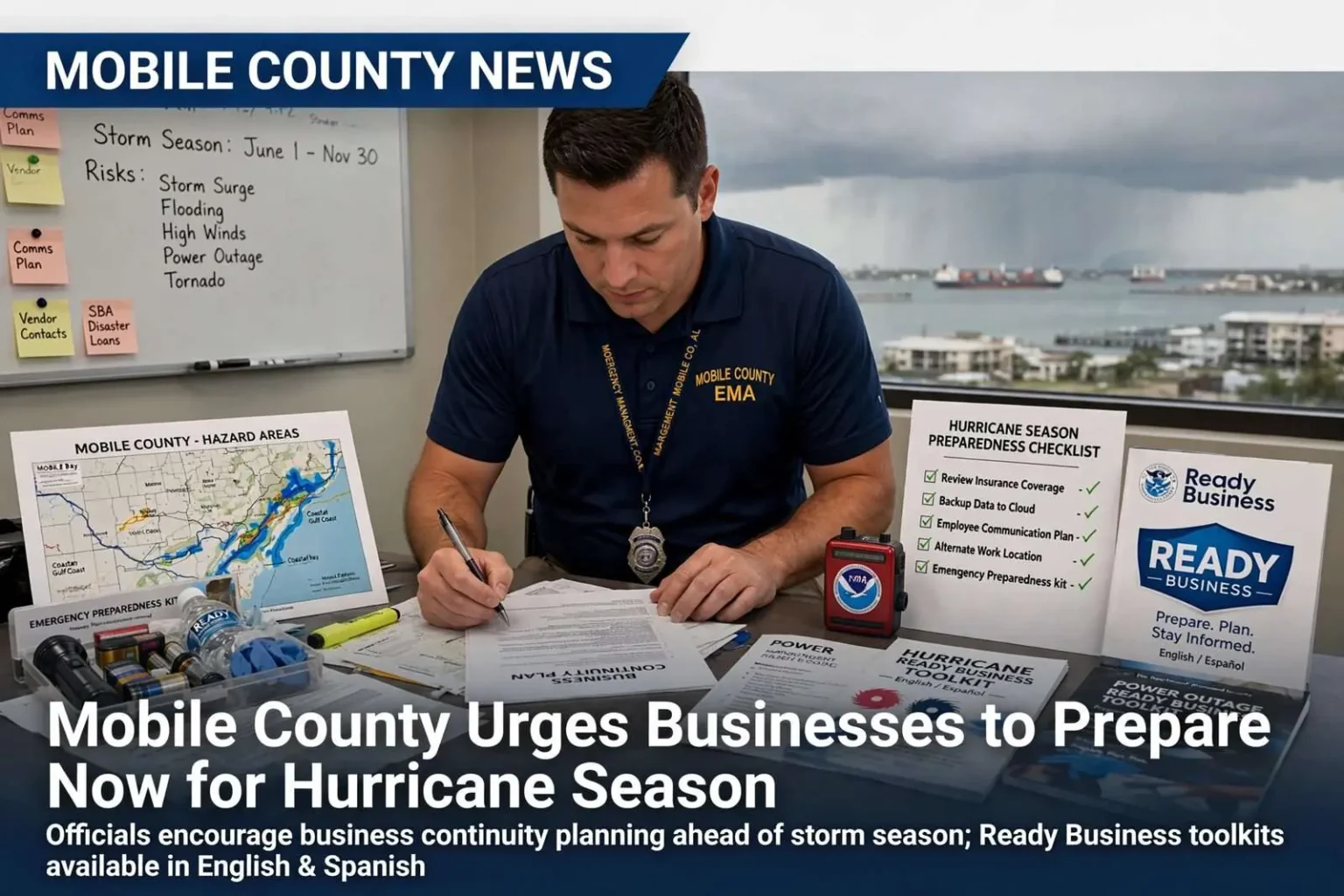
With hurricane season underway along the Alabama Gulf Coast, local emergency preparedness officials are reminding Mobile County business owners that planning ahead can make the difference between a quick reopening and a prolonged shutdown after a storm. A business continuity plan, they say, can help a company resume serving the community as soon as possible once a disaster hits, and there are financial resources available for businesses that suffer damages. Mobile County is considered at risk for a range of hazards tied to tropical weather, including heavy rain, strong winds, wind-driven rain, coastal and inland flooding, tornadoes and coastal storm surge from tropical storms and hurricanes. Beyond storms, officials note that businesses also face health hazards such as widespread illness, human-caused hazards like accidents or acts of violence, and technology-related hazards such as power outages and equipment failure.
Building a Plan Before a Storm Hits
Business leaders are encouraged to think through how their company would operate without power, including alternate work locations and cloud-based storage for important documents. Planning ahead for how to communicate with employees, vendors and clients during and after a disruption is also considered a key part of preparedness.
Officials recommend that business owners take several concrete steps, including preparing employees for what to do in an emergency and reviewing business insurance coverage well before storm season peaks. Once a disaster has been officially declared, disaster loan assistance may become available to help businesses recover.
To help business leaders put a plan together, the national Ready campaign’s Ready Business program offers guidance for building preparedness plans tailored to the most likely hazards a company might face. Additional resources on continuity planning, emergency response and crisis communications plans are also available through the Ready campaign.
Toolkits for Specific Hazards
The Ready Business Toolkit series breaks down preparedness by hazard type, with dedicated toolkits for hurricanes, inland flooding, power outages and severe wind or tornadoes. Each toolkit walks business leaders through four steps: identifying their risk, developing a plan, taking action, and being recognized while inspiring others to prepare as well.
The Hurricane Ready Business Toolkit is aimed specifically at helping leaders protect employees and customers while maintaining business continuity through tropical storms and hurricanes, given Mobile County’s exposure to storm surge, high winds and flooding. A Spanish-language version of the hurricane toolkit is also available.
Because Mobile County carries some risk of inland flooding as well, officials point businesses, community groups and other organizations toward the Inland Flooding Ready Business Toolkit, also offered in Spanish, to help them understand the potential impacts of flooding beyond the coast.
Power outages, while less dramatic than a tornado or hurricane, can still cause significant damage to homes, businesses and communities. According to figures cited by officials, power outages cost the U.S. economy between $20 billion and $55 billion annually, with that cost continuing to climb each year.
A dedicated Power Outage Ready Business Toolkit, along with a Spanish version, is available to help businesses plan for extended outages. Severe wind and tornadoes are not limited to the traditional “Tornado Alley,” and most of the country carries some level of risk.
The Severe Wind/Tornado Ready Business Toolkit, offered in English and Spanish, is designed to help business leaders prepare for those events as well. For organizations interested in sharing this information more broadly, a “How-To” guide is also available explaining how to plan for and deliver effective Ready Business workshops within a company or community group.
The Ready campaign and national preparedness
The Ready campaign is a national public service initiative managed by the U.S. Department of Homeland Security, designed to help individuals, families, businesses and communities prepare for emergencies of all kinds.
Its Ready Business program, which provides the toolkits mentioned in the announcement, is specifically aimed at helping business owners understand their risks and take practical steps to protect their employees, customers and operations. The program is free, available in English and Spanish, and organized by hazard type so that businesses can focus on the threats most relevant to their location.
Season Dates and Disaster Loans
The Atlantic hurricane season runs from June 1 through Nov. 30. The Ready campaign is run by the Federal Emergency Management Agency, part of the U.S. Department of Homeland Security.
After a disaster declaration, the U.S. Small Business Administration offers low-interest disaster loans to businesses of all sizes and to private nonprofits, including physical damage loans and Economic Injury Disaster Loans for working capital, with applications made directly to the SBA.