Emergency Managers From Across South Alabama Meet in Robertsdale to Prepare for Disasters
Emergency managers, first responders and state officials met in Robertsdale for a quarterly Alabama Emergency Management Agency training on disaster mitigation, response and recovery.
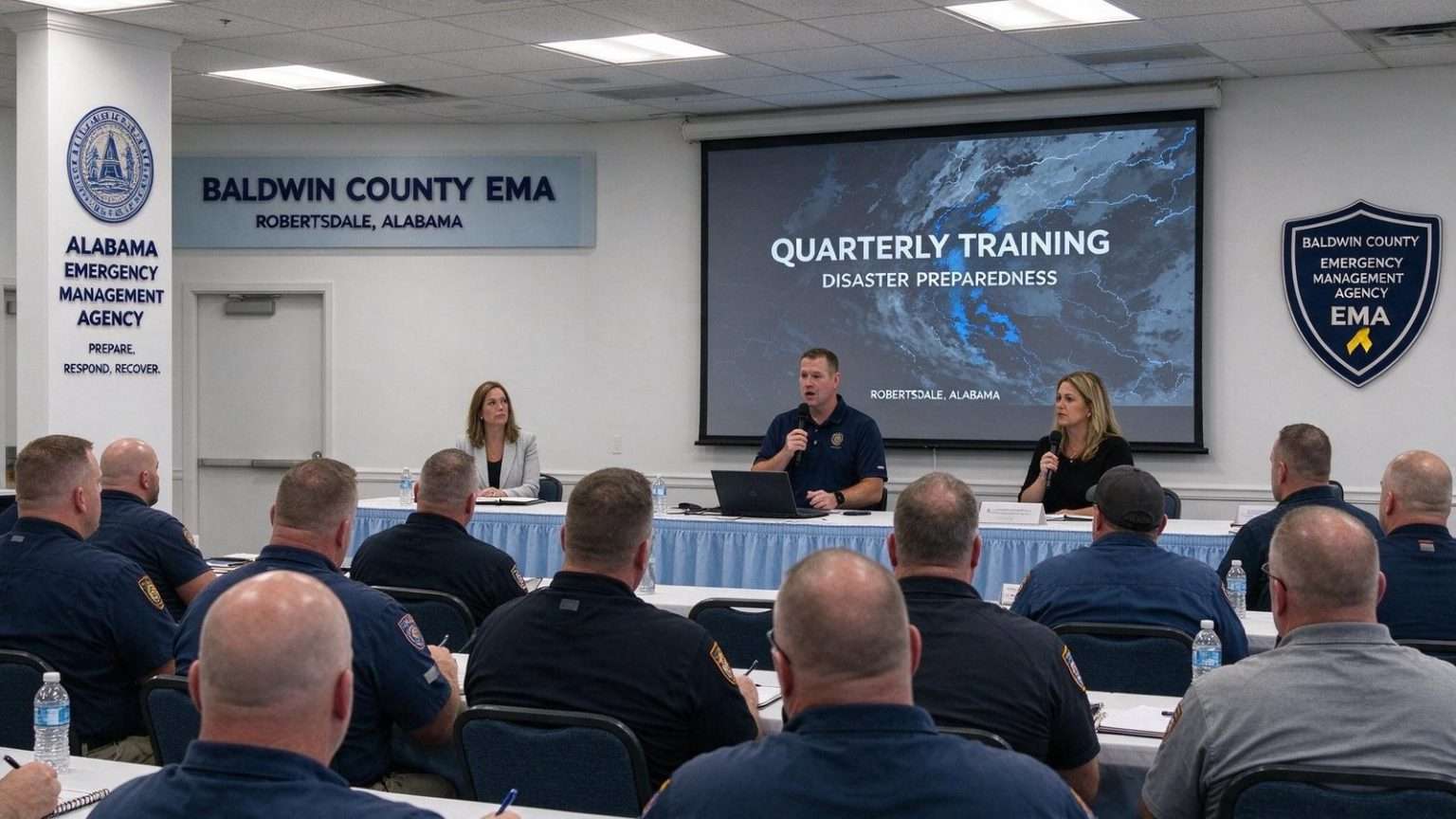
ROBERTSDALE, Ala. — Emergency managers, first responders and state officials from across the region gathered this week in Baldwin County for a quarterly training session focused on disaster mitigation, response and recovery. The meeting at the Baldwin County EMA in Robertsdale was hosted by Division A of the Alabama Emergency Management Agency and led by AEMA Division Coordinator Steven Huff, continuing a regular rotation that brings state and county emergency management staff together four times a year.
The session drew a broad cross-section of the state’s emergency management community: AEMA staff, representatives from the National Weather Service, members of the Alabama Association of Emergency Managers, and emergency managers from multiple counties. For a day, the people who would coordinate a hurricane evacuation, open shelters or request state resources during a wildfire all sat in the same room, working through briefings and training exercises designed to keep the region’s response network on the same page before the next event, not after it.
Why the Region Gathers Quarterly
South Alabama’s emergency management landscape is built on relationships as much as plans. When a tropical system threatens the Gulf Coast, county emergency management agencies do not respond alone — they lean on AEMA’s area coordinators, on mutual aid from neighboring counties, on National Weather Service forecasters in Mobile, and on volunteer organizations that staff shelters and distribution points. Quarterly division meetings give those partners a standing forum to hear what has changed at the state level and to raise local concerns before hurricane season, severe weather season and the long recovery periods that follow both.
Baldwin County, one of the fastest-growing counties in the state, carries an outsized share of that planning burden. Its coastline, bay systems and expanding subdivisions mean a single storm can generate evacuation traffic, wind damage and flooding across dozens of communities, from Gulf Shores and Orange Beach on the coast to Bay Minette in the north. Hosting the session at the Baldwin County EMA’s Robertsdale facility put visiting county managers inside one of the region’s most experienced operations.
New Laws and Safer Spaces
AEMA Executive Operations Officer Craig Bolling walked attendees through a new camp safety law, providing a timeline for additional guidance intended to clarify the law’s intent and how it will be implemented. The briefing gave county-level emergency managers an early look at how the law may affect camps and similar facilities in their jurisdictions.
That kind of advance notice matters for county staff. Camps — from church retreat grounds to youth and recreation facilities — operate in rural and semi-rural corners of the region, often with limited access roads and varying levels of emergency planning. New legal requirements touching those facilities eventually land on county emergency managers to interpret and enforce locally, and Bolling’s timeline for follow-up guidance gave attendees a schedule for the answers they will need before implementation begins.
AEMA Field Operations’ Pam Cook led a discussion on the Safer Spaces program, which helps counties support organizations that want to serve as shelters during severe weather. The program is designed to give communities more options for safe shelter when storms threaten, an especially relevant concern along the Gulf Coast, where severe weather and tropical systems are a recurring risk.
The shelter question is a persistent one in small South Alabama communities. Tornado warnings arrive with minutes of notice, and residents who live far from a designated shelter or who lack transportation often have nowhere to go but an interior room at home. Programs that identify and prepare volunteer shelter partners — churches, community centers, schools — widen that safety net county by county, and Cook’s briefing covered what counties can do to recruit and support those partners.
Recovery and volunteer coordination filled the second half of the agenda. AEMA Recovery’s Kim Bryant and Selena Hardy, of the Governor’s Office of Volunteer Services, addressed long-term recovery efforts following disasters, an area of emergency management that often receives less public attention than initial storm response but can shape a community’s rebuilding for months or years afterward.
Long-term recovery is where disaster response becomes slow and unglamorous. Days after a hurricane, the region watches rescues and damage assessments; years later, the work is rebuilding housing, replacing lost documents, resolving insurance disputes and helping families who fell through every crack in the system. Bryant and Hardy’s presentation focused on how counties organize that work, including the recovery committees and case management structures that track households from immediate need to permanent stability.
Kim Lawkis, representing Alabama Voluntary Organizations Active in Disaster, or Alabama VOAD, spoke about the essential role volunteer organizations play during crisis response, from immediate relief efforts to longer-term recovery work.
The VOAD network is the connective tissue between professional emergency management and the volunteer energy that floods a disaster area. Its member organizations — faith-based groups, national relief agencies, local nonprofits — coordinate through the VOAD structure so that donations, volunteer labor and rebuilding efforts reach the communities that need them without duplicating one another. In past Gulf Coast storms, that coordination has determined how quickly mucked-out homes were gutted, how many tarps went on roofs, and how many rebuilt houses followed the first wave of federal aid.
What It Means for Local Residents
For residents of Baldwin and Mobile counties, sessions like this one shape how the region performs when the next storm makes landfall. Every briefing on new state laws, shelter programs and recovery coordination translates into county plans, trained staff and pre-positioned relationships. When a hurricane watch is issued, those connections are what allow a county EMA to request generators, shelter staff or state assistance and know exactly who on the other end of the line will answer.
The quarterly format also builds in accountability. County emergency managers do not simply receive updates; they report on their own exercises, gaps and needs, and the division coordinator carries those items back to Montgomery. Over years of meetings, that loop has steadily standardized how South Alabama counties prepare for, respond to and recover from disasters.
The meeting closed with the region’s emergency management community looking toward the seasons ahead. With hurricane season, spring tornado season and the region’s continued population growth all raising the stakes, attendees left Robertsdale with new guidance to review, shelter partners to contact and recovery plans to update — the unglamorous homework that decides how the Gulf Coast weathers its next disaster.
Disaster Mitigation Gets Its Turn
The quarterly meetings rotate among host counties in the division, and attendance has become a fixture on the calendar for emergency managers who juggle day jobs as fire chiefs, county administrators and volunteer coordinators. Attendance is not mandated for the public’s benefit; it is how a multi-county region keeps dozens of small agencies operating from the same playbook.
While response and recovery draw the headlines, mitigation — the work of reducing damage before a disaster strikes — is where the region’s long-term savings are found, and it was a recurring thread through the session’s briefings and training exercises. Mitigation ranges from drainage and elevation projects to updated building codes, safer rooms and public education campaigns. Every dollar spent hardening a community before a storm, emergency managers have long argued, saves multiples of that dollar in avoided losses and recovery costs afterward.
For Baldwin County, mitigation planning carries particular urgency. Decades of growth have pushed new subdivisions into areas that flood or that depend on a handful of evacuation routes, and each new roof is another structure for wind and water to test. County and municipal staff who attended the session came away with updated guidance they can fold into local hazard mitigation plans, which in turn keep communities eligible for federal grant programs that fund the projects.
A Network Tested by Storms, Strengthened by Practice
The people in the room this week have managed some of the worst weather the Gulf Coast can produce. Hurricanes, tornado outbreaks, ice storms and flash floods over the past two decades have tested every link in the chain that runs from a National Weather Service warning in Mobile to a county EMA’s activation, a shelter opening and a state resource request. Each of those events exposed something — a gap in communications, a shelter that filled too fast, a recovery bottleneck — and the fix has usually been worked out afterward in rooms exactly like the one at the Baldwin County EMA.
That is the quiet purpose of a quarterly training session. No one gave a dramatic speech, and no emergency was underway. Instead, coordinators reviewed new laws, shelter partnerships, recovery structures and volunteer coordination, then sat through exercises that rehearsed the same handoffs they will make under pressure. For the residents of South Alabama, the value of a day like this one is measured only later — in warnings received in time, shelters that had room, and communities that put themselves back together faster than anyone expected.