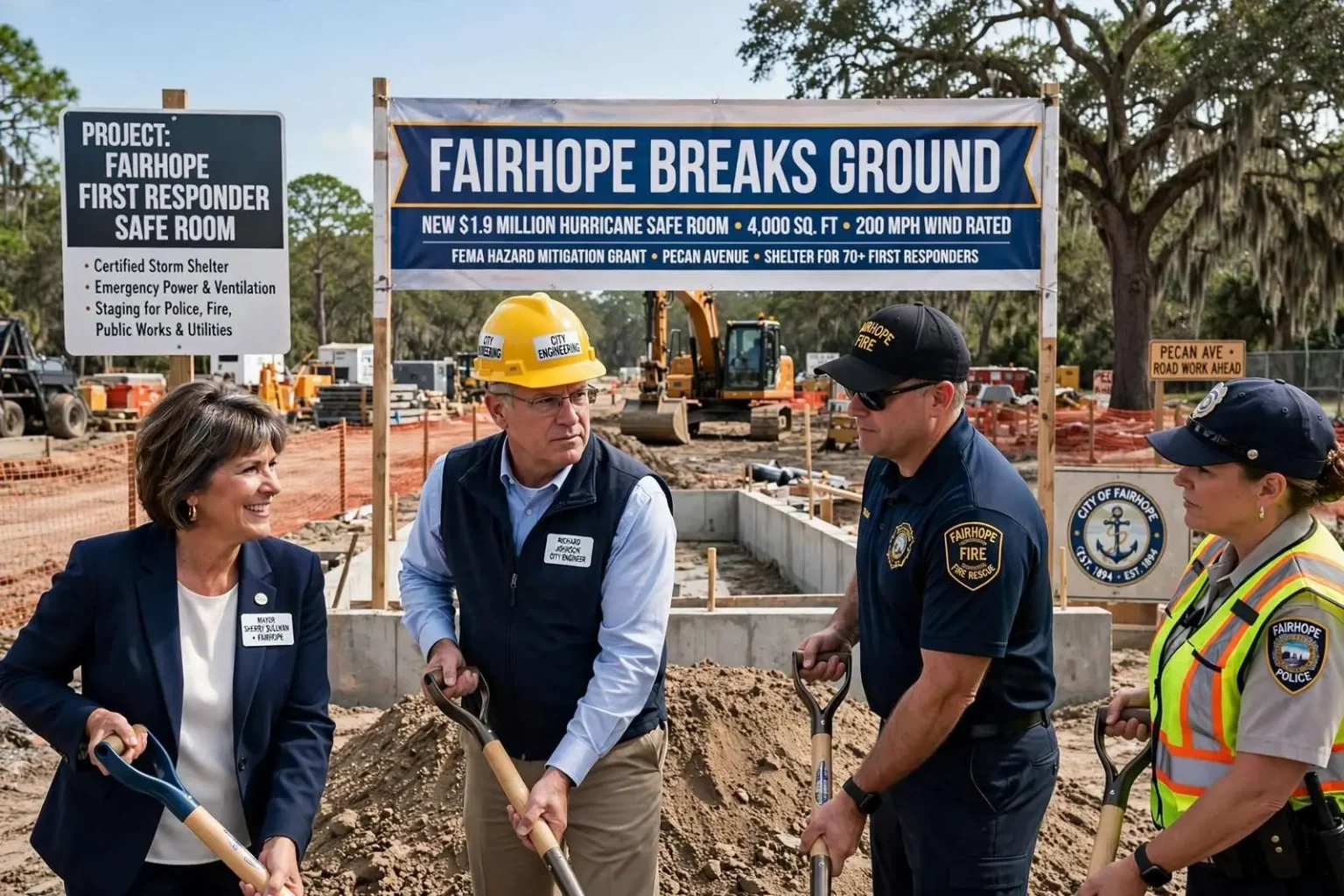
FAIRHOPE — Fairhope is building its first dedicated hurricane safe room, a $1.9 million facility designed to give police officers, firefighters and other essential city workers a secure place to ride out a major storm while they continue serving the community. The 4,000-square-foot structure, under construction on Pecan Avenue, is engineered to withstand wind speeds up to 200 miles per hour.
Once complete, it will be able to shelter more than 70 first responders, including local police, fire, public works and utility personnel, as well as responders from neighboring agencies who may need a safe place to stage during a storm. The project places Fairhope among a growing number of coastal Alabama communities investing in hardened facilities built specifically to keep emergency personnel in place — and ready to deploy — when hurricane-force winds make ordinary buildings dangerous.
City officials say the project fills a gap that has long left first responders without a certified place to shelter during hurricanes and other high-wind events. “We have no certified housing to keep our people in, in the city, to ride out a high-wind event such as a hurricane,” Fairhope City Engineer Richard Johnson told the City Council.
A Lesson From Hurricane Sally
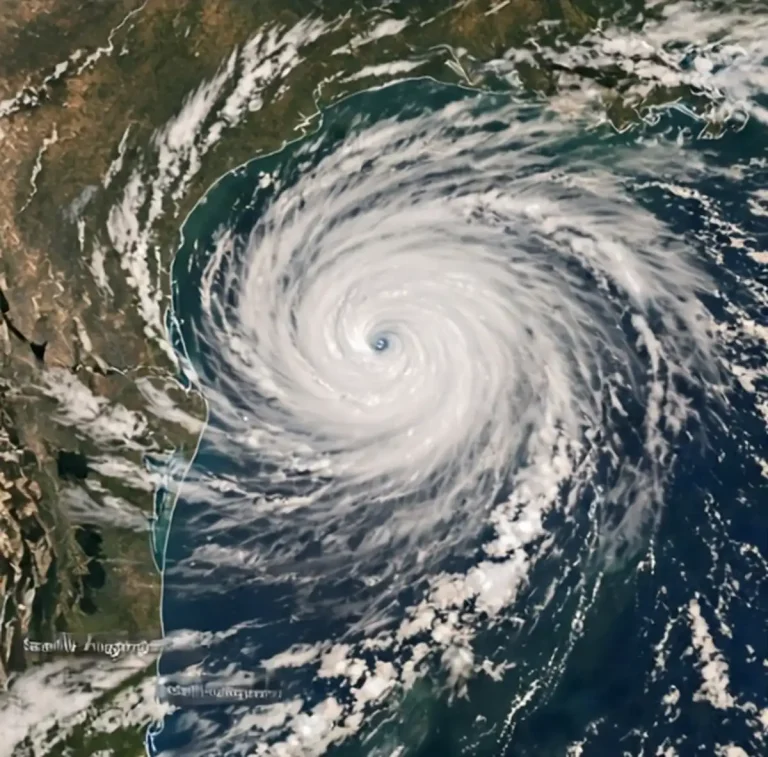
City leaders point to Hurricane Sally, which struck the Gulf Coast in 2020, as a clear example of why a facility like this is needed. The storm underscored how difficult it can be to keep emergency personnel sheltered and ready to respond when a hurricane makes landfall near Mobile Bay.
Sally made landfall in September 2020 as a slow-moving Category 2 storm, and its crawl across the northern Gulf Coast subjected Baldwin County and the wider Mobile Bay area to hours upon hours of damaging winds, heavy rain and record flooding. The slow pace of the storm was as destructive as its intensity: downed trees and power lines blocked roads for days, and utilities across the region reported some of the most extensive outages in their history. For communities along the Eastern Shore, the storm became the benchmark against which future hurricane preparation is measured.
The experience left cities along Mobile Bay rethinking where their own employees would shelter if a similar storm arrived. During a major hurricane, first responders who remain in town typically ride out the worst of the weather in reinforced schools, courthouse wings or other structures that were never designed to the standards of a certified storm shelter. A purpose-built safe room removes that uncertainty by giving the city a facility engineered from the ground up for the wind speeds that a landfalling hurricane can produce.
Beyond serving as a shelter, the safe room is also expected to improve the city’s ability to prepare for major storms before they arrive. “This would also give us the ability, in the event that we knew we were going to have a catastrophic event, to go ahead and stage utility crews and then have them ready to go in the event of a storm,” Fairhope Mayor Sherry Sullivan said.
The staging function is a significant part of the facility’s value. In the hours after a hurricane passes, the first priority for any city is clearing roads, restoring traffic control and accounting for damaged utilities — work that can only begin once crews are assembled and safe. A dedicated safe room allows a city to pre-position utility workers, equipment operators and public safety personnel inside the community as the storm approaches, rather than scrambling to recall them from distant shelters once conditions allow travel. Crews housed through the worst of the wind can move the moment it subsides, potentially cutting hours off the initial response.
Funded Through a FEMA Grant
Construction is being funded in large part through a hazard mitigation grant from the Federal Emergency Management Agency, part of a broader federal effort to help coastal communities like Fairhope reduce the impact of natural disasters. Hazard mitigation grants typically require a mix of federal and local funding and are aimed at projects that reduce future storm-related losses, such as reinforced shelters and infrastructure upgrades.
FEMA’s hazard mitigation programs, including the Hazard Mitigation Grant Program that often follows federally declared disasters, operate on a simple premise: every dollar spent strengthening a community before a storm saves multiples of that amount in avoided damage and recovery costs afterward. Safe rooms and storm shelters are among the categories of projects the programs routinely fund, particularly in Gulf Coast states where hurricane exposure makes the risk calculation straightforward. Baldwin County, which has absorbed multiple major hurricanes and tropical systems over the decades, has been a frequent participant in federal mitigation efforts.
The local share of the Pecan Avenue project represents the city’s investment in a facility that is expected to serve its emergency workforce for decades. Safe rooms of this type are built to stringent design and construction standards covering reinforced concrete or steel construction, anchored roof systems, impact-resistant openings and independent emergency power and ventilation — features intended to keep occupants protected even when surrounding structures suffer damage.
What the Safe Room Means for Fairhope
For the city’s police officers and firefighters, the facility addresses a professional obligation that sets first responders apart from most residents during a hurricane. While the general public is urged to evacuate inland ahead of a major storm, essential personnel must remain close enough to respond immediately afterward. Until now, Fairhope has lacked a certified structure for those employees to occupy during the height of the wind, leaving the city to improvise with whatever reinforced space was available.
The safe room’s capacity of more than 70 occupants also gives neighboring agencies a staging option. Baldwin County’s emergency response network depends on municipalities and county departments assisting one another after major storms, and responders who deploy into a damaged area need a certified place to shelter if conditions deteriorate again. Having such a facility on Pecan Avenue strengthens that regional network as a whole.
City officials say they expect the Pecan Avenue safe room to be finished before the start of next year’s hurricane season, giving Fairhope’s emergency crews a reinforced home base the next time a major storm threatens Baldwin County and the greater Mobile Bay area. Hurricane season along the Gulf Coast runs from June 1 through the end of November, with the statistical peak of activity falling in late summer, and the completion deadline is designed to have the facility staffed and operational before that window opens.
Fairhope’s investment comes as communities across the northern Gulf Coast continue to absorb the lessons of recent storm seasons. The 2020 season was among the busiest on record for the Atlantic basin, and the Alabama coast, which had been spared a direct major-hurricane strike for many years before Sally, saw how quickly that streak could end. The storm’s path across Baldwin County damaged homes, businesses, schools and public infrastructure from the beaches of Gulf Shores and Orange Beach to the bayside communities along Mobile Bay, and recovery efforts stretched on for years.
For a growing city like Fairhope, whose population has expanded steadily as the Eastern Shore develops, hardening the public-safety infrastructure has taken on added urgency. More residents mean more police calls, more fire responses and more utility demands in the critical hours after a storm, and the safe room ensures the personnel responsible for that work will be rested, protected and in position when the call comes.
The Pecan Avenue facility will also serve as a visible reminder of the storm that made it necessary. Safe rooms built with federal mitigation dollars are intended to stand for generations, and each future hurricane season will find Fairhope’s emergency workforce better protected than the one that rode out Sally without a certified shelter of its own. City officials describe the project as a direct answer to the question Sally raised — where do the people who protect the city go when the storm arrives — and by the time the next season opens, that question will have an answer standing on Pecan Avenue.
Emergency management officials across Baldwin County have long emphasized that the recovery period after a hurricane is when the region’s mutual-aid relationships matter most. Utility lineworkers from neighboring cities, county road crews and volunteer agencies all converge on the hardest-hit areas in the first days after landfall, and a certified shelter like Fairhope’s gives those incoming responders a known, reliable base of operations on the Eastern Shore. That regional benefit was part of the calculation city officials cited when presenting the project to the council, alongside the protection it offers the city’s own police officers, firefighters and utility workers.
Inside the facility, the design focus is endurance. Certified safe rooms are intended to keep occupants protected not only during the peak wind event but through the hours afterward, when downed lines, blocked roads and damaged communications can leave a city isolated. Power independence, food and water storage space, and sanitary facilities are standard considerations in shelters meant to house emergency personnel who will be working the moment the storm clears. For Fairhope’s planners, those details matter because the safe room is not a public refuge but a working facility — the starting line for the city’s recovery rather than the end point for the residents taking shelter in it.