Ashley Rich Leans on Murder-Team and Drug-Court Experience in Bid for Mobile County DA
Republican candidate Ashley Rich is campaigning for Mobile County District Attorney on 14 years of prosecutorial experience, including service on the office's murder team and leadership of its drug-court program.
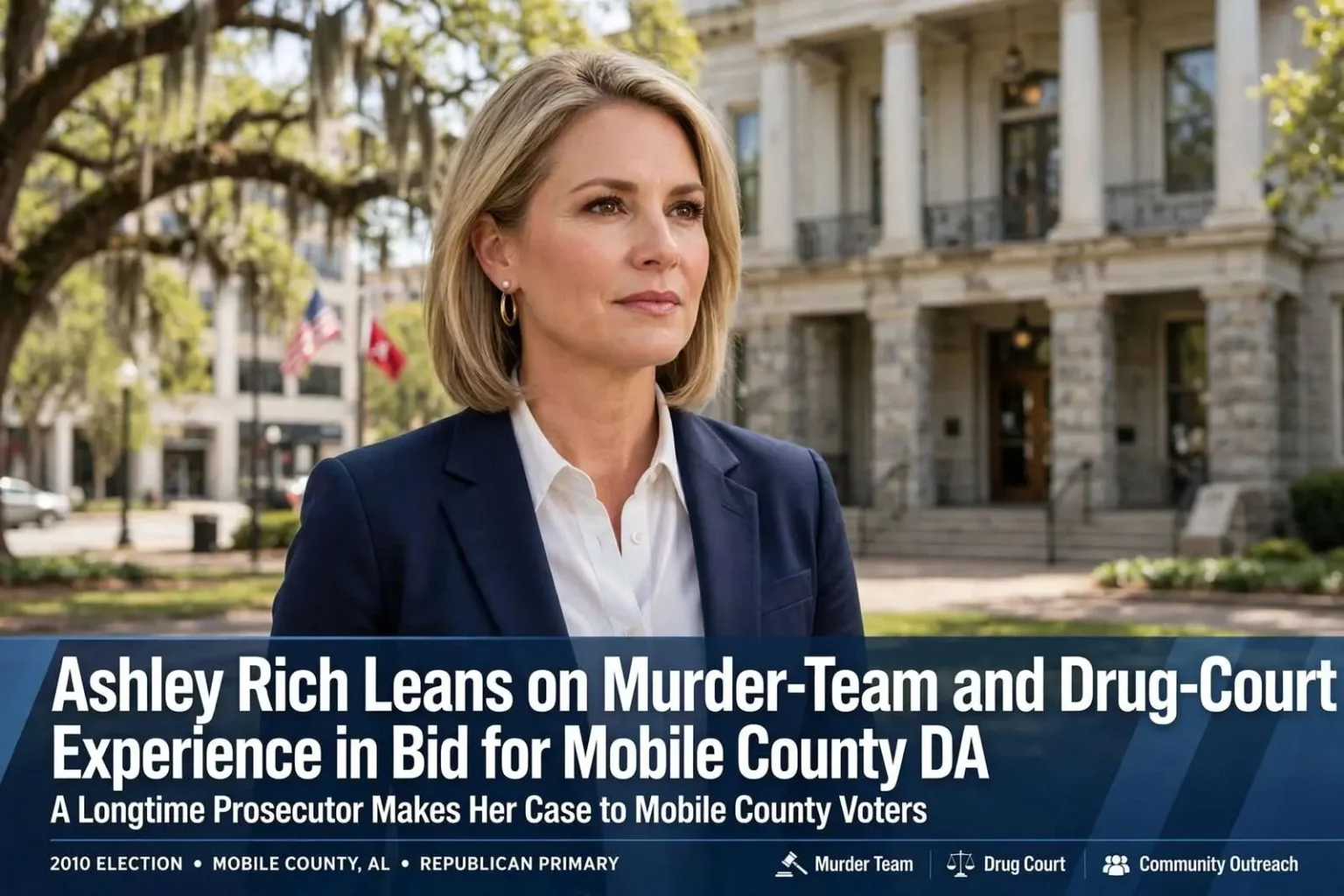
A Longtime Prosecutor Makes Her Case to Mobile County Voters
Ashley Rich, a career prosecutor with the Mobile County District Attorney’s Office, is running as a Republican for Mobile County District Attorney in the 2010 election cycle. Rich has built her campaign around a simple pitch to voters: more than a decade of hands-on courtroom experience prosecuting some of Mobile County’s most serious criminal cases, paired with a record of community involvement outside the courthouse.
Rich has served Mobile County since 1996, a tenure that spans more than a decade of shifting caseloads, changing courtroom technology, and evolving approaches to prosecuting violent crime, drug offenses, and domestic violence. Over that period, she says she has handled more than 100 jury trials and over 1,000 bench trials — a volume of casework that reflects the grinding, high-stakes pace of a mid-sized Gulf Coast county’s criminal docket.
A Career Built on the Toughest Cases
Since 2002, Rich has been a member of the District Attorney’s Office murder team, the unit of prosecutors assigned to Mobile County’s homicide cases. Murder teams in prosecutors’ offices across Alabama and the country typically consist of the most senior trial attorneys, given the complexity, evidentiary demands, and high public stakes involved in prosecuting homicide cases. Assignments to such units are generally treated as a mark of a prosecutor’s trial experience and judgment, since these cases often involve extensive forensic evidence, multiple witnesses, and appeals scrutiny that can stretch on for years after a verdict.
Rich has also taken on leadership roles within the office’s drug-prosecution and drug-court teams. Drug courts, which began spreading across Alabama and the rest of the country in the 1990s, offer an alternative track for certain nonviolent drug offenders: instead of a conventional prosecution and sentence, participants agree to intensive supervision, regular drug testing, and treatment programs, with the goal of reducing repeat offenses and easing the burden on jails and prisons. Mobile County has operated versions of these problem-solving court dockets for years, reflecting a broader trend among Alabama’s judicial circuits toward diversion programs for lower-level drug cases while still pursuing tougher sentences for trafficking and violent drug crime.
Taken together, Rich’s murder-team and drug-court experience covers much of the spectrum of what a modern district attorney’s office handles day to day: the rare, high-profile homicide prosecution on one end, and the far more common, high-volume drug case on the other. That range of experience is a common theme in campaigns for chief prosecutor positions, where candidates often emphasize breadth of trial work as evidence they can manage an office responsible for thousands of cases a year across many different categories of crime.
Community Involvement Beyond the Courtroom
Beyond her work inside the Mobile County court system, Rich has pointed to a record of community engagement as part of her case to voters. She has been involved in youth outreach efforts and has served on the board of the Penelope House Domestic Violence Center, a Mobile-based nonprofit that provides shelter, counseling, and support services for survivors of domestic violence in the region. Organizations like Penelope House typically rely heavily on community volunteers, local board members, and coordination with law enforcement and prosecutors to support survivors through both the immediate crisis of leaving an abusive situation and the often-lengthy legal process that can follow.
Rich has also participated in Mobile’s Underage Drinking Task Force, one of many coalitions that have formed across Alabama and the broader Gulf Coast region to address underage alcohol access and consumption. These task forces generally bring together representatives from law enforcement, prosecutors’ offices, schools, parents, and retailers to coordinate enforcement of alcohol sales laws, run public awareness campaigns, and address the particular risks that underage drinking poses around graduation season, summer break, and other high-risk periods for young people.
Involvement in these kinds of task forces and nonprofit boards is common among prosecutors seeking countywide office, both because the issues intersect directly with criminal justice work and because such roles put candidates in front of community members outside a traditional courtroom setting.
Family and Community Roots
On a personal level, Rich has been married for 11 years to Ritchie R. Hurt, a business development manager at Thompson Engineering, a Mobile-based engineering, surveying, and environmental consulting firm with a long history of work on infrastructure and construction projects across the Gulf Coast. The couple has two children and attends St. Luke’s Episcopal Church in Mobile.
Candidates for local prosecutorial office in Alabama frequently highlight family and church ties as part of their public profile, particularly in county races where personal reputation and community standing can carry significant weight with voters who may know a candidate, or a candidate’s family, through schools, churches, and civic organizations rather than exclusively through campaign advertising.
The Race for Mobile County District Attorney
The office of Mobile County District Attorney is one of the most consequential local elected positions in South Alabama’s legal system. The district attorney oversees prosecution of felony and many misdemeanor cases within Mobile County, supervises a staff of assistant district attorneys and support personnel, sets office-wide policy on plea negotiations and charging decisions, and represents the state’s interest in everything from violent crime and property crime to white-collar fraud and juvenile cases. District attorneys in Alabama are elected on a partisan ballot to six-year terms, giving the office considerable durability and influence over how criminal justice is administered locally.
The 2010 race for Mobile County District Attorney took shape as part of a broader statewide election cycle. Alabama’s 2010 primary elections were held June 1, with a primary runoff later that month for races in which no candidate secured a majority, followed by the general election in November. As is typical in county-level judicial races in a heavily Republican area like Mobile County, the Republican primary in many years functions as the de facto deciding contest, since the eventual Republican nominee often faces limited or no Democratic opposition in the general election — though that is not the case in every cycle and depends on which candidates ultimately qualify to run.
Rich sought the Republican nomination as an experienced insider candidate, positioning her decade-plus of prosecutorial service — including years in leadership positions on major case teams — as the central argument for why voters should choose her over her opponent in the primary.
How District Attorney Races Typically Unfold in Alabama
District attorney elections in Alabama’s larger counties tend to draw significant attention because of the office’s direct role in public safety and the criminal justice system. Campaigns in these races often center on a handful of recurring themes: trial experience, management of the office’s caseload and budget, relationships with local law enforcement agencies, and approaches to specific categories of crime such as violent offenses, drug crime, and domestic violence.
Because sitting assistant district attorneys frequently run for the top job when an incumbent retires or steps down, these races often pit longtime insiders against one another, with each candidate emphasizing different aspects of their record — years of service, specific units or case types they have led, courtroom win rates, or endorsements from law enforcement officers, judges, and fellow prosecutors. Voters in these races are frequently asked to weigh experience and institutional knowledge against promises of reform or a different management approach, a dynamic that plays out in judicial and prosecutorial elections throughout Alabama and much of the South.
Mobile County’s Criminal Justice Landscape
Mobile County, anchored by the city of Mobile, is one of Alabama’s most populous counties and has one of the busiest court systems in the state outside the Birmingham metro area. The Mobile County District Attorney’s Office handles a wide range of case types annually, from violent crime prosecutions to property crime, drug offenses, and specialized dockets such as domestic violence and juvenile cases. The office works closely with the Mobile Police Department, the Mobile County Sheriff’s Office, and other regional law enforcement agencies, as well as with community organizations such as Penelope House on domestic violence cases and with the county’s drug court program on diversion cases.
Given the volume and variety of cases moving through Mobile County’s court system, candidates for district attorney typically face scrutiny not only on their trial record but also on how they propose to manage the office’s overall caseload, staffing, and relationships with the judiciary and law enforcement partners across the county.
What Came Next
As the 2010 primary season moved toward its June 1 vote, Rich continued to campaign on her record within the District Attorney’s Office alongside her community involvement through organizations like Penelope House and the Underage Drinking Task Force. Voters in Mobile County were set to weigh her candidacy against that of her Republican primary opponent as part of a broader slate of local, judicial, and statewide races on the 2010 ballot.
Rich went on to serve as Mobile County District Attorney in the years following the 2010 election, succeeding longtime District Attorney John Tyson Jr., and she was later re-elected to additional terms in the office.