Mobile Firefighters Contained Two-Alarm Vacant-Home Fire in 2008
Mobile firefighters contained a two-alarm fire at a vacant house on Michael Donald Avenue in July 2008; no injuries were reported.
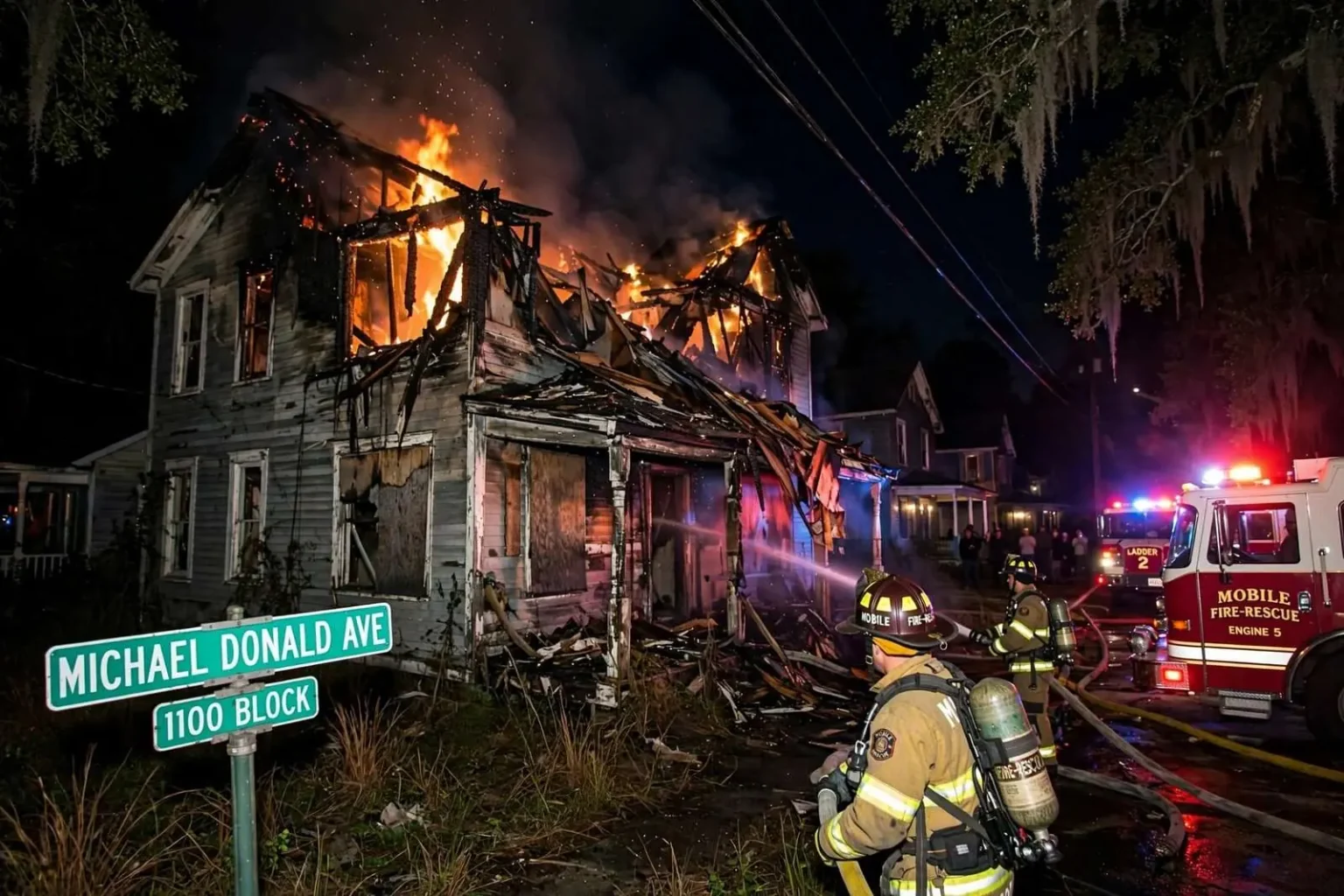
MOBILE, Ala. — Mobile firefighters contained a two-alarm fire at a vacant home on Michael Donald Avenue in July 2008, according to an archived local news report from July 14 of that year, bringing the blaze under control in roughly an hour despite a partial roof collapse.
The fire began about 9:40 p.m. at a house that officials said had been vacant for about three years. Mobile Fire-Rescue spokesman Steve Huffman said the blaze appeared to begin on the second floor and caused the roof to collapse as crews worked the scene — an escalation that automatically raises the danger for firefighters operating inside a structure whose stability is already compromised.
Crews put the fire out in roughly an hour, protected nearby buildings from extension, and reported no injuries — a result that reflects both the aggressive defensive posture crews take when a burning structure begins to shed its roof and the value of a fast, well-staffed two-alarm response on a residential street at night.
Neighbors told officials that people who did not belong at the property had been seen going in and out of the house in the period before the fire, a detail that places the blaze in the familiar category of vacant-structure fires, where unsecured buildings become gathering places and ignition sources multiply. The archived report does not state a later cause finding, and this historical account preserves that gap.
The street and its name
Michael Donald Avenue carries one of the most significant names in Mobile’s modern history. The street was renamed in memory of Michael Donald, the 19-year-old Mobile man kidnapped and lynched by members of the Ku Klux Klan in 1981 — a crime that stunned the city, led to a federal civil case that ultimately broke the United Klans of America, and became a landmark in the legal history of the civil rights era. Naming a street for him made his memory part of the daily geography of the city where he was born.
The house that burned in July 2008 stood on that street in a residential part of Mobile where occupied homes sit close to vacant properties, a pattern common in older Mobile neighborhoods that lost population in recent decades. When a house sits empty for three years, as officials said this one had, it changes the block: vegetation grows up, windows fail, and the building becomes a hazard that neighbors watch warily.
Neighbors’ reports that unfamiliar people had been going in and out are among the most consistent details in vacant-building fires everywhere. Unsecured structures attract trespassers seeking shelter, and fires in such buildings often occur at night, complicate firefighter operations because of unknown interior conditions, and draw extra scrutiny from investigators afterward.
Two alarms on a dark street
A two-alarm designation means the initial response was quickly supplemented with additional engines, ladders, and command personnel — a decision incident commanders make when the first units on scene report fire showing, structural instability, or a building whose size and condition will outmatch the first-alarm assignment. In a vacant two-story house with fire on the second floor and the roof already under threat, the second alarm buys the resources needed for a defensive attack and for protecting exposures.
Protecting nearby buildings is the defining priority in a defensive operation on a residential street. Hose lines are positioned between the burning structure and its neighbors, and crews work to keep radiant heat and wind-blown embers from igniting the houses next door. The archived account’s note that nearby buildings were protected indicates that priority was met: the fire, however destructive to the vacant house, did not spread to occupied homes.
The roof collapse changed the mathematics of the interior fight. Once a roof begins to fail, command pulls all crews outside, because the floors and walls of the structure follow the roof in a progression of collapse that no interior position can survive. Fighting from outside takes longer and uses more water — the hour to control reported in this incident is consistent with that shift — but it keeps firefighters alive.
Vacant buildings and the city’s struggle
The fire on Michael Donald Avenue was one entry in a much larger ledger. Vacant and abandoned structures have been a persistent challenge for Mobile and cities like it, and fire departments consistently report that vacant-building fires produce a disproportionate share of firefighter injuries. Empty houses hide their condition: floors are rotted, stairways are compromised, utilities are disconnected or illegally rigged, and nobody with knowledge of the building is present to tell crews what to expect.
Cities respond to that hazard with programs that identify abandoned structures, require owners to secure them, and demolish the worst of them. A house vacant for three years — as officials said this one was — sits well past the point where routine securing usually suffices, and neighbors on blocks with such properties often become the unofficial reporting system, alerting police to trespassers and fire officials to deterioration.
The detail that “people who did not belong at the property” had been seen entering and leaving is also a reminder of the ambiguity that shadows vacant-building fires. Investigators weigh such reports alongside burn patterns, utility records, and any evidence of heating or lighting sources inside. The archived report from July 2008 does not state a cause finding, and the historical record here does not supply one.
What the record shows
Stripped to its verified facts, the incident is straightforward: a two-story vacant house, empty for about three years, caught fire on the second floor about 9:40 p.m. on a July night in 2008. The fire was upgraded to two alarms, the roof collapsed, crews protected the neighboring buildings, the blaze was controlled in about an hour, and no one was hurt.
For the neighborhood, the fire removed a long-standing hazard — the burned shell of a house that had been empty since 2005, by the timeline officials gave. For Mobile Fire-Rescue, it was another example of the vacant-structure fights that consume resources without an occupant to save, fought at night, in summer heat, against a building that had already begun to give way.
And for the record, the fire is preserved here exactly as the archived report preserved it: with Steve Huffman’s account of the second-floor origin and roof collapse, the neighbors’ observations about trespassers, and no cause finding — a historical report that does not reach conclusions the original coverage did not.
The Michael Donald case behind the name
Because the fire occurred on Michael Donald Avenue, the street’s own history deserves its place in the record. Michael Donald was abducted and lynched in Mobile in 1981, in a retaliation killing by Klansmen that shocked the nation when it was exposed. His mother, Beulah Mae Donald, pursued a civil lawsuit against the United Klans of America with the help of civil rights attorneys, and the 1987 judgment that followed — a verdict that bankrupted the organization and transferred its assets — became a template for using civil litigation against hate groups.
The renaming of a Mobile street in his honor turned that history into an everyday landmark, so that the block where this 2008 fire occurred carries the name of a young man whose death helped dismantle one of the country’s most violent organizations. It is a name neighbors on the street know well, and it gives even a routine vacant-house fire a setting weighted with meaning.
Fighting fire at night in July
The conditions of the July 2008 fire — a nighttime start, Gulf Coast summer heat and humidity, a vacant structure — stack the physical burden on firefighters in ways that incident reports rarely capture. Mobile’s July nights offer little relief from the heat, and structural firefighting gear traps body heat while crews push heavy hose lines. Rehabilitation rotations, cooling stations, and additional companies beyond the first alarm exist in part to manage exactly that strain.
Night operations add their own complications: limited visibility, residential streets crowded with parked cars and onlookers, and a window of hours in which a burning building’s collapse risk grows while the number of witnesses to any earlier interior activity shrinks. That a fire with a collapsed roof produced no injuries on either side of the incident speaks to the discipline of crews and command in pulling personnel out of the structure in time.
The hour to control is also a function of the defensive strategy. Exterior streams must be repositioned as the fire burns through different sections of the structure, and a roof collapse opens new air pathways that can flare the blaze before it is finally darkened. Crews then remain on scene for overhaul — pulling apart charred material to find hidden fire — long after the flames themselves are out.
Vacant structures as a continuing problem
Every city department that deals with vacant properties — fire, police, inspections, and public works — inherits the same property in different ways, and the Michael Donald Avenue fire touched all of them. Before the fire, it was a trespass and blight complaint; during it, a structure fire and collapse hazard; after it, a demolition site and a lot to clear. The cost of an unsecured house is distributed across years and departments, which is precisely why cities invest in early intervention rather than waiting for the fire.
Mobile’s older neighborhoods have carried this burden for decades, and the pattern that produced a three-year vacancy on this street in 2008 — population shifts, aging housing stock, absentee ownership — continued long after. Fire officials routinely include vacant-structure fires in the statistics they cite when advocating for code enforcement and demolition programs, because the alternative is fighting the same preventable fires again and again, at greater risk to crews each time.
The July 2008 fire ended without injuries and without spread to neighboring homes, which is the best available outcome for a fire of its kind. Its cause was never publicly resolved, and the archived report is honest about that limit. What remains is a documented incident on a street named for one of Mobile’s most important modern stories — a blaze that drew two alarms, took a roof, and left a neighborhood to deal with the lot that came next.