Man Dies in Shed Fire on Mobile’s Houston Street
A fire that broke out overnight on Houston Street in Mobile killed a man who reportedly lived in a backyard shed.
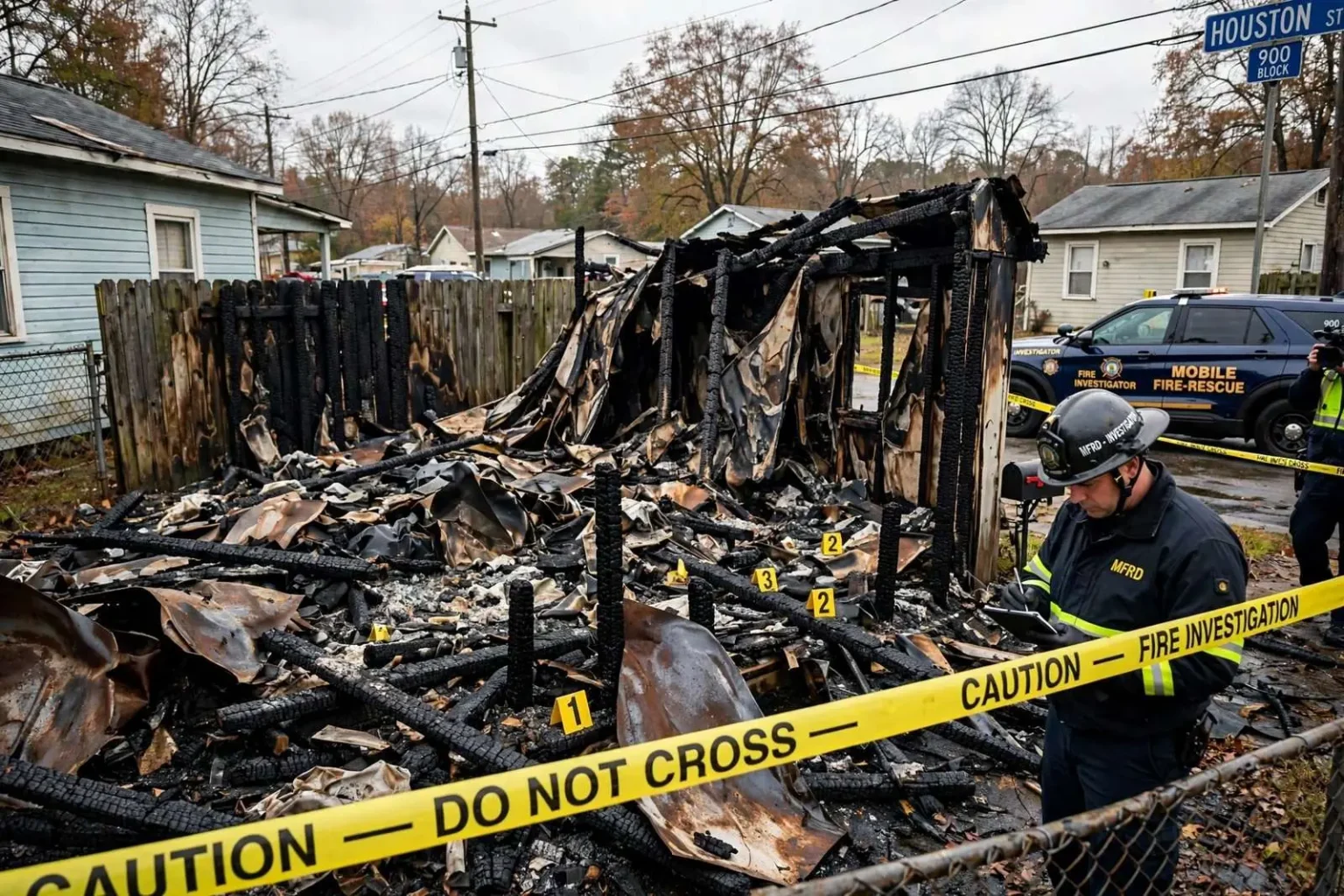
Fire investigators spent Saturday working to determine what sparked a blaze on Mobile’s Houston Street that left one man dead overnight. Firefighters with the Mobile Fire-Rescue Department were called to the 900 block area near Houston Street, between Dublin and Sligo streets, just before 8:30 p.m. Friday after reports of flames on the property. Crews arriving on scene could see fire visible from behind the home and found a backyard shed “fully involved” in flames, according to MFRD spokesman Steve Huffman. Firefighters brought the blaze under control within about 15 minutes, Huffman said.
Once crews were able to get inside the charred structure, they discovered a man dead. Huffman said the property’s homeowner told investigators the man had been living in the shed. Authorities have not released the man’s identity, and Huffman said investigators had not yet determined whether foul play played any role in the fire as of Saturday. Fire investigators were continuing to examine the scene to pin down a cause.
The response unfolded in a residential section of the city where homes sit close together on modest lots, the kind of neighborhood where a detached outbuilding can be only a few feet from a neighbor’s fence line. That proximity matters in fire response terms, because a shed burning at full involvement produces intense heat and flying embers that can threaten the main house, fences, vehicles and power lines. Crews arriving to find a structure already fully involved must balance an aggressive attack on the fire with a search for anyone who might be inside, a calculation made harder at night when visibility is poor and the building’s layout is unknown.
Mobile Fire-Rescue is the primary fire and emergency medical agency for the city, operating fire stations spread across its districts and fielding both engine and ladder companies along with specialized investigators. The department handles thousands of calls each year across Mobile, and structure fires — particularly in older neighborhoods — account for some of its most demanding responses. Friday night’s call came at a time when temperatures in south Alabama can drop enough that residents turn to whatever heat sources they have available, a factor investigators routinely weigh when a fire involves an improvised living space.
Sheds Turned Living Spaces Draw Scrutiny
Structure fires involving detached sheds, garages and other secondary buildings converted into makeshift living spaces have drawn increased attention from Mobile fire officials in recent years, particularly in older neighborhoods where such structures sometimes lack proper wiring, ventilation or smoke detection. Housing pressures and economic hardship mean that across Mobile and communities like it, outbuildings built for storage or workshops occasionally end up sheltering residents, whether on a long-term basis or temporarily. Those buildings were never designed for habitation, and the gap shows in fire data: no insulated walls, no second exit, and often no electrical system inspected by anyone.
Fire investigators typically look closely at electrical systems, heating equipment and any combustible materials stored nearby when determining a cause in cases like this one. Extension cords running from a main house to an outbuilding, portable space heaters, cooking appliances not intended for the space, and stored paint, fuel or yard equipment can each serve as ignition sources, and investigators document the scene methodically to rule possibilities in or out. When a fatality is involved, the examination becomes even more deliberate, because the findings may matter to insurance determinations, to the county coroner’s review of the death, and potentially to criminal investigators if foul play is not ruled out.
Investigators had not determined whether foul play played any role as of Saturday, which means the fire officially remained under investigation rather than being classified as accidental. Scenes such as the one on Houston Street are typically preserved for a day or more, with the charred structure secured while investigators photograph, diagram and sift through debris. Findings can take days or weeks to finalize, particularly if evidence is sent for laboratory analysis, and officials often release a formal cause only after that work is complete.
The Mobile Fire-Rescue Department has not released additional details about the victim or the circumstances that led to him living in the shed. The homeowner’s account to investigators, described by Huffman, established that the man had been living in the structure, but officials have not said how long he had been there, what his relationship to the property owner was, or whether anyone else was aware of the arrangement. Residents in the Houston Street area were left with a scorched structure and a lot of questions Saturday as investigators combed through the scene.
Fire Officials Urge Precautions in Outbuildings
MFRD urged residents citywide to ensure that any outbuildings used for storage or habitation have working smoke detectors and to avoid using space heaters or open flames near flammable materials, a common contributing factor in residential fires investigated by the department. The department’s safety messaging stresses that a smoke detector is as important in a shed or garage used by a person as it is in a house, because outbuilding fires can go unnoticed until they are already threatening nearby structures. Officials also encourage property owners to make sure anyone staying in an outbuilding has a clear path to escape and is known to family members who might otherwise assume they are inside the main house.
The guidance reflects patterns investigators see repeatedly. Fires that begin in detached structures spread to primary homes more often when the buildings are close together, and nights with low temperatures reliably produce an increase in heating-related fires across the Gulf Coast, where many homes and improvised living spaces lack central heat. Space heaters placed too close to bedding, upholstered furniture or stored belongings remain among the most common ignition sources identified in fatal fires investigated in the region.
An Open Case in a Close-Knit Neighborhood
For neighbors on the 900 block near Houston Street, the fire’s aftermath was visible all day Saturday as investigators moved between the main house and the burned shed behind it. Fires on residential blocks draw spectators and questions, and in cases where the person who died was living in an outbuilding, neighbors often know the individual by sight even when authorities have not yet released a name. The department has not said when that identification might be made public, which typically happens after next-of-kin notification is complete.
The case also underscores the wider challenge that fire departments across Alabama face as older housing stock ages. Mobile’s historic neighborhoods contain thousands of homes built decades ago, many with detached garages, carports and sheds added over the years. As structures age and housing costs rise, fire officials have increasingly used public outreach to warn about the risks of informal electrical connections, unvented heating and improvised cooking arrangements in spaces never meant for people. The department’s message after the Houston Street fire repeated those themes directly, tying them to the specific hazards investigators look for in secondary-structure fires.
No further updates on the cause of the fire had been released as investigators continued their work into the weekend. The identity of the man who died has not been released, and no injuries to firefighters or neighbors were reported in connection with the response. The main house on the property was not reported destroyed, though officials have not detailed the extent of any exposure damage to it or to neighboring properties.
Until investigators announce a finding, the fire will remain an open case in the department’s records. The 15-minute knockdown was a demonstration of the department’s basic capability, but the harder questions on Houston Street — how the fire started, why a man was living in a backyard shed, and whether anything could have prevented his death — are the ones that will take longer to answer. Residents with information about the fire, or about anyone who may have been staying in the structure, are typically encouraged to share it with investigators as the review continues.
Mobile has faced this pattern before, and fire officials have responded with a mix of enforcement and education. When investigators identify structures being used as unauthorized dwellings, property owners can be referred to city code enforcement, but officials consistently note that enforcement alone does not solve the underlying shortage of affordable options that pushes people into outbuildings in the first place. That is why the department pairs any fatal-fire response with renewed reminders about free and low-cost protections: working smoke detectors, clear escape paths, careful use of heating equipment, and honest conversations with relatives or landlords about who is actually staying on a property. Each of those steps costs little, and investigators say they are routinely the difference between a close call and a fatality like the one reported on Houston Street.