Why Mobile’s Fire Hydrants Wear Different Colored Hats
Blue, green, orange or red: the paint on a Mobile fire hydrant is not decoration. A city fire official explained the national code that tells firefighters how much water a hydrant can actually deliver.
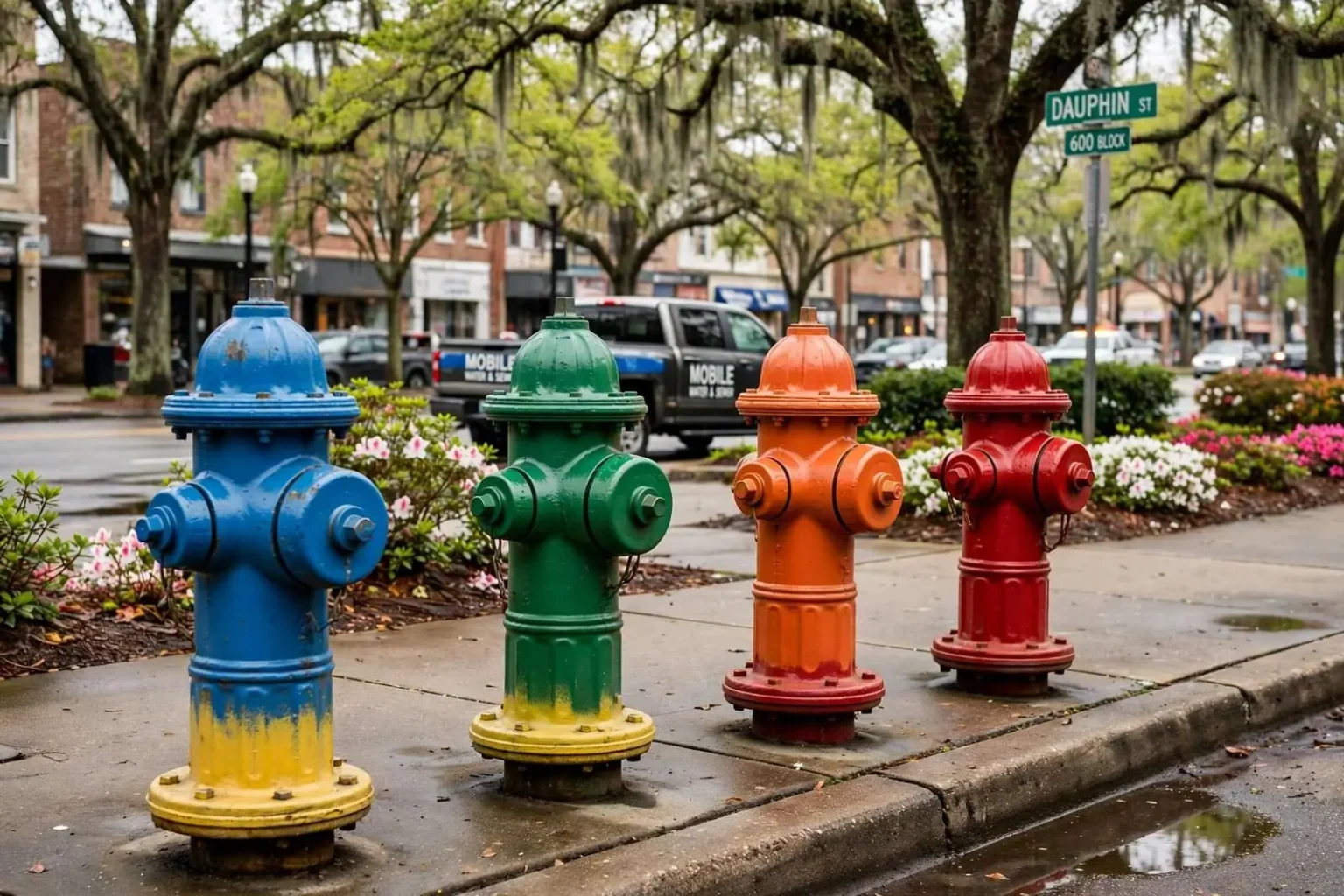
MOBILE — With spring brightening the streetscape, Mobile’s fire hydrants seemed to be blooming too — freshly painted in an assortment of hues, some wearing bonnets of blue, others green or orange, their bases yellow or red.
The colors are not decoration, and they are not the whim of a public works crew with leftover paint. They are a code, and Steve Huffman of the Mobile Fire Department explained what it means. Every hydrant in the city is wearing, in effect, a performance rating that any firefighter can read at a glance from a moving engine.
Mobile’s hydrant system is spread across a city that runs from the dense, older grid downtown to the sprawling newer neighborhoods on the western side, tied together by hundreds of miles of water mains of very different ages and sizes. A hydrant on a main installed in one decade does not behave like one on a main installed in another, and the fire department has long needed a way to keep that information in front of the crews who depend on it.
What the colors say
“The hydrants are color coded based on the size of the water main, the amount of water it will supply and discharge, and the pressure to which it is discharged,” Huffman said.
The critical number is what firefighters call available flow — how much water a given hydrant can actually deliver, measured in gallons per minute. Under the National Fire Protection Association’s standard, NFPA 291, the hydrant’s top — the bonnet — and its caps are painted according to that capacity:
Blue: 1,500 GPM or more. Very good flows. Green: 1,000 to 1,499 GPM. Good for residential areas. Orange: 500 to 999 GPM. Marginally adequate. Red: below 500 GPM. Inadequate. Blue is best; red is a warning.
The NFPA, the nonprofit organization whose codes govern fire protection across the United States, publishes NFPA 291 as the recommended practice for fire flow testing and marking of hydrants. The standard is the reason a hydrant in Mobile and a hydrant in Chicago or Phoenix can carry the same meaning: the color classes were designed so that a crew arriving in any compliant city knows, without a manual, whether the water in front of it is abundant, adequate or scarce.
Those flow numbers are not estimates. They come from flow tests, in which crews open a hydrant and measure both static pressure and residual pressure while water discharges at a known rate. The difference between the two tells the water system how much the main can truly supply, and the results drive both the painting schedule and the fire department’s pre-incident planning.
Why it matters at 3 a.m.
The practical stakes are considerable. “Primarily, we need to know how much water is available from the closest hydrant so that we may select the appropriate size hose lines for the size and complexity of the fire,” Huffman said, “but not select lines which would exceed the capacity of the hydrant and thus be ineffective.”
That is the crux of it. A hose line too large for its hydrant does not deliver more water — it delivers less, or none. A crew that connects a heavy line to a red-capped hydrant on a residential street has not gained firepower; it has wasted the only minutes that mattered.
Fireground decisions are made in seconds. The first engine on scene has to choose where to connect, what diameter line to stretch and whether to plan for additional supply before the first drop of water is ever moved. A blue bonnet says the crew can commit to heavy streams and expect replenishment; an orange or red bonnet says the plan must change — smaller lines, a second hydrant farther away, or a call for additional engines to relay water from a better source.
Pressure is the second variable, and it is a peculiarly local one. “Water pressure is affected by elevation,” Huffman said. “The communities that we serve are spread over many elevations so pressures found in hydrants vary greatly.”
Mobile runs from near sea level along the waterfront up through the ridges of Spring Hill and beyond, and a hydrant’s pressure varies accordingly. Water pushed up into the higher neighborhoods loses force with every foot of elevation gained, while hydrants near the river and the bay sit at the bottom of the gradient where pressure is naturally strongest. Two hydrants a mile apart can behave like two different systems.
Knowing the range in advance lets a crew implement the correct pumping operation immediately and compensate for low pressure using the pumps aboard the engine. A pumper can boost the flow a weak main provides, but only if the operator knows going in that a boost is needed — which is exactly what the color code communicates before the first coupling is ever made.
A system built for a glance
Why paint, rather than a database or a placard? Because of how firefighters actually encounter hydrants.
“It has also been found that the most efficient means to convey this important information to firefighters is to paint the hydrant tops and caps using standardized color codes,” Huffman said. “These colors give us a reasonably accurate picture as to how the hydrant should perform. They are easy to recognize, and as fire crews travel the streets performing their various duties, they see these hydrants and get a feel for where the problem areas exist well in advance of a fire alarm being called in.”
That last clause is the elegant part. The system does not merely inform a crew at the moment of an emergency; it teaches them their district passively, over months of ordinary driving, so that by the time an alarm sounds they already know which blocks are thin on water.
Fire departments run on familiarity. The same companies respond to the same neighborhoods week after week — inspections, medical calls, false alarms — and every one of those routine trips is a chance to absorb the water map without a lesson. A driver who has passed a stretch of orange-capped hydrants fifty times does not need to be told, at 3 a.m., that the area around it is marginal.
Flow classes also matter to the water utility as much as to the fire department. Weak hydrants flag weak mains: a cluster of orange or red caps points the water system to pipe that is undersized, aging or choked with buildup, and fixing it is cheaper and easier when the problem has already been marked in paint for everyone to see. In that sense the color code works as maintenance planning as much as firefighting intelligence, tying the fire department’s paintbrush to the water system’s capital budget.
The paint also survives the conditions that defeat paper. Hydrants stand outside through Gulf Coast humidity, rain, sun and years of use; a chart in a station binder is only as current as its last revision, but the bonnet on the corner is always on scene, always current, and visible to every unit that drives past it.
The base is a different story
Huffman noted that typically only the bonnet and caps carry the flow code. The base of a hydrant may be white, yellow, red or violet in various parts of the country; in Mobile, yellow and red predominate.
“It’s the basic colors of the caps that matter most,” he said.
The base colors are mostly a matter of manufacturer and local preference rather than performance. Body paint has no meaning under NFPA 291 — the information lives in the bonnet and the caps — but cities often paint bodies to match their own fleets and fixtures, which is why Mobile’s streetscape shows a mixture of yellow and red bases beneath the more telling tops.
Violet bases, where they appear elsewhere in the country, carry one important exception worth knowing: in many jurisdictions violet indicates non-potable water — a reclaimed or raw-water system that should not be used for drinking. Mobile’s residential hydrant network is potable, which is one more reason the base color never carries the critical message here.
The standard appears in both the International Fire Code and the NFPA code and is recognized nationwide — which means a firefighter from Mobile could arrive in a strange city that follows it and read its hydrants at a glance. Mutual aid works both ways: when crews from across the region converge on a large fire, every one of them is reading the same painted language.
Not every city does. Some systems mark hydrants by ownership, some by their own local schemes, and some do not repaint after flow conditions change. But where the code is followed, the language is the same.
So the next time a hydrant on a Mobile street corner appears to be wearing a bright blue hat, it is not decoration. It is telling anyone who knows how to read it that if the house behind it ever catches fire, there will be water enough. And if it wears orange instead, the message is just as clear: the water here is thinner than it looks, and the crews who answer the alarm already know it.