
Lions Club to Roast a Retired Congressman in Mobile
The Mobile Lions Club scheduled its third annual celebrity roast for April 20, 2006, with retired U.S. Rep. H.L. 'Sonny' Callahan as the guest of honor and a lineup of local roasters.
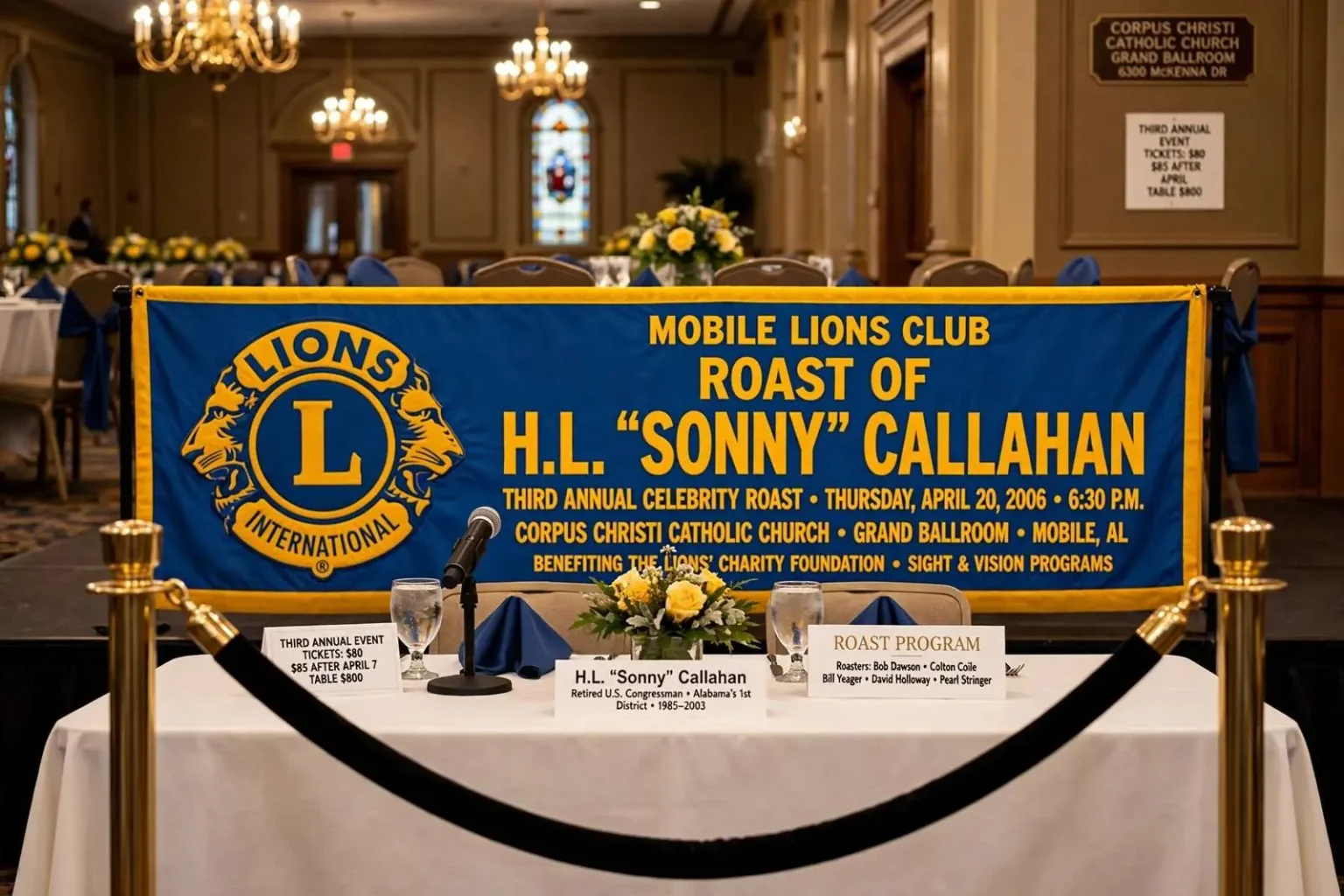
MOBILE — The Mobile Lions Club announced it would roast former U.S. Congressman H.L. “Sonny” Callahan on Thursday, April 20, 2006, at 6:30 p.m. in the Grand Ballroom on the campus of Corpus Christi Catholic Church, 6300 McKenna Drive, off Hillcrest Road near Airport Boulevard. The event marked the Lions Club’s third annual celebrity roast. Previous headliners had included then-Mayor Mike Dow and the late Joel Swanson. Proceeds benefited the Lions’ Charity Foundation.
By its third year, the roast had established itself as one of the spring’s reliably popular civic events in Mobile — an evening built on the promise that a prominent local figure would sit good-naturedly at a head table while friends and colleagues took turns at the microphone.
The roasters
The lineup announced at the time included: Bob Dawson. Colton Coile. Bill Yeager, Callahan’s longtime media consultant — the sort of person who knows exactly which stories a candidate spent thirty years hoping nobody would repeat in public. David Holloway, a local food writer, billed with characteristic irreverence as its “Doctor of Cuisine” and a recipient of Tony Chachere’s Christmas card. Pearl Stringer, or, as the announcement allowed, a less sophisticated relative.
The menu was overseen by Lion and longtime Mobile restaurateur Filippo Milone, formerly of The Pillars — a restaurant that occupied a particular place in the city’s memory as the site of decades of political dinners, wedding receptions and deals.
Tickets were $80 per person until April 7, rising to $85 thereafter, or $800 for a table of ten. Seating was limited. Information was available from Melisa Yeend.
The ticket pricing followed a pattern familiar to Mobile’s charity-event calendar: an early-bird rate that rewarded prompt committees, a modest bump as the date approached, and a table-of-ten price aimed at the banks, law firms, contracting companies and real estate offices that historically filled the room. Corporate tables were the backbone of events like this one, and the $800 table price put an evening of roasting within reach of any downtown firm that wanted its name attached to the Lions’ work.
The venue itself was a natural choice. Corpus Christi’s Grand Ballroom sat in the middle of the Hillcrest Road corridor, minutes from both Spring Hill and West Mobile, with parking and capacity that smaller downtown halls could not match. For an audience drawn from every corner of the city — and, in Callahan’s case, from every corner of the First Congressional District — the church campus was an easy drive for nearly everyone.
Why Callahan was worth roasting
Sonny Callahan was, by 2006, one of the more remarkable political survivors in south Alabama history. He had served roughly thirty years in elected office at the state and federal levels, and had done so as both a Democrat and a Republican — a party switch that, in the Alabama of the late twentieth century, was less an act of betrayal than an act of demographic realism.
He represented Alabama’s First Congressional District in the U.S. House from 1985 until his retirement in 2003, rising to chair the House Appropriations subcommittee on foreign operations. For a district anchored on the Port of Mobile, a seat on Appropriations was not a ceremonial honor; it was the mechanism by which harbor deepening, military installations, roads and federal buildings arrived.
Callahan’s path to Congress ran through the Alabama State House, where he spent well over a decade in the legislature before moving to Washington. In the House, he built a reputation as a workhorse rather than a show horse — a member who traded seniority for results and who could be counted on, election after election, to win easily in a district that had grown steadily more Republican during his tenure.
The foreign operations subcommittee chairmanship suited both the district and the man. Mobile’s economy has always depended on what moves through its port and what the federal government builds along its waterfront, and a chairman with authority over overseas aid and international programs sat at the center of the appropriations process that funded American engagement abroad. Colleagues in both parties knew him as a courteous, serious committee man; back home, he remained a retail politician of the old school, comfortable in a fish camp or a church fellowship hall.
He was also, by wide agreement, a man with a sense of humor about himself — a prerequisite for the evening. Retired politicians who cannot bear to be teased rarely agree to sit through a roast; Callahan had spent three decades answering constituents’ questions and enduring editorial pages, and by 2006 the stories of his career were the shared property of every political hand in the room.
The roast as a local institution
The celebrity roast has a durable place in the civic life of American cities, and Mobile is no exception. It works because it collapses the ordinary distance between the powerful and everyone else for a couple of hours, and because it raises money for causes — in the Lions’ case, principally sight and vision programs — that would otherwise depend on more tedious appeals.
There is a reason the format persists. A luncheon speech by a retired congressman sells a modest number of tickets. A promise that his own media consultant will spend fifteen minutes at a microphone telling the room what really happened sells considerably more.
The Lions Club’s connection to sight and vision work is one of the oldest service commitments in American civic life. Lionism’s founding pledge to serve the blind and visually impaired has made sight conservation, eye exams, glasses drives and vision research the recurring beneficiaries of Lions fundraising across the country, and Mobile’s club carried that tradition into its local giving through the Charity Foundation. Every ticket sold that April evening translated directly into that mission.
The first two roasts had set the tone. Mike Dow, then mayor, had spent years as the most visible public official in the city, and Joel Swanson — remembered in the announcement as “the late,” a reminder of how quickly Mobile’s civic generation turned over — had been a familiar figure in the community’s public life. Roasting Callahan in the third year was, in a sense, an elevation: the headliner was a man who had represented the entire district in Washington for eighteen years.
Callahan, who had by then been out of Congress for three years and remained an active presence in Mobile’s political life — he served as campaign chairman for a candidate in the city’s 2005 mayoral race — was a natural choice. Retirement from Congress had not meant retirement from Mobile politics, and anyone buying a ticket knew the evening might double as an informal update on where the city’s political currents were running.
The Grand Ballroom at Corpus Christi was expected to fill. For $80 — $85 for procrastinators — attendees would get a Milone-supervised dinner, a lineup of roasters that included the man who had managed Callahan’s public image for decades, and the particular pleasure of watching a three-decade public servant take the stage not as a candidate but as a target. In Mobile’s civic calendar, there were worse ways to spend a Thursday in April.
Mobile’s tradition of political humor
Mobile has long been a town where politics and entertainment mix easily, and the roast format fits the city’s temperament. The port city’s political culture — shaped by Mardi Gras mystic societies, courthouse factions and a business community that treats election years as a spectator sport — has always rewarded public figures who can take a joke and deliver one. Callahan, whose congressional campaigns were famously run on shoe leather and personal visits as much as advertising, came out of that tradition, and his audiences had watched him deploy self-deprecating humor for three decades.
The roasters selected for the evening reflected that same culture. A media consultant who knew the candidate’s history better than any reporter, a food writer with a national seasoning company’s Christmas card to his name, and a relative introduced with a deliberately unflattering description — the announcement’s own copy made clear that the club intended the night to be genuinely funny rather than merely ceremonial. Roasts in Mobile were understood to be affectionate, but nobody bought a ticket expecting a puff piece.
The choice of a church ballroom for the event also said something about how south Alabama’s civic and religious institutions overlap. Parish halls and church campuses host an enormous share of the region’s charity functions, political forums and community dinners, a practical arrangement that reflects both the capacity those buildings offer and the central place congregations hold in local social life. An April roast under the auspices of a service club, in a Catholic parish ballroom, benefiting vision charities, was a thoroughly Mobile evening.
What the proceeds supported
The Lions’ Charity Foundation directed the evening’s proceeds toward the organization’s charitable work in the community, with sight and vision programs standing at the historical center of Lions giving. Local Lions clubs across Alabama have funded eyeglasses for schoolchildren, supported clinics and screenings, and contributed to research and service organizations for the blind — work that continues quietly year-round and depends on events like the April roast for its funding.
Service clubs such as the Lions occupy a distinctive place in a city like Mobile. Between the large philanthropic foundations and the ad hoc charity drives, the clubs provide the volunteer infrastructure that turns small donations into concrete assistance, and their fundraising events double as the social occasions where the community’s business, political and professional circles actually gather. A roast of a retired congressman was simultaneously a fundraiser, a reunion and, for the civic-minded, a cheap form of political intelligence.
For attendees, the evening delivered what the format promises: a well-fed room, a series of toasts and roasts from people who knew the honoree when, and the sight of a former subcommittee chairman laughing at stories that would never have made a campaign mailer. The Mobile Lions Club’s third annual roast had found its headliner, and the Grand Ballroom at Corpus Christi was expected to hold every one of them.