Bentley Joins Ribbon-Cutting for Fairhope Aviation and Trades Academy
Gov. Robert Bentley joined Fairhope leaders to dedicate a new workforce academy teaching aviation, welding and industrial maintenance skills.
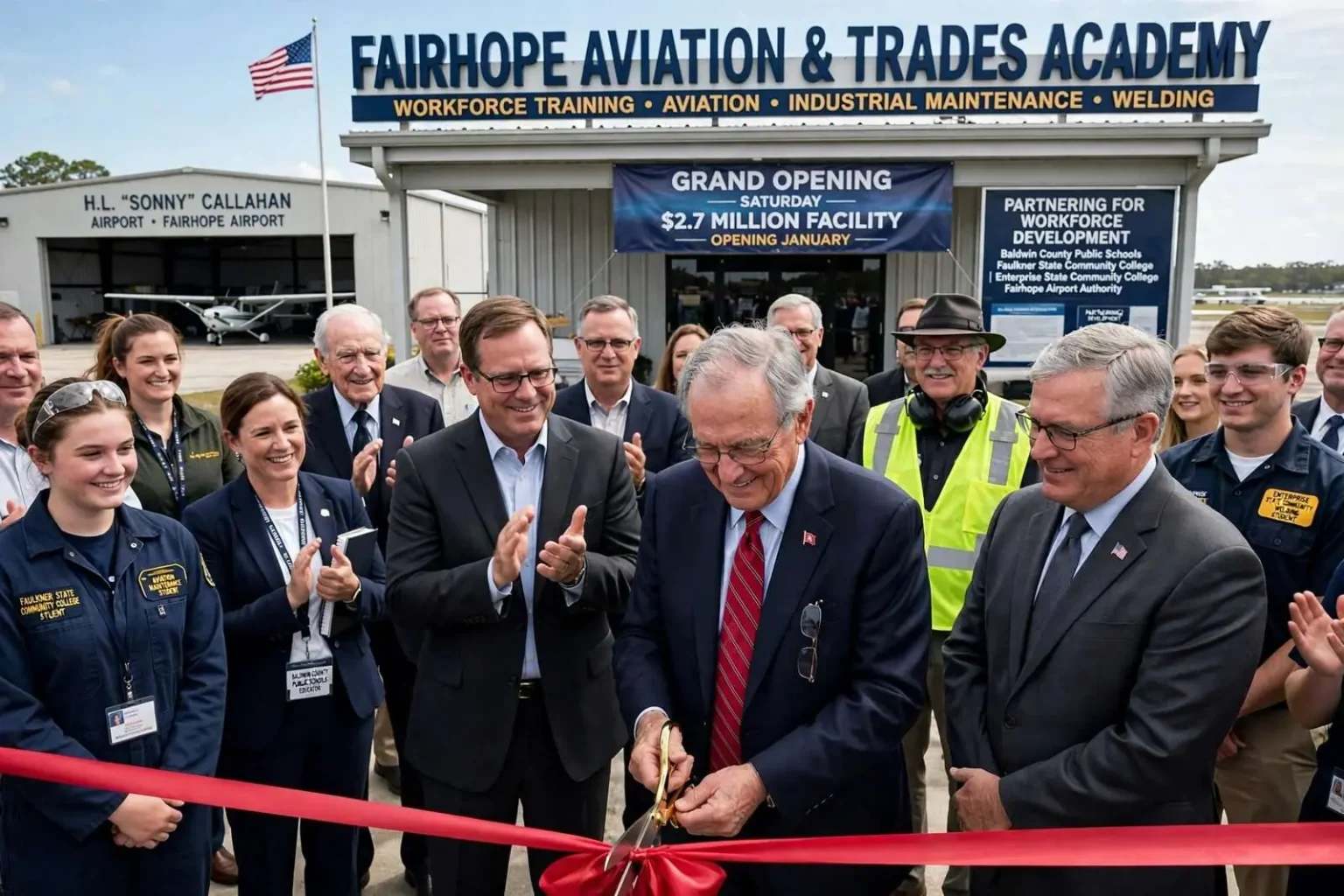
Educators, elected officials, students and residents gathered at the Fairhope Airport on Saturday to formally dedicate a new workforce training academy that supporters say could reshape the local job market for years to come.
Alabama Gov. Robert Bentley traveled to the ceremony outside H.L. “Sonny” Callahan Airport to help cut the ribbon on the Academy at the Fairhope Airport, a $2.7 million, 15,000-square-foot facility that began teaching students in January. The academy offers coursework in aviation, industrial maintenance and welding, with classes open to both high school students earning college credit and adult learners looking to retrain for skilled trades.
“If you don’t have a skilled workforce, you can’t recruit and you can’t retain,” Bentley told the crowd, adding that international companies considering Alabama look closely at the quality of the local labor pool. “They know one thing about Alabamians: they know that Alabamians work harder than anyone else in the country.”
The governor’s presence at a county academy dedication was itself a statement about priorities. Bentley had made workforce development a signature theme of his administration, arguing that the state’s economic development successes — automotive plants, aerospace projects and expanding ports — depended on a pipeline of trained workers. An academy teaching aviation and the trades on the Gulf Coast fit squarely into that message, and the governor used the podium to reinforce it.
A Decade in the Making
Fairhope Mayor Tim Kant said the academy grew out of an idea first floated roughly nine years earlier and represents years of planning among local and state partners. “We have an opportunity to make sure our children will be able to finish up high school, have a job where they can support their families right here and never leave Fairhope,” Kant said. “That’s the most positive thing that we can do.”
That nine-year arc is common for projects of this kind. A workforce academy requires land, funding, an institutional partnership, a curriculum aligned with actual employer demand and a building — and each step in Baldwin County involved multiple boards and agencies moving together. The dedication ceremony marked the point where all of those threads finally tied off, with students already inside the building and learning.
The trades the academy teaches were chosen for their staying power. Welding and industrial maintenance are the connective tissue of nearly every manufacturing operation in the region — shipyards, fabrication shops, food processors and the aerospace suppliers spread along the Gulf Coast all depend on them. Aviation maintenance, meanwhile, pairs a national shortage of certified technicians with a local industry presence that keeps growing. None of the three fields can be automated away easily, and all of them pay wages that can support a family without a four-year degree.
A Gathering of the Gulf Coast’s Representatives
The event drew a notable lineup of current and former officials representing Alabama’s coastal congressional district. U.S. Rep. Bradley Byrne, a Fairhope Republican who serves on the House Education and the Workforce Committee, sat alongside three of his predecessors in the seat: Jack Edwards, who served from 1965 to 1985; Sonny Callahan, who held the office from 1985 to 2003; and Jo Bonner, who served from 2003 to 2013.
Byrne told attendees the country faces a widening skills gap as experienced workers retire, calling the new academy a step toward closing that gap locally.
The skills gap Byrne described is not an abstraction on the Gulf Coast. Employers across the region report difficulty filling maintenance and technical positions as veteran tradespeople retire faster than replacements are trained, and community colleges statewide have responded by expanding programs built directly around employer needs. The Fairhope academy is that response rendered in a building — and its opening with students already enrolled showed the gap was real enough that the community did not wait for the ribbon to be cut.
The gathering of four generations of the district’s representatives was unusual by any measure. Edwards, Callahan and Bonner each left their own imprint on the Gulf Coast — federal investments in the port, the coast’s infrastructure and the region’s institutions — and their appearance together at a local academy dedication signaled how completely workforce training had become the region’s shared cause across party generations. The airport itself carries the Callahan name, a reminder of that continuity.
Al Thompson, who represents District 1 on the Alabama State Board of Education, said he has spent two decades working with lower-income families in Baldwin County and believes the academy’s hands-on training could change lives by opening doors to well-paying, in-demand trades. For families for whom a four-year degree is neither affordable nor the right fit, a pathway that starts in high school and ends in a certified trade is often the difference between staying in the community and leaving it.
Mark Heinreich, chancellor of the Alabama Department of Postsecondary Education, said he hopes the Fairhope model spreads to other parts of the state. “If we’re going to fill those high-skill, high-wage jobs in this state, we’re going to have to dot the state with these kinds of facilities,” he said.
How the Partnership Works
The academy was built through a partnership among Baldwin County Public Schools, Faulkner State Community College, Enterprise State Community College and the Fairhope Airport Authority, combining K-12 and two-year college resources under one roof. Organizers say the goal is to give students a direct path from high school coursework into certified trades without requiring them to leave the area for training.
That structure solves two problems at once. High school students earn college credit while still in school, shortening the time and cost of a credential, and the two-year colleges gain a facility and a feeder pipeline without building one alone. The airport authority’s role is equally practical: an operating airfield gives aviation students proximity to the environment they will work in, and it gives the airport a stake in producing the mechanics and technicians the industry needs.
The placement on an airfield also matters for aviation instruction specifically. Aircraft maintenance programs require space, hangar-type buildings and an operational setting for students to see the systems they are learning about. Alabama’s aviation employers — from the aerospace manufacturers clustered around Mobile’s shipbuilding and aerospace corridor to the fixed-base operators serving Gulf Coast airfields — need certified technicians, and programs sited at working airports have historically been the most direct route into those jobs.
What It Means for Baldwin County’s Economy
Baldwin County’s rapid growth supplies the demand side of the equation. As one of the fastest-growing counties in Alabama, it has attracted new residents, schools, retail and medical facilities — all of which depend on the trades the academy teaches. Industrial maintenance technicians and welders are on the hiring lists of manufacturers across the region, and aviation maintenance skills travel well beyond the local market in an industry with nationwide shortages.
Supporters of the academy point to the double benefit for the county’s economy: keeping young talent at home while making the area more attractive to employers deciding where to expand. A company considering a Baldwin County site can now point to a local source of trained workers — and students who might otherwise have left for trade school elsewhere can complete their training at home, then take jobs in Mobile, Baldwin County or along the entire Gulf Coast without relocating.
For the students already studying inside the building, the ceremony carried its own lesson. Seeing a governor, a congressman and three former members of Congress gather at their school sent a signal about how seriously the state takes what they are learning — and, in a county where new schools and facilities have opened alongside thousands of new residents, about the futures available close to home. Instructors used the day to show visitors student work in progress, from welding booths to maintenance projects underway in the aviation bays.
The academy’s model also reflects how career and technical education has changed. The old stereotype of shop class as a track for students not bound for college has given way to programs that stack credentials, articulate directly into college credit and lead to certifications that employers recognize nationwide. Dual-enrollment students finish high school with a head start on a credential; adult learners can retrain mid-career without uprooting their families. The academy is built for both at once, which is precisely the flexibility the state’s workforce officials have been pushing for.
With the facility already operating since January, Saturday’s ceremony served largely as a public celebration of a project years in the making, and as a signal from state leaders that workforce training tied to aviation and skilled trades remains a priority for Baldwin County’s economic future. The ribbon-cutting, four generations of congressional representatives, a governor and a room full of students made the point in person: the county had built the facility it spent nine years planning, and the task now was filling it — and the jobs it points toward — for years to come.