Mobile Police Arrest 12 in Two-Day Crackdown on Synthetic Drugs
Mobile police arrested 12 people and seized homemade and packaged spice during a two-day operation targeting the synthetic drug across the city.
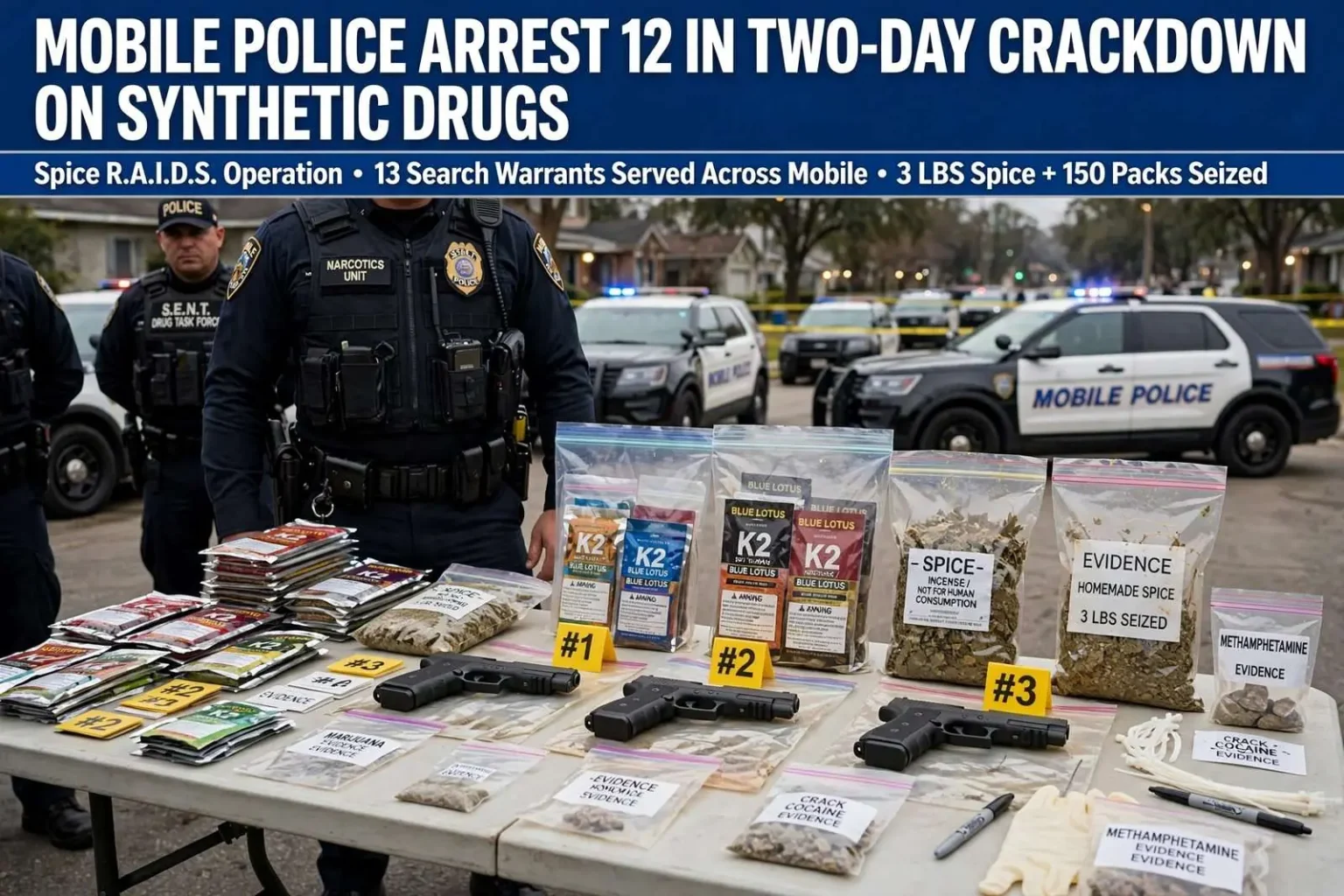
Mobile police arrested 12 people over two days in a coordinated crackdown targeting the sale and possession of spice, the synthetic drug that has sent hundreds of local residents to area emergency rooms in recent months. Officers served 13 search warrants across the city Thursday and Friday as part of an operation authorities dubbed Spice R.A.I.D.S., short for Reduction Awareness Interdiction Deterrence Strategy.
Mobile Police Department spokeswoman Ashley Rains said the operation was designed “to curtail the current epidemic” of spice use in the area. The two-day sweep represented one of the department’s most concentrated enforcement actions against the drug, pulling together multiple specialized units for a single coordinated effort aimed at the retail network distributing the product on city streets.
Who was arrested and what was seized
Of the 12 people taken into custody, eight face spice-related charges. Five were charged with possession of the substance, while three face charges of distribution. One suspect named by authorities could not immediately be located in Mobile County Metro Jail records, and police have not explained the discrepancy.
During the raids, officers seized roughly three pounds of homemade spice along with approximately 150 packs of prepackaged product, according to Rains. Investigators also recovered three handguns and small amounts of marijuana, crack cocaine and methamphetamine during the searches. The mix of recovered items illustrates how spice operations frequently overlap with other illegal activity — the handguns discovered during the searches underscored the violence risk that accompanies open-air drug markets in residential neighborhoods.
The operation touched neighborhoods across Mobile, with warrants served at locations including blocks of Owens Street, LeCren Street, Government Street, Graham Avenue, Columbia Street, Frederick Street, Hemley Avenue, Navco Road, Cherokee Street and multiple blocks along 10th, 11th and 2nd streets. The sweep of addresses reached from downtown corridors into residential neighborhoods across the city, a geographic spread that police said reflected how widely spice had penetrated the local market rather than being confined to a single area.
A multi-unit effort
Multiple units within the Mobile Police Department took part in the coordinated effort, including the Narcotics Unit, the Mobile County Street Enforcement Narcotics Teams’ Drug Task Force, the Tactical Intelligence Detail, the Community Services Division and the Community Based Response Accountability Detail. The combination paired investigative and tactical units with community-facing divisions, an approach the department has used when it wants enforcement to be followed by visible engagement in the affected neighborhoods.
The Mobile County Street Enforcement Narcotics Team, known regionally as the S.E.N.T. Drug Task Force, pools officers from area agencies to pursue drug distribution networks that cross jurisdictional lines, while the Tactical Intelligence Detail supplies the surveillance and case-building work that search warrants of this scale depend on. Community Services and the accountability detail handle the follow-up — communicating with residents, connecting users with treatment resources and monitoring the corners where the warrants were served.
The health emergency behind the raids
The crackdown comes as spice-related health emergencies have surged locally. According to the Alabama Department of Public Health, Mobile County emergency rooms treated at least 250 people for spice-related complications in a matter of months, a caseload that strained emergency departments and alarmed public health officials. The emergencies ranged from rapid heart rates and seizures to severe agitation and psychosis, and local physicians described symptoms far more dangerous than those associated with marijuana, the drug spice is chemically unrelated to despite its marketing.
Spice — often sold under names like K2, Blue Lotus, Scooby Snax or simply “synthetic marijuana” — consists of plant material sprayed with laboratory-produced chemicals that act on the brain far more powerfully than THC. Because the chemical formulas are constantly altered to stay ahead of state laws, users frequently have no way of knowing what substances they are actually ingesting, and the same brand bought two weeks apart can contain entirely different compounds. Medical toxicologists have repeatedly warned that this unpredictability is what makes the drug uniquely hazardous, particularly for young users who assume the packaged product is safe because it is sold openly.
In Mobile, the problem was compounded by how the product reached users — sold in small retail packs at convenience stores, gas stations and street-level dealers across the city, at prices low enough to attract teenagers and users of other drugs. The packaged format also made street-level distribution easy to hide, which is why the enforcement response relied on search warrants built from neighborhood complaints and undercover purchases rather than a single large trafficking case.
How the cases will proceed
The charges filed against those arrested range from misdemeanor possession to felony distribution counts, depending on the quantity involved and each suspect’s prior record. Distribution charges tied to spice carry significant prison exposure under Alabama law, which the Legislature has repeatedly amended in attempts to keep pace with the shifting chemical formulas manufacturers use. Prosecutors in Mobile County have treated spice distribution cases as priorities during the surge in emergency room visits, and convictions can also trigger the seizure of assets connected to the sales.
Police officials have framed operations like Spice R.A.I.D.S. as a continuing strategy rather than a one-time event, warning retailers and street dealers alike that enforcement will return to neighborhoods where the product reappears. The department has also pressed the public-reporting angle: Rains and other spokespeople have encouraged residents to report spice sales through the department’s tip lines, noting that several of the addresses served in this operation first came to investigators’ attention through community complaints.
The arrest figures themselves tell the story of a layered market. Possession charges pointed to street-level sellers, while the three distribution cases targeted the supply line feeding the packaged product into neighborhoods. Investigators say the seized homemade spice — roughly three pounds of loose product alongside the 150 retail packs — suggests local packaging operations rather than simple resale of manufactured inventory, a detail that matters for both prosecution and for tracking where the chemicals originate.
What spice does to users
The medical picture behind the raids is grim and well documented. Synthetic cannabinoids bind to the same brain receptors as THC but with a potency that can be dozens to hundreds of times stronger, producing effects that include vomiting, kidney injury, dangerous drops in blood pressure, aggressive behavior and, in the most severe cases, death. Emergency physicians in Mobile and across Alabama have reported patients arriving unconscious, combative or in full psychotic episodes after using the drug, and the poison control network has tracked waves of hospitalizations each time a new chemical formulation hits the market.
Young people have been particularly affected. Because spice is marketed with colorful packaging and labels claiming it is incense or potpourri — “not for human consumption” printed in fine print — it has circulated in settings where marijuana itself is unavailable or risky, including schools and workplaces with drug testing. Public health campaigns in Mobile have stressed that the drug bears no real relation to marijuana despite the nickname, and that a single use can produce a medical emergency in an otherwise healthy teenager.
The path forward for the neighborhoods involved
For the residents of the streets where the 13 warrants were served, the operation’s aftermath will determine whether it produces lasting relief or a temporary dip in activity. Community policing units have planned follow-up visibility in the affected neighborhoods, and the department’s accountability detail continues to work with neighborhood associations on the complaints that built the underlying cases. Residents’ willingness to report open-air sales remains the single most important ingredient in future operations, investigators say.
The two-day timeline also demonstrated the department’s capacity for rapid, citywide coordination. Search warrants of this number ordinarily require weeks of individual casework; compressing 13 of them into Thursday and Friday required the specialized units to run parallel investigations and execute simultaneously, minimizing the warning time available to dealers. Police officials described the model — intelligence gathering, simultaneous execution and immediate community follow-up — as a template for future operations against both spice and other street-level drugs.
Meanwhile, the health side of the crisis continues to be tracked by the Alabama Department of Public Health, whose emergency-room surveillance gave the Spice R.A.I.D.S. operation its urgency. Public health officials and police alike have emphasized that enforcement alone cannot end a synthetic drug epidemic — treatment access, education and the constant chase of new chemical formulas all play roles — but the two-day sweep delivered a message to Mobile’s spice trade that the city intended to meet the emergency room numbers with handcuffs, one neighborhood at a time.
With 12 arrests, 13 warrants, three pounds of seized spice and 150 packs of packaged product off the street, the operation marked the largest single enforcement action of the local spice surge to date — and a signal that Mobile’s response to the synthetic drug crisis had entered a more aggressive phase.