Baldwin County Adds Loxley Officer’s Name to Law Enforcement Memorial
Baldwin County officials honored a fallen Loxley police sergeant during a National Police Week memorial ceremony held in Robertsdale this week.
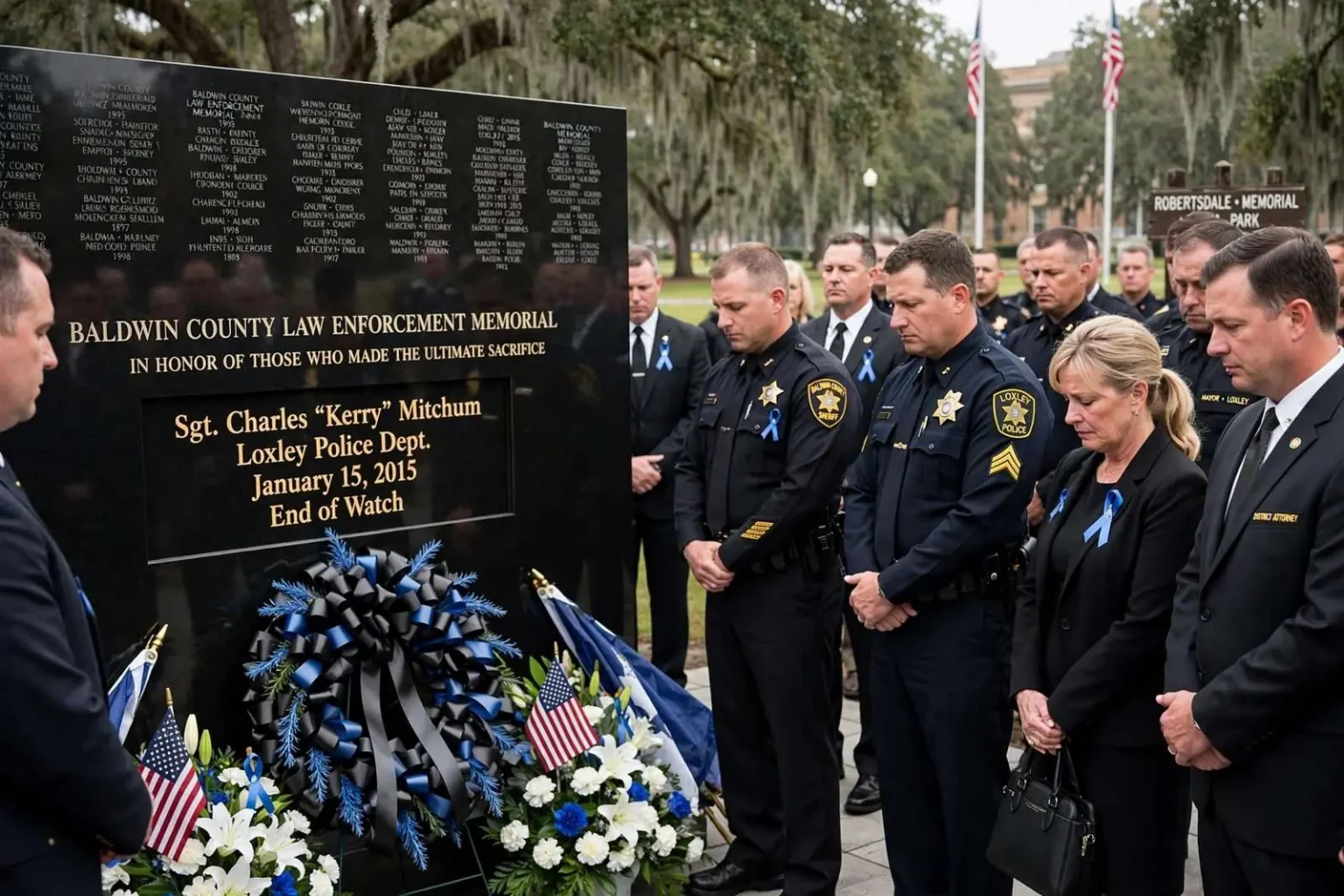
Officials in Baldwin County gathered Tuesday morning to add the name of a Loxley police sergeant to the law enforcement memorial in Robertsdale, part of a ceremony recognizing officers from across the county who have died in the line of duty. The service marked the formal engraving of a name that has now become part of the county’s permanent record of sacrifice. Attendees filled the memorial grounds for a program that blended remembrance, reflection and recognition of the risks that come with wearing a badge in communities large and small.
Sgt. Charles “Kerry” Mitchum, a member of the Loxley Police Department, died in late January 2015 following a single-vehicle accident linked to an apparent medical episode. His death underscored a reality familiar to law enforcement families across the Gulf Coast: not every line-of-duty loss comes from a confrontation or a high-speed pursuit. Medical emergencies behind the wheel, traffic crashes and training accidents all claim officers’ lives, and classification policies increasingly recognize those deaths as deaths in the line of duty when the officer was serving at the time.
Mitchum’s passing in early 2015 rippled through the small law enforcement community of southern Baldwin County, where municipal departments frequently work side by side and officers often know one another by name long before they meet on a call. Loxley, a growing town along the U.S. 90 and Alabama 59 corridors near Robertsdale, fields a police department whose officers handle everything from traffic enforcement along the busy routes that feed the beaches to the day-to-day calls that come with rapid residential growth in the county’s central corridor.
Family members, friends and fellow Loxley officers attended the memorial service, which drew a wide cross-section of the county’s law enforcement and judicial leadership. The presence of prosecutors, judges and federal investigators alongside municipal officers reflected the way a single officer’s death reaches across every level of the justice system that depends on the work police do each day.
A Countywide Tribute
Baldwin County District Attorney Hallie Dixon, Loxley Mayor Billy Middleton and Probate Court Judge Tim Russell were among those who took part, alongside the special agent in charge of the FBI’s Mobile Field Office and police chiefs representing multiple departments throughout Baldwin County. Dixon’s office prosecutes felony cases arising from Baldwin County arrests, making her participation a signal of the connection between the officers who make cases and the lawyers who carry them to court. The FBI’s Mobile Field Office, which covers South Alabama’s coastal counties, works routinely with local departments on major investigations, and its attendance reflected those standing partnerships.
The gathering was designed not only to honor Mitchum but to recognize every Baldwin County officer who has died while serving the community. Ceremonies of this kind traditionally include a reading of the names already inscribed on the memorial, remarks from local officials, and a moment set aside for the families of the fallen. For the departments involved, the annual ritual serves a practical purpose as well: it reminds younger officers, many of whom never met the men and women whose names appear on the stone, that the history of policing in Baldwin County includes real people who left for a shift and did not come home.
Robertsdale, where the memorial stands, sits at the center of southern Baldwin County’s network of small cities — Foley, Loxley, Summerdale, Elberta, Silverhill and Robertsdale itself — whose police departments together provide daily coverage for tens of thousands of residents across the county’s southern half. Hosting the county’s memorial in that corridor places it within easy reach of the departments whose officers are most often represented on it.
Why the Name Engraving Matters
Adding a name to a county memorial is a formal act with meaning beyond symbolism. Once inscribed, an officer’s name becomes part of the public record of the community’s debt, read aloud at future ceremonies and visited by family members long after the funeral crowds have gone home. For departments like Loxley’s, the county memorial also ensures that an officer’s sacrifice is remembered at a scale larger than any single town could sustain on its own.
According to the Officer Down Memorial Page, at least seven law enforcement officers have lost their lives in the line of duty in Baldwin County dating back to 1895. The Officer Down Memorial Page, a nonprofit database founded in 1987, has become the standard national reference for documenting officer deaths, tracking each case with dates, circumstances and agency affiliations. Its records for Baldwin County span more than a century, stretching back to an era when the county’s law enforcement consisted of a handful of deputies and town marshals patrolling an agricultural landscape of farms, sawmills and small rail towns long before the beach communities boomed.
Officials at the ceremony also noted that 118 officers died in the line of duty nationwide in the prior year alone, underscoring the risks law enforcement personnel face even in smaller communities. That figure includes officers killed in traffic-related incidents, which for years have ranked alongside shootings as a leading category of line-of-duty death — a fact that gives particular weight to cases like Mitchum’s, where a crash and a medical episode ended a career in an instant. National totals of that scale land differently in a county like Baldwin, where the annual addition of even a single name to the memorial wall is felt across every department in the county.
National Police Week Context
The Baldwin County ceremony was one of several held across the region as part of National Police Week, an annual observance dedicated to honoring law enforcement officers nationwide. The observance traces its origins to 1962, when Congress designated May 15 as Peace Officers Memorial Day and the week in which it falls as Police Week. In Washington, the week draws thousands of survivors and officers to memorial events at the National Law Enforcement Officers Memorial, while communities across the country hold local ceremonies of their own — events like the one in Robertsdale that bring the national observance down to the courthouse square and the memorial park.
For Gulf Coast agencies, Police Week has become a fixture on the calendar that pairs formal remembrance with community engagement. Departments use the week not only to honor their dead but to explain to residents what the thin blue line of names on a memorial represents: deputies, municipal officers, state troopers and federal agents whose service ended in circumstances recorded forever in the public record. The timing in mid-May also places the observance ahead of the busy summer season along the coast, when the region’s police departments surge in staffing to handle the influx of visitors to Gulf Shores, Orange Beach and the Mobile Bay communities.
The accumulation of names on memorials like Baldwin County’s also carries an administrative weight. Agencies consult the historical record when processing survivor benefits, and organizations that support fallen officers’ families rely on documented line-of-duty classifications to extend scholarships, counseling and financial assistance. A formal county ceremony is often the last public step in a process that begins with a crash investigation and ends with an officer’s family receiving official confirmation that their loss is recognized as a sacrifice made in service.
A Family and a Department Remember
For the Mitchum family, the engraving ceremony marked the continuation of a grief that began on a January road in 2015, but also a public affirmation that the community remembers. Survivors of fallen officers frequently describe memorial ceremonies as bittersweet milestones — painful in the remembering, but meaningful in the evidence that the officer’s department and community have not moved on and forgotten. Departments across Baldwin County have historically turned out in force for these events, with honor guards, patrol units and command staff traveling from across the county to stand behind a single name being added to the wall.
Later the same week, officers in Mobile County held a similar memorial service at the Public Safety Memorial Park, continuing a tradition of coordinated regional tributes during the observance. The Mobile County facility, located near the Mobile city center, serves as the region’s primary site for honoring officers from the county’s many agencies — the Mobile Police Department, the Mobile County Sheriff’s Office, Prichard, Chickasaw, Saraland, Satsuma, Creola, Bayou La Batre, Dauphin Island and the state troopers who patrol the region’s highways. Holding the Baldwin and Mobile County ceremonies within days of each other creates a week in which the two counties that anchor South Alabama jointly mark the costs of policing on the Gulf Coast.
Earlier in the week, U.S. Rep. Bradley Byrne visited with Mobile Police Department officers to personally thank them for their service to the community, part of a broader push by elected officials across South Alabama to recognize law enforcement during the observance. Byrne, whose district at the time included all of Mobile and Baldwin counties, has made stops at police departments, fire stations and military installations a regular feature of his congressional schedule. For rank-and-file officers, visits from federal representatives during Police Week carry a dual message: appreciation from the officials who fund federal grant programs that equip local departments, and visibility for the local agencies whose needs often compete for attention in Washington.
What It Means for Local Residents
For Baldwin County residents, the annual memorial ceremony is a reminder of the infrastructure of public safety that operates largely out of sight. The county’s law enforcement network spans the Baldwin County Sheriff’s Office, more than a dozen municipal departments, state trooper posts and federal offices, all coordinating across a geography that runs from the Florida state line to the Mobile Bay causeway and from the beaches of Gulf Shores to the piney woods north of Bay Minette. Each name on the Robertsdale memorial represents an incident that touched one part of that network, but the inscription honors a risk shared by all of it.
The ceremonies also serve the practical purpose of connecting residents to the support systems that exist for officers’ families. Nonprofit organizations and county programs that assist surviving spouses and children depend on community awareness and donations, and Police Week events are often where those connections are made. Attendees at ceremonies across South Alabama are regularly encouraged to remember that the cost of an officer’s death extends for decades — mortgages raised by single parents, children who grow up without a parent, and careers of service that end without a retirement.
As Baldwin County continues to rank among the fastest-growing counties in Alabama, the demands on its police departments keep rising along with its population. New subdivisions along the Foley and Loxley corridors, expanding schools and the perpetual tourist traffic toward the beaches all add calls for service in a county where the memorial in Robertsdale grows a name at a time. The 2015 loss of Sgt. Kerry Mitchum remains part of that record — a reminder that growth, traffic and routine shifts carry risks even when nothing about a day feels dangerous.
The week’s observances across Baldwin and Mobile counties closed another chapter in the region’s continuing effort to honor its fallen. For the officers who attended, the family who heard a name read aloud one more time, and the officials who stood at the podium, the message was the same one carried by memorial walls in every county in Alabama: the names are few compared with the thousands who serve, but each one was a neighbor, a colleague and a protector whose community will keep the promise to remember.