Oil Reached Baldwin County Beaches Again in June 2010
A 2010 WKRG report documented new oil reaching Baldwin County beaches while volunteers planted sea oats near Bon Secour.
BALDWIN COUNTY, Ala. — Oil again reached parts of the Baldwin County shoreline in June 2010 during the Deepwater Horizon spill, according to a local news report, confirming fears that had been building along the coast since the rig exploded seven weeks earlier. The material’s arrival on Alabama’s beaches turned months of anticipation into a reality that residents, business owners and responders had hoped against hope to avoid.
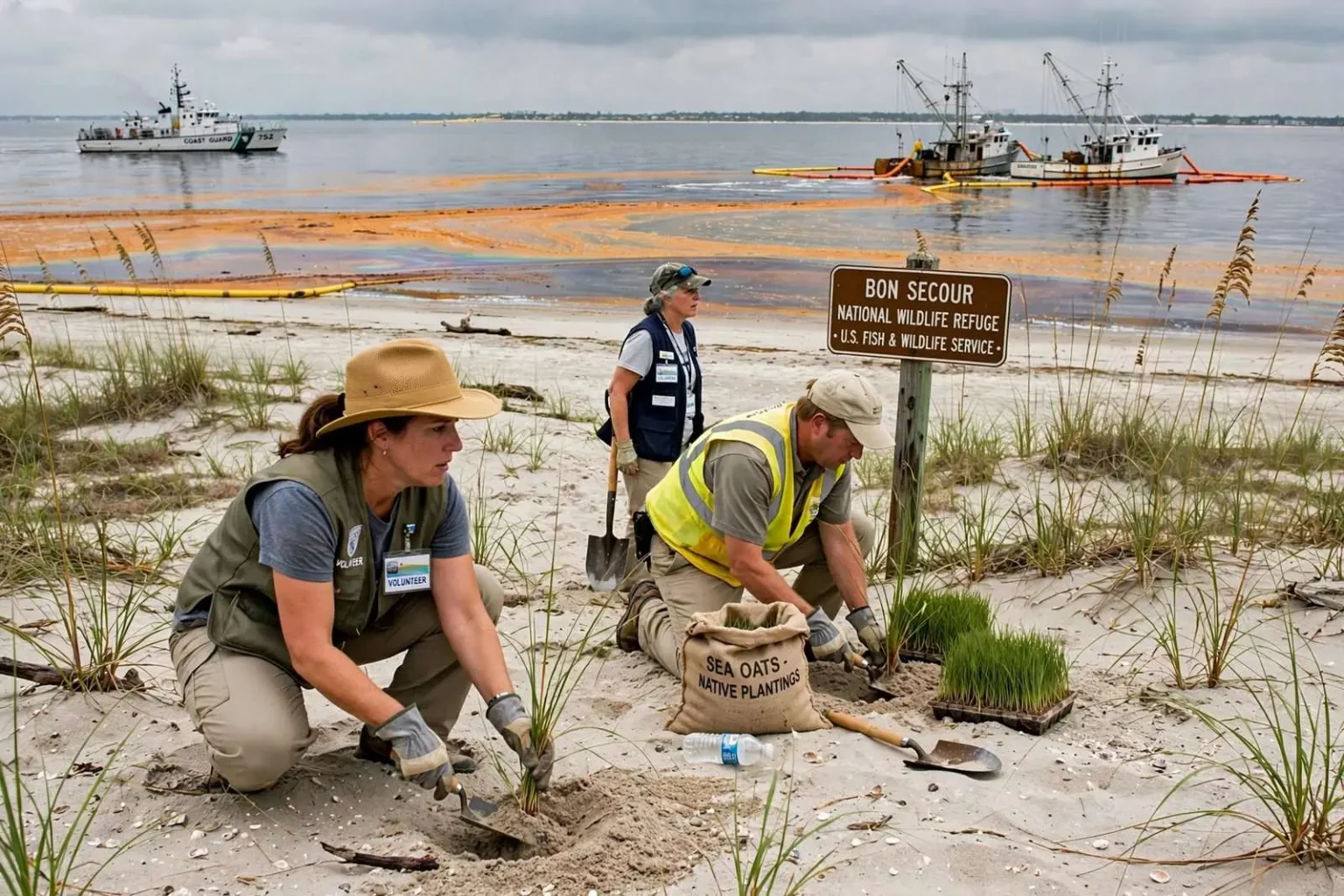
The report described volunteers planting sea oats at Bon Secour National Wildlife Refuge to help protect dunes from storm surge and oil when material began coming ashore nearby. The scene was emblematic of the summer of 2010: volunteers with planting tools working at the water’s edge while an oil slick approached from the horizon, their efforts part of a broader scramble to shield the coast’s most sensitive habitats from the spreading crude.
The report described a sheen and orange emulsified oil offshore, as well as oil on local beaches. Those stages of oil weathering — from the rainbow sheen visible on the water’s surface to the thick, pudding-like orange mousse that forms as crude mixes with seawater — marked the progression of the spill’s leading edge as it moved toward the Alabama coastline. Once emulsified oil reached the beaches, cleanup became a matter of manual removal, raking and, in heavier concentrations, mechanical collection of oiled sand.
The station reported that Coast Guard cutters and shrimp boats were working offshore as oil approached the coast. The vessels of the Vessels of Opportunity program — fishing and shrimp boats retooled for spill response — became an iconic image of the 2010 response along the Gulf Coast, as the same fishermen whose livelihoods the spill threatened were hired to deploy boom, skim oil and serve as spotters for the response effort.
Bon Secour and the dune defense effort
Bon Secour National Wildlife Refuge occupies 7,000 acres of beach, dune, scrub and maritime forest at the Fort Morgan peninsula’s western end, and it is among the most ecologically significant parcels on the Alabama coast. The refuge provides critical nesting habitat for endangered sea turtles, including loggerhead and Kemp’s ridley turtles whose nesting season runs through the summer months, along with habitat for migratory birds, the endangered Alabama beach mouse and a host of other species found nowhere else in such concentration on the Alabama coast.
The sea oat plantings that volunteers were carrying out in June 2010 served a dual purpose in the context of the spill. Sea oats and other dune vegetation anchor the sand that forms Alabama’s protective dune system, which shields inland habitat and development from storm surge. If oil killed dune vegetation, the weakened dunes would be more vulnerable to erosion in future storms — a cascading effect that made the plantings about far more than aesthetics. Volunteers and refuge staff worked throughout the response to protect the dunes, staging boom and absorbent materials in sensitive areas and coordinating with spill response officials to minimize the impact of cleanup operations themselves on the fragile habitat.
Access to parts of the refuge was restricted during the response, and biologists monitored turtle nests along the Gulf Coast with extraordinary care that summer. Concerns that oil could affect hatchlings emerging from nests during the peak season prompted unprecedented measures, including the transport of nests from oiled beaches to the Atlantic coast for hatching in cleaner sand — an extraordinary intervention that response officials undertook to protect the year’s turtle generation.
The response offshore
The offshore picture during June 2010 was one of the most complex responses in maritime history. Coast Guard cutters patrolled the waters between the well site and the shore, coordinating a fleet of skimming vessels, boom deployments and aircraft spotting surface oil. Inshore, hundreds of fishing boats enrolled in the Vessels of Opportunity program worked the nearshore waters of Mobile Bay and the Gulf, laying containment boom around the bay’s entrances and sensitive passes, including the waters around the Fort Morgan peninsula and Perdido Pass.
Despite those efforts, oil found its way through. Currents and winds pushed slick material past the offshore barriers, and by early and mid-June 2010, oiled material was appearing on Baldwin County’s beaches in visible quantities. Crews responded with rakes, shovels, sifting machines and the labor of thousands of cleanup workers, but the material kept coming with each shift of wind and tide. The June arrival of oil marked the transition from preparation to impact for Alabama’s beach communities, and the weeks that followed brought the heaviest oiling the state’s shoreline would see during the spill.
The economic effect on Baldwin County was immediate and severe. June is the heart of the vacation season, and cancellations piled up at condominiums and rental houses from Gulf Shores to Orange Beach even where oil never touched the sand. Charter fishing boats sat idle as federal authorities closed fishing grounds, and the region’s seafood industry faced testing requirements and consumer doubts even for products from unaffected waters. Claims processes established by BP to compensate affected businesses became a fixture of the summer, with business owners documenting losses that would take years to fully adjudicate.
The broader context of the spill
The Deepwater Horizon spill began with the April 20, 2010 explosion that destroyed the drilling rig and killed 11 workers. Oil flowed from the damaged well until it was capped in July, making the disaster the largest marine oil spill in American history. Baldwin County’s beaches were among the most heavily impacted shorelines in the region, and images from the summer — boom lines at Pass-a-Grille, orange mousse on white sand, workers in white suits raking the beach — became part of the national consciousness.
The June 2010 report of oil coming ashore near Bon Secour captured the moment when the disaster moved from something happening offshore to something residents could see, smell and touch on their own beaches. For volunteers planting sea oats as the material came ashore, the juxtaposition was stark: the long-term work of coastal restoration continuing alongside the immediate emergency of spill response.
In the years since, restoration funding from the spill’s legal settlements has directed major investments into coastal Alabama, including habitat restoration at Bon Secour and other refuge lands, dune restoration along the public beaches, and improvements to the coastal ecosystems that the spill threatened. The refuge remains a centerpiece of those efforts, hosting researchers, volunteers and hundreds of thousands of visitors annually who come to see the beaches, birds and sea turtles that the 2010 response worked so hard to protect.
This is a historical summary of 2010 oil-spill reporting. It is not a current beach-condition report. Readers seeking present-day information about Bon Secour National Wildlife Refuge, beach conditions or oil-related concerns along the Baldwin County coast should consult current sources from the U.S. Fish and Wildlife Service, the Alabama Department of Conservation and Natural Resources, and local authorities, since the conditions described here reflect only what was reported during the summer of 2010.
The volunteer mobilization that surrounded the plantings became one of the summer’s defining features. Along with organized response workers, residents and visitors organized independent efforts — filling sandbags, staging hay bales, planting vegetation and reporting oiled wildlife. Coordination challenges emerged as the response grew, and officials eventually worked to channel volunteer energy through official channels where it could be most effective, but the impulse behind it was genuine and widespread: people wanted to do something, and planting sea oats in the path of an approaching slick was something concrete they could do.
Wildlife impacts along the Baldwin County shoreline were documented throughout the response, with oiled birds recovered and treated at rehabilitation facilities set up during the spill. The refuge’s importance as bird habitat made it a priority for monitoring, and biologists tracked the spill’s effects on the species that depend on the peninsula’s beaches and wetlands. Sea turtle nesting continued through the summer, with nests marked, monitored and, where necessary, relocated as part of the unprecedented protective measures undertaken during the spill.
The sheen and emulsified oil described offshore in the June report were visible from the beaches themselves, and residents gathered at the shoreline in the evenings to look toward the horizon where the response fleet worked. Local news coverage during those weeks documented the emotional weight of the disaster for a community whose identity and economy are built on the water — a weight that made the eventual recovery all the more meaningful for the people who lived through it.
For Baldwin County, the lessons of June 2010 influenced everything from emergency planning to environmental stewardship in the years that followed. The county’s coastal communities invested in restoration, dune protection and habitat conservation with spill-related funding, and the volunteer networks formed during the spill evolved into lasting conservation organizations that continue to work on the coast today. The image of volunteers planting sea oats at Bon Secour as oil came ashore nearby endures as a symbol of both the vulnerability of Alabama’s coast and the commitment of the people who call it home.