Former Commissioner Steve Nodine Freed Ahead of Murder Trial
Former Mobile County Commissioner Steve Nodine walked out of federal custody this week for the first time in nearly a month, though his freedom could prove short-lived as Baldwin County authorities pressed to revisit his bond.
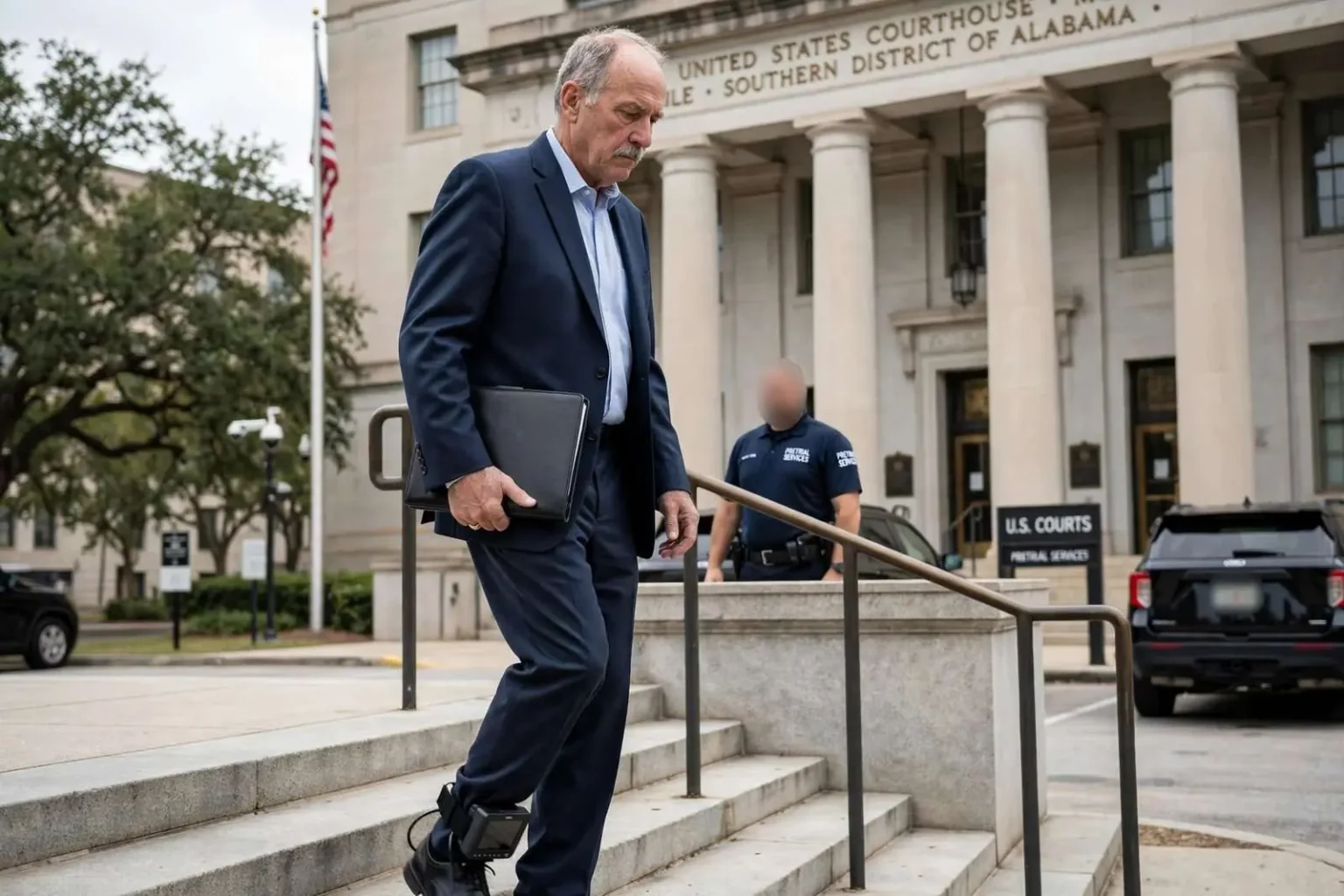
Former Mobile County Commissioner Steve Nodine tasted freedom on Wednesday for the first time in almost a month, released from federal custody as he awaited trial on a murder charge in Baldwin County. His release, his attorneys cautioned, could prove short-lived. The decision capped weeks of legal maneuvering across two court systems, and it left open questions that judges in both the federal and state cases would have to resolve in the days ahead.
Nodine walked out of federal custody under a set of conditions that court officials described as among the most restrictive available short of continued detention. He was required to remain under supervision, limit his movements, and answer to pretrial services officers in the federal system, all while the murder case against him continued to move forward in Baldwin County Circuit Court. Any misstep, his attorneys acknowledged, could put him back behind bars within hours.
How he was freed
Nodine’s release followed a decision by U.S. District Judge Ginny Granade, who affirmed an earlier order by U.S. Magistrate Judge William Cassidy allowing Nodine out of federal custody. Cassidy had attached rigorous conditions to Nodine’s movements and behavior, all of which Nodine pledged to observe. Those conditions governed where he could travel, whom he could associate with, and how his supervision would be handled while the federal charge against him worked its way toward trial.
The federal case accused Nodine of being a drug addict in possession of a firearm, an unusual charge that authorities invoked after he had already posted bond on the far more serious state count. Prosecutors in the federal system argued that his admitted drug use made his possession of firearms unlawful, and that the combination justified holding him until trial. The defense countered that he could be supervised safely in the community, and the magistrate agreed.
A local construction firm had agreed to employ Nodine upon his release, according to Gordon Armstrong, his attorney in the federal matter. The job offer was a significant element of the release package, giving the court evidence that Nodine had stable employment, a fixed daily routine, and a lawful source of income while he awaited proceedings in both cases. Employment ties are among the factors federal judges routinely weigh when deciding whether a defendant can be safely released under supervision.
Granade’s decision came as little surprise to those following the case. “It was the right ruling,” said Dennis Knizley, who along with associate John Conrad Williams is defending Nodine against the state murder charge. “I don’t think Nodine is a flight risk or a danger to the community. The judge doesn’t think either exists to any significant degree. Consequently, there’s no reason to reverse the ruling.”
Knizley noted that a magistrate’s ruling in such matters is rarely reversed by the district judge. Under the federal court structure in the Southern District of Alabama, magistrate judges handle initial appearances, bond hearings, and detention determinations in the first instance, with district judges reviewing those decisions only when a party formally objects. The review is deferential by design: the district judge examines whether the magistrate applied the proper factors, not whether a different judge might have reached a different result on the same record.
In Nodine’s case, that structure worked in his favor. The magistrate had already weighed the evidence of his ties to the community, his family connections, his promised employment, and the conditions of supervision, and had concluded that release with restrictions was adequate. Granade’s affirmation meant the decision would stand unless circumstances changed materially, and it transferred the practical business of oversight to the federal pretrial services office that would monitor his compliance.
The murder charge
Nodine faces a murder charge in Baldwin County in connection with the May 9 shooting death of Angel Downs in Gulf Shores. He has pleaded not guilty. The case has drawn intense attention across the two-county region, both because of Nodine’s prominence in Mobile County government and because of the questions surrounding the circumstances of the shooting, which investigators have spent weeks piecing together.
His freedom hinged in part on developments in that state case. Baldwin County authorities had asked Circuit Judge Charles Partin to reconsider his order reducing Nodine’s bond from $500,000 to $250,000 on the murder count. Partin set a hearing on the motion for Wednesday, June 23. Prosecutors in Baldwin County had argued that the original bond reflected the gravity of the charge, while the defense maintained that the reduction was warranted by the facts as the court found them.
According to legal observers, the judge was considered unlikely to reverse himself, given that little had changed since he entered the order, except that federal authorities had now deemed the defendant to be neither a flight risk nor a danger to himself or others. In the calculus of bond review, that federal finding carried real weight. A state judge reconsidering his own bond order looks for a material change in circumstances, and the federal court’s conclusion that supervised release was appropriate supplied exactly that, in the direction of leaving the reduced bond in place.
The conditions that govern his movements
The conditions attached by the magistrate were described as rigorous, and they will shape every part of Nodine’s daily life while both cases are pending. Supervised release of this kind typically requires regular check-ins with pretrial services officers, restrictions on travel outside the district, limits on the possession of weapons of any kind, and often treatment requirements tied to the allegations in the federal complaint. Violations can be reported to the court immediately and can result in revocation of release without a new hearing on the merits.
For Nodine, the conditions mean that the freedom he regained on Wednesday is conditional in every sense. He is free to work at the construction firm that offered him a job, to meet with his attorneys, and to prepare for trial, but nearly everything else is subject to supervision. His attorneys said he understood the terms and pledged to observe them fully, recognizing that any violation would hand prosecutors in either case a fresh argument for detention.
A rapid fall
The developments marked another turn in a swift reversal of fortune for a man who not long before had been one of the most visible elected officials in Mobile County. Nodine resigned his District 2 seat on the county commission amid impeachment proceedings, and his departure left the commission a member short and set off a crowded special election to succeed him. The seat he vacated covered a broad swath of the county, and the contest to replace it drew attention from across the local political landscape.
His legal troubles began with the federal gun and drug allegation and deepened with the murder charge out of Baldwin County. In a matter of weeks, Nodine went from presiding over county road projects and budget deliberations to facing the most serious charge in the Alabama criminal code, with parallel proceedings unfolding in federal and state courthouses on opposite sides of Mobile Bay.
When federal authorities detained him on the firearm count, it was after he had already been released on a $250,000 bond in the murder case. The federal arrest surprised even seasoned court watchers, because it came after the state court had already set conditions for his release. Prosecutors in the federal system, however, viewed his admitted drug use and his possession of firearms as a separate federal violation that the state bond did not address, and they moved to take him into custody on that basis.
Court officials in the region noted at the time that the federal charge Nodine faced was one that could be applied broadly. State court officials said federal authorities could pursue as many as 40 such “drug addict in possession of a firearm” cases a month if agents for the Bureau of Alcohol, Tobacco and Firearms and the Drug Enforcement Administration chose to bring them. The statute at the heart of the federal case makes it unlawful for a person who is an unlawful user of, or addicted to, any controlled substance to possess a firearm, and it requires no allegation that the weapon was used in any crime.
That breadth is why the charge drew comment from court officials across the region. Applied literally, it reaches a wide population of people who use controlled substances and keep firearms, and the number of potential prosecutions in any urban county would be substantial. The fact that it was brought against a recently resigned county commissioner suggested to observers that federal authorities viewed the combination of his admitted drug use and his access to weapons, including a county-issued handgun, as serious enough to justify federal intervention while the state case was pending.
The federal intervention also illustrated the practical overlap between state and federal enforcement in south Alabama. The Bureau of Alcohol, Tobacco and Firearms maintains jurisdiction over firearms offenses, and the Drug Enforcement Administration over narcotics violations, and both agencies routinely work alongside local sheriff’s offices and district attorneys in Mobile and Baldwin counties. When a local investigation surfaces evidence of a federal violation, as this one did, federal prosecutors can add charges that state prosecutors cannot bring, with different bond rules, different detention standards, and a different sentencing structure.
What remains ahead
For the moment, Nodine was free, bound by the strict conditions the magistrate imposed and by the prospect of a hearing days away that could send him back into custody. The June 23 hearing before Judge Partin on the bond reconsideration motion loomed as the next checkpoint in the state case, and federal prosecutors retained the option to seek revocation of his release if the conditions of supervision were violated in any respect.
Both the federal firearm case and the Baldwin County murder case remained pending, with trials still ahead. Neither case had been tested by the proof at trial, and the burden in each rests on the government. The federal case will be resolved in the U.S. District Court in Mobile, while the murder case proceeds in the Baldwin County courts in Bay Minette, where Circuit Judge Charles Partin’s docket will determine the pace of pretrial proceedings.
For the residents of Mobile and Baldwin counties who followed the case from the beginning, the week’s developments offered no final answers, only the latest movement in a story that has repeatedly defied prediction. A commissioner who resigned under threat of impeachment is now a private citizen facing trial, out on supervised release with a job waiting, and the legal machinery in two courthouses continues to turn toward the trials that will ultimately decide the questions the community has been asking since May.
The warnings from his own attorneys framed the moment. Release, they said, could prove short-lived, and nothing in the week’s rulings changed the underlying exposure in either case. What changed was the immediate circumstance: a man who spent almost a month in federal custody is home, under conditions, employed, and preparing to answer the charges against him in open court.