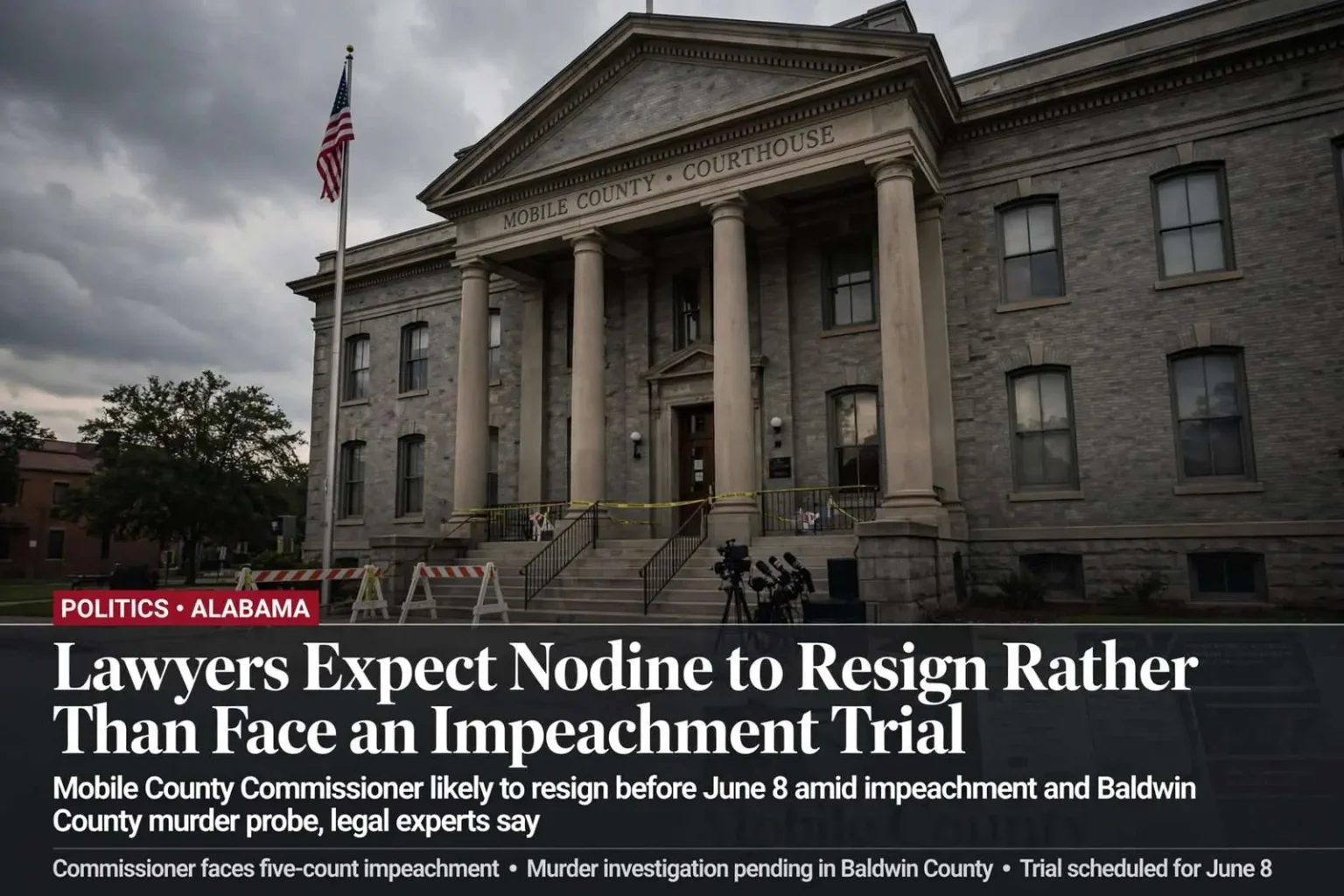
Lawyers Expect Nodine to Resign Rather Than Face an Impeachment Trial
Legal sources said Mobile County Commissioner Steve Nodine would almost certainly leave office rather than testify in an impeachment case while a possible murder charge hung over him.
Mobile County Commissioner Steve Nodine almost certainly will not be tried on the five-count bill of impeachment a grand jury returned against him, according to informed legal sources in Mobile. Those sources said it was highly likely Nodine would resign his office rather than risk having to testify in a hybrid civil-criminal proceeding while a possible murder charge hung over him in Baldwin County. The calculation placed the commissioner’s political survival in direct tension with his legal exposure, and the lawyers watching the case saw only one direction it could go.
Attorneys familiar with such cases described sound legal and tactical reasons for the maneuver. “Fighting a multi-front war is bad strategy,” said one Mobile attorney with 25 years of criminal defense experience, using considerably blunter language. A defendant facing parallel proceedings, one that could strip him of office and another that could send him to prison, must split his attention, his resources and his public message, and each proceeding complicates the defense of the other.
The problem with taking the stand
An Alabama impeachment case is governed largely by civil procedure, although the burden of proof is beyond a reasonable doubt, the criminal standard. Nodine could not be compelled to testify. But his failure to take the stand in his own defense would almost certainly lead to defeat, experienced lawyers said, because a removal trial invites the sort of fact-finding that a defendant cannot survive by silence.
If he did testify and invoked his Fifth Amendment right against self-incrimination, there was little upside for the defense, particularly if he could not assert a blanket privilege and instead had to invoke it question by question. Each refusal would arrive in open court with a reporter present, and counsel for the county could be expected to frame every invocation as an admission. Coverage of such a performance, lawyers said, could create a public perception of stonewalling that might reach a future Baldwin County jury pool and damage his prospects in a case with far higher stakes.
The dilemma is built into the structure of an impeachment proceeding. A criminal defendant facing a jury can decline to testify and rely on the state’s burden of proof; a commissioner facing removal cannot easily do the same, because the tribunal judging him is weighing fitness for office, a question he is personally positioned to answer. The choices available to Nodine were therefore narrowed to a list no one wanted: testify and arm the Baldwin County prosecution, stay silent and almost certainly lose the office, or give up the office before the trial began.
What a resignation would accomplish
Lawyers expected any resignation to arrive before the June 8 trial date. The likely aim, according to those sources, was to wipe the Mobile County slate clean: resign the office, resolve the drug case with a plea to a misdemeanor, and concentrate the defense entirely on Baldwin County. A resignation would render the impeachment case moot, remove the procedural forum that most threatened to generate damaging sworn testimony, and allow the defense team to focus its preparation and its public strategy on the single proceeding that mattered most.
The drug case was no small matter on its own, but a plea to a misdemeanor carried consequences measured in probation and fines rather than prison time, and defense attorneys routinely accept that trade to eliminate a case that could otherwise be tried in front of journalists covering both dockets. Consolidating the defense would also simplify coordination among the lawyers, witnesses and exhibits that any high-profile prosecution drags along with it.
Baldwin County authorities had identified Nodine as their sole suspect in the Mother’s Day evening shooting death of Angel Downs, 45, who was shot through the head and died in the driveway of her Fort Morgan Road townhouse in Gulf Shores while neighbors reportedly watched a red Ford pickup with government plates leave the scene. Sources said he could be indicted as soon as Monday, when Baldwin County District Attorney Judy Newcomb convened a grand jury. The prospective murder case, with a maximum sentence that dwarfed anything the impeachment and drug matters could produce, was where the defense’s future would be decided.
The state of the case
Criminal defense attorneys John Williams and Dennis Knizley were retained Tuesday afternoon to lead Nodine’s defense, replacing Matt Green. Williams and Knizley were both familiar figures in the Mobile area’s courtrooms, and their hiring signaled that the defense intended to mount a serious, professionally staffed effort across whatever proceedings remained. The midstream change in counsel came with the calendar already compressed, a sign of how quickly the case was moving from a county commission scandal into the machinery of the courts.
Circuit Judge Sarah H. Stewart was assigned to preside over the impeachment trial, set for June 8, with Chief Assistant District Attorney Nicki Patterson and Assistant District Attorney Martha Tierney leading the prosecution. A preliminary hearing was scheduled for Thursday morning, giving the parties an early courtroom appearance while the larger questions, resignation or trial, murder charge or not, remained open.
The grand jury’s impeachment action alleged corruption in office, incompetency, intemperance in the use of alcohol or narcotics, offenses involving moral turpitude and willful neglect of duty. Those statutory grounds track the traditional categories Alabama law has used since the nineteenth century to remove public officers, and they cover a wide range of conduct, from outright criminality to the chronic impairment of an official’s capacity to serve. A separate indictment charged Nodine with possession of a controlled substance, second-degree possession of marijuana and possession of drug paraphernalia.
The Mobile County Commission seat Nodine occupied made him one of three commissioners governing Alabama’s second-most populous county, a board responsible for roads, drainage, parks and other services across a jurisdiction stretching from the Mississippi line to the bay. His absence from commission business, whatever its duration, would itself have practical consequences for a county government that conducts much of its routine work through that three-member board.
Precedent in Mobile County
Impeachment proceedings are uncommon, but Patterson and Tierney previously prosecuted the impeachment of School Commissioner David Thomas Jr., who was removed from office. Thomas was defended by Donald Briskman and Christ Coumanis. Briskman had recently represented Kimberlee Nodine in her divorce filing against the commissioner, a detail that gave the local bar’s small-world quality a prominent display and linked the removal case to the commissioner’s personal as well as public troubles.
The Thomas precedent mattered for more than personnel. It demonstrated that Mobile County’s courts would entertain a removal case to judgment, that the statutory grounds could sustain an actual ouster rather than remaining theoretical, and that the prosecutors now assigned to Nodine’s impeachment had walked the path before. For the defense, the precedent cut the other way: it showed that a resignation was not merely face-saving theater but a realistic response to a proceeding that had recently ended a sitting official’s career.
How removal works in Alabama
Alabama’s constitution and statutes provide several routes for removing a public officer, and impeachment in the classic sense, with a trial before a judge and the ability to appeal, is among the less commonly invoked. The grounds written into state law, including corruption, incompetency, intemperance, moral turpitude and neglect of duty, date from an era when public officers could be removed for drunkenness as readily as for bribery, and courts have interpreted them as serious, provable charges rather than political grievances. Because the proceeding blends civil mechanics with a criminal burden of proof, it has produced a body of unusual case law that lawyers on both sides of the Nodine matter had to master quickly.
The stakes differ sharply from a criminal trial. An impeachment conviction removes an official from office and can carry a ban on holding future office, but it cannot impose imprisonment; a murder conviction can. That asymmetry explains the defense’s reported priorities and the maneuvering observers expected: no amount of procedure in the county’s civil courts could outweigh the exposure building across the bay in Baldwin County.
The clock and the remaining choices
Nodine had entered no plea in the impeachment case, had not been charged in the death of Angel Downs, and had given no public indication that he intended to leave office. The silence left the county commission, the district attorney’s office and the courts all operating in a procedural holding pattern, with a trial date on the calendar and an indictment possible within days.
Each passing deadline narrowed his options further. Once the Baldwin County grand jury acted, any negotiation over the Mobile County matters would proceed against the leverage of a pending murder case, and once the June 8 impeachment trial began, testimony given under the county’s charges would become part of the public record that any Baldwin County jury could encounter. Legal observers in Mobile described the sequence as nearly deterministic: the interests of the defense pointed overwhelmingly toward clearing the Mobile County dockets quickly, and every day of delay pushed the case toward the outcomes his attorneys were reportedly working to avoid.
For residents of the two counties, the case was becoming a rare, public lesson in how Alabama’s overlapping legal systems handle an official’s fall from grace. A county commissioner suspected in a Gulf Shores death, impeached over his conduct in office, indicted on drug charges, and facing a divorce in the same courthouse where his school-board counterpart had been removed, presented a convergence of dockets that local courts had rarely seen, and the resolution that lawyers predicted, a quiet resignation ahead of a June trial, would resolve only the first of the questions hanging over him, leaving the gravest one to be answered in Baldwin County.