A Lifelong Democrat at 84 Casts His First Republican Ballot
For 84 years John Tyson Sr. had known only one party. This month, to back a candidate for Mobile County district attorney, the veteran Democrat did something he had never done before: he asked for a Republican primary ballot.
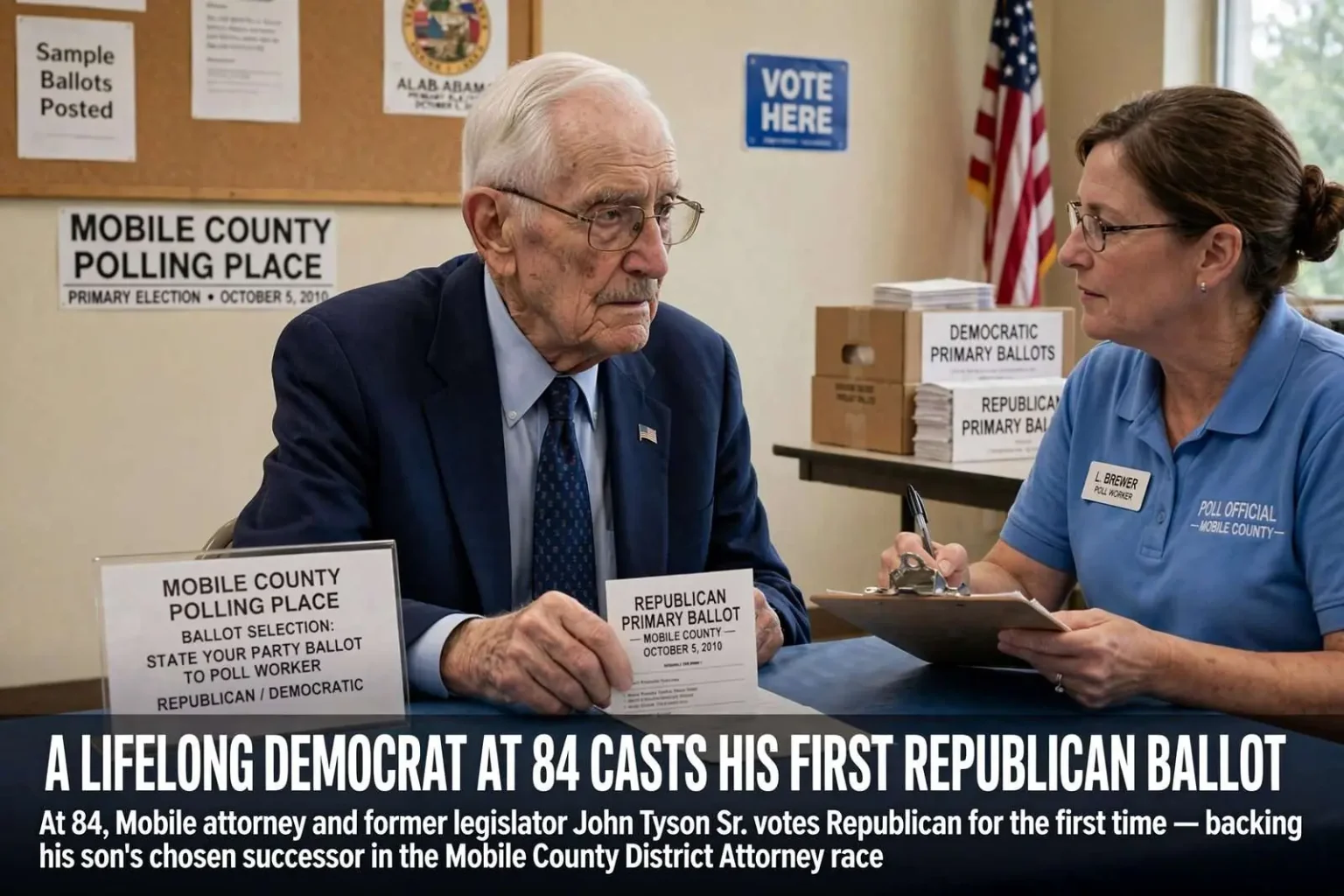
For 84 years, John Tyson Sr. had known only one political home. Born into a Democratic family and raised on Democratic loyalty, the Mobile attorney and former legislator had never voted any other way. Then, earlier this month, when a poll worker asked which party’s primary he wished to vote in, Tyson said a word he had never said before at the ballot box: “Republican.”
“It was a hard word to say,” Tyson admitted. “But it didn’t hurt too bad. I knew what I had to do.”
The moment was a long time coming, and Tyson treated it with the mixture of gravity and amusement that a man of his years brings to a first. Alabama’s primaries require voters to choose a party’s ballot on the spot, so the crossover is not a secret act but a declared one — spoken aloud to a poll worker, recorded in the moment, and for Tyson, remembered.
A Vote for Family, and for the Office
What moved him was not ideology but a race close to home. His son, John Tyson Jr., the 16-year Mobile County district attorney and himself a lifelong Democrat, had chosen not to seek re-election. Instead, the younger Tyson threw his support behind a member of his own staff, Assistant District Attorney Ashley Rich, a member of the Mobile County Republican Executive Committee who stepped up to challenge early GOP candidate and former party chairman Mark Erwin.
To vote for Rich, Tyson Sr. had to cross over. He said he intended to do it again in the fall, even though former U.S. Attorney Don Foster would appear on the ballot as the Democratic nominee for the office. If you support a candidate through a campaign, Tyson reasoned, you support her through the entire election cycle.
“I thought it was very important to get the best D.A. who knows what needs doing,” he said. “With a tremendous amount of crime, you need someone who is schooled in dealing with it.” He said he also voted for U.S. Rep. Jo Bonner, a friend, and added with a shrug, “Frankly, I didn’t have a governor to vote for, but that’s not unusual.”
The endorsement by inheritance was unusual in Alabama politics: a sitting district attorney steering his own succession by backing a prosecutor from the opposite party, and a patriarch following across party lines to make it stick. In Mobile County, where the district attorney’s office handles one of the state’s largest caseloads, the succession fight drew attention precisely because the Tyson name had defined the office for a generation and a half.
Roots in a One-Party South
Tyson’s reluctance carried the weight of family history. His grandfather, he said, was an early organizer of the Democratic Party, and his mother was among the first women to run for office in Florida. When Tyson served in the Legislature, he recalled, there was scarcely a Republican to be found.
In truth, he suggested, the labels had always been looser than they looked. “The Democrats in the South were always independents,” he said. “Technically, we were Democrats to get out from under the heel of Reconstruction.” A politician needed a party, and in the South the Democrats were the only one on offer.
That began to change, by his reckoning, in 1964. “Everything swung to the Republican side” from that point, Tyson said. “Since that time, the Democrats have been on the wane. The money, the power, the media is on the other side.”
His timeline tracks with the political history of the region. The Republican takeover of the South unfolded in stages — presidential politics first, then Congress and the statehouses, and finally, over decades, the courthouse offices and legislative seats that one-party Democrats had held since Reconstruction. Tyson lived through each stage, first as a legislator in the waning days of Democratic dominance, then as an observer of the realignment that made his own crossover vote possible without scandal.
Independence Over Party
Even in crossing over, Tyson would make an unlikely party spokesman. “Republicans put party first and the country second,” he said. “We don’t do it that way.” His vote for Rich, he explained, echoed a philosophy he attributed to his son: the best party is the one that has the least to say about how a prosecutor runs the office.
“I preferred to have the girl not being so tied to the party to the point that she can’t use her own best judgment,” he said.
That view of the district attorney’s office — as a post that belongs to the officeholder’s judgment more than to any party — has been a recurring theme in the Tyson family’s long association with it. John Tyson Jr.’s sixteen years in the office spanned cases and controversies that drew both criticism and praise from across the political spectrum, and the elder Tyson’s argument for Rich was built on continuity of professional judgment rather than partisan alignment.
As for the local Democratic organization he had belonged to all his life, Tyson offered a rueful assessment. “We still don’t have a Democratic Party locally; maybe one day they’ll get organized,” he said. “With the Republicans you have way too much party and with the Democrats way too little.”
A Career of Almosts and Service
An attorney who nearly won a seat in Congress almost half a century earlier, Tyson had watched the political ground shift beneath Mobile for decades. His career traced the arc of the city’s civic life — the Legislature, the law practice, the boards and campaigns and county conventions through which Mobile’s establishment has always governed itself. The near-miss in Congress remained part of his story, a reminder that his generation of Mobile Democrats contested seats that their successors could no longer win.
This month, at 84, he stepped across the line himself. The vote was one ballot in one primary, but it compressed a century of Southern political history into a single exchange with a poll worker: a man whose grandfather helped organize the Democratic Party in a one-party South declaring, quietly and without regret, that his loyalty ran to people and offices rather than to a party name — and that, this year, that meant saying a word he had never said before.
Mobile County’s electorate has grown accustomed to such crossings in both directions. Open primaries allow voters to choose their ballot contest by contest, and long-serving public figures frequently carry coalitions that ignore party labels. But the sight of an 84-year-old lifelong Democrat voting Republican — to elevate his son’s chosen successor as the county’s top prosecutor — was a singular coda to a political lifetime, delivered in Tyson’s own dry register: a hard word to say, he admitted, but one that didn’t hurt too bad.
The fall election, with Rich and Foster facing each other for the district attorney’s office, would test whether the rest of Mobile County’s voters agreed with the judgment the elder Tyson rendered in the primary — one last race shaped, at its origin, by a family decision and a word spoken at the ballot box for the first time in eighty-four years.
The Office at Stake
The Mobile County district attorney’s office is one of the busiest prosecutorial offices in Alabama, responsible for felony and misdemeanor prosecutions across the state’s second-most-populous county — everything from capital murder cases in downtown courtrooms to the daily docket work that moves through the city and county courthouses. Sixteen years of John Tyson Jr.’s tenure had given the office a long, continuous administration, and his decision not to seek re-election made the 2010 race the first genuinely open contest for the post in a generation.
That openness drew candidates from both parties. Ashley Rich, an assistant district attorney inside the office, carried the sitting administration’s endorsement and the practical advantage of hands-on experience with the office’s caseload, though her seat on the Mobile County Republican Executive Committee tied her visibly to the GOP. Mark Erwin, a former county party chairman, entered the primary as the early Republican contender with deep organizational ties of his own. On the Democratic side, former U.S. Attorney Don Foster eventually carried the party’s banner into the fall — the nominee Tyson said he respected but would not support after backing Rich in the primary.
The unusual alignment put party loyalty under strain from every direction: a Democratic incumbent backing a Republican staffer, a lifelong Democratic family voting in a Republican primary, and a general election that would ask Mobile County voters to choose between a prosecutor endorsed across party lines and a Democratic nominee with federal prosecutorial credentials of his own.
Crossover Voting in Alabama
Alabama does not register voters by party, and its open primary system means every voter chooses a party ballot at each election. Crossover voting is therefore common and unremarkable in much of the state — Republicans routinely vote in Democratic primaries in counties where the real contest is on the Democratic side, and Democrats do the same in reverse. What made Tyson’s crossover a story was not the mechanics but the man: an 84-year-old whose family history ran to the founding of the Democratic Party itself, crossing over for the first time in his life and saying so plainly.
The episode also illustrated how local politics in Mobile has often worked beneath the partisan surface — through families, professional relationships and the personal credibility that prosecutors, in particular, must carry across party lines. Tyson’s vote was cast for competence and continuity as he saw them, with a shrug at the party question. “It was a hard word to say,” he repeated — and then, with the same dry humor, he moved on to the rest of the ballot, where an old friend named Bonner was running again.