‘Be a Man’: Stranger Confronts Nodine in Mobile County Courtroom
A well-dressed man described as a rival for the affections of Angel Downs called on Commissioner Steve Nodine to admit what he did, moments after a preliminary impeachment hearing adjourned.
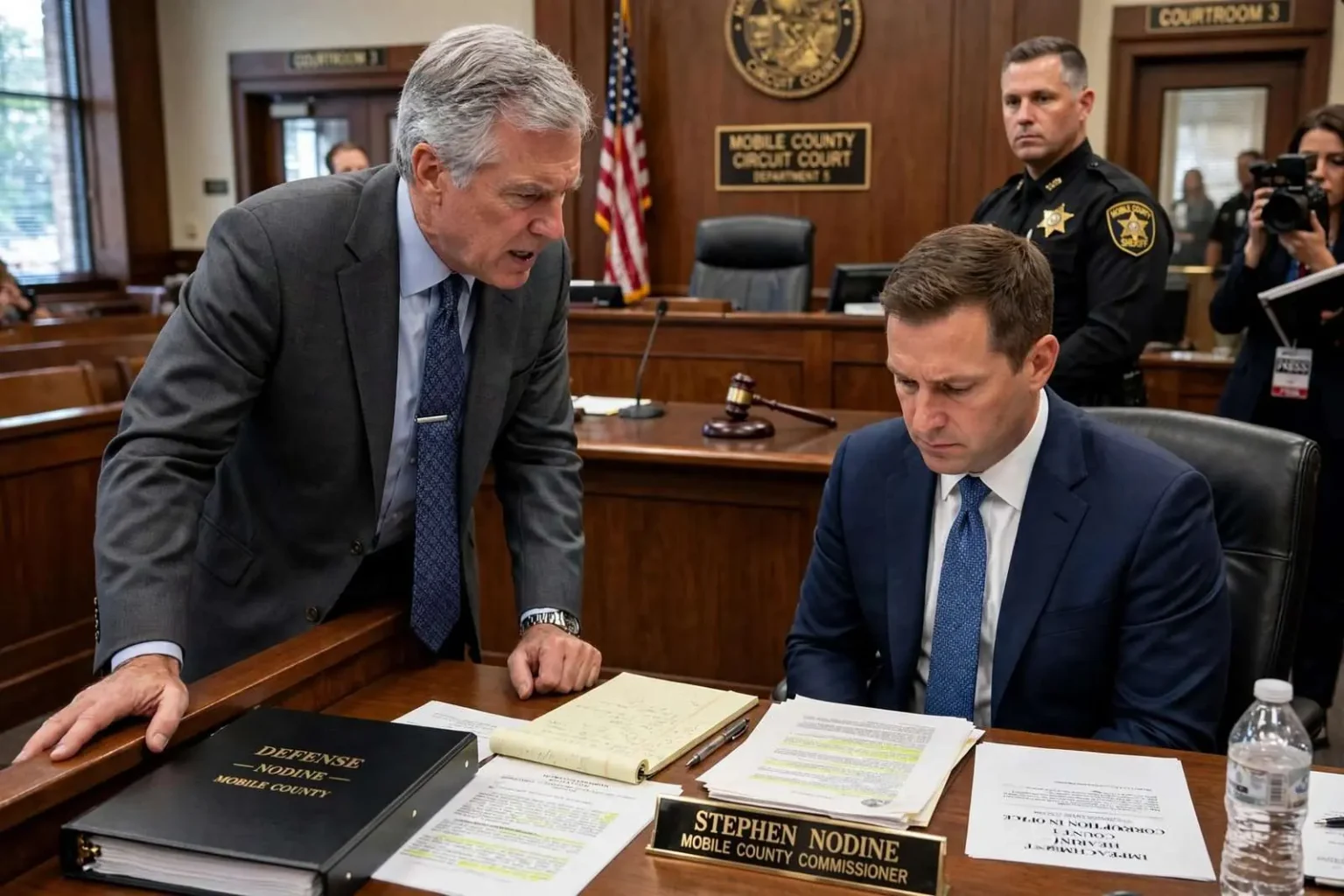
A tall, gray-haired man in an expensive suit, described by courthouse regulars as another man in Angel Downs’ life, confronted Mobile County Commissioner Stephen Nodine in a courtroom Thursday, calling on him to admit responsibility for her death.
“Do the right thing, Steve, admit what you did,” the man said, clearly and forcefully but short of a shout. “Be a man.”
Moments after the gavel
The encounter came just after Mobile County Circuit Judge Sarah H. Stewart adjourned a preliminary hearing in the impeachment action a grand jury brought against Nodine. Trim, clean-cut and well dressed, the man appeared to be in his mid-forties. He declined to give his name when questioned by reporters in the hallway afterward, saying only that the last had not been heard from him.
One of Nodine’s attorneys, John Williams, said the defense team did not know who the man was, though someone suggested he might be a Baldwin County financial adviser who had been in a relationship with Downs. Williams said the outburst probably would have drawn a reprimand from the court had Stewart not already left the bench.
The timing made the moment possible. A courtroom fills and empties in minutes around a hearing like that one, and the interval between the judge’s exit and the lawyers’ gathering of files was all the opening the man needed. By the time deputies understood what was happening, it was over — a few sentences delivered across a courtroom, a commissioner seated at his counsel table, and a room full of witnesses who understood they had just seen something no procedural hearing had promised.
For Nodine, who had spent weeks as the subject of a murder investigation he had not been charged in, the confrontation compressed the whole affair into a single public scene: a man grieving a woman’s death, standing over him in open court, demanding an admission. Whatever the legal eventualities, the image traveled out of the building within the hour.
Security tightens
Courthouse security personnel said hearings related to the Nodine case would draw extra scrutiny going forward. The exchange was a reminder that a case being argued in the language of statutes and standards of proof had, at its center, the violent death of a woman with family, friends and a life outside the courtroom.
Security planning for high-emotion hearings is standard practice in courthouses, but the Nodine case presented an unusual combination: a sitting county commissioner, an uncharged homicide investigation, a pending impeachment and a gallery packed with press. Deputies who staff metal detectors and courtroom aisles for a living measure risk by the emotions in the room, and this room had more of them than the docket usually supplied.
Downs, 45, was shot through the head and died in the driveway of her townhouse off Fort Morgan Road in Gulf Shores on the evening of Sunday, May 9. Baldwin County authorities named Nodine the only suspect in the murder investigation. He had not been charged.
The geography of the case ran through the bay. Downs was a Gulf Shores real estate agent whose death happened in Baldwin County, where the homicide investigation lived. Nodine was a Mobile County commissioner whose alleged misconduct in office had been presented to a Mobile County grand jury. The two proceedings moved on separate tracks, in separate courthouses, each with the power to end his career in a different way — and neither in a hurry.
The impeachment case
Nodine faced a five-count bill of impeachment returned by a Mobile County grand jury, alleging corruption in office, incompetency, intemperance in the use of alcohol or narcotics, offenses involving moral turpitude and willful neglect of duty. A separate indictment charged him with possession of a controlled substance, second-degree possession of marijuana and possession of drug paraphernalia.
Impeachment is a mechanism Alabama keeps for officials the ballot cannot reach mid-term, and it proceeds more like a civil case than a criminal one — no proof beyond reasonable doubt required, and removal from office as the remedy. The grand jury’s five counts covered a range of alleged misconduct stretching well beyond the events in Gulf Shores, painting a picture of a commissioner whose personal conduct had overtaken his public duties.
The drug indictment, by contrast, was an ordinary criminal case that could be tried on an ordinary schedule. Its charges were modest by felony standards, but its facts — drawn from the same investigation that followed the discovery of Downs’s body and a county vehicle in Gulf Shores — kept it tethered to the larger story no matter how the courtroom calendars sorted it.
Criminal defense attorneys Williams and Dennis Knizley had recently taken over the defense, replacing Matt Green. Chief Assistant District Attorney Nicki Patterson and Assistant District Attorney Martha Tierney were leading the prosecution, with trial set for June 8 before Judge Stewart.
The change of counsel signaled preparation for a long fight. Williams and Knizley were among the most experienced criminal defense lawyers on the Gulf Coast, and their arrival suggested Nodine’s team expected the drug case, the impeachment and whatever Baldwin County brought to be contested in full rather than negotiated quietly away.
Informed legal sources continued to say that Nodine would more likely resign than stand trial on the impeachment counts while a homicide investigation remained open in another county. Baldwin County District Attorney Judy Newcomb was expected to convene a grand jury the following Monday.
That calculus — resignation as the path of least damage — ran through every conversation in the courthouse that week. An impeachment trial would air the grand jury’s allegations in a public forum with the commissioner as a witness against himself in effect, and it would unfold simultaneously with a murder investigation that had already claimed his reputation. Resignation would end the impeachment, leave the criminal cases to run their course, and spare the county a spectacle it had never seen before.
Whether Nodine saw it that way remained the open question. He had continued to attend commission business, continued to appear with counsel and continued to maintain, through his lawyers, that he had done nothing criminal. Associates described a man preparing to fight rather than fold, even as the calendar marched toward the Baldwin County grand jury and the June 8 trial date.
A city watching closely
The hearing drew a full gallery, an unusual sight for what was, procedurally, a routine scheduling matter. With the June 1 primaries less than two weeks away, and with a county commission seat potentially coming open, the case had become the fixed point around which the rest of Mobile County politics turned.
The political implications stacked up behind the legal ones. Nodine’s district covered a large share of the county, and his absence — temporary or permanent — left constituents without the representation they had elected, while prospective successors quietly measured the timing of their ambitions. Candidates for other offices found every forum asked about the commissioner’s fate before any issue of county business.
That is what made the courtroom outburst resonate beyond its few seconds. The county’s government, its Republican primary ballot and its courthouse dockets had all bent around the case of Stephen Nodine, and into that charged room walked a private citizen who said what no official process yet said aloud. The judges, prosecutors and defense attorneys would spend the summer arguing over counts and standards of proof. The man in the expensive suit had gone home, unnamed, having tried to cut through all of it with six words: admit what you did — be a man.
What happens next follows a schedule rather than a script. The Baldwin County grand jury meets Monday, and whatever it returns — an indictment, or no indictment — will reshape the calculations of every lawyer in the case. The impeachment counts wait on Judge Stewart’s calendar, and the drug trial holds its June 8 date unless the defense’s new attorneys move it. In the middle sits a county commission that must conduct its business with one of its five seats shadowed by all of it.
Courtroom observers said the commissioner showed no visible reaction as the man spoke. Deputies did not approach him, no charge of contempt was mentioned, and the hearing’s official record ended where it always would have — with the gavel, the continuance, and the date. But everyone in the gallery understood that the day’s real testimony had come after the record closed, from a man no one could identify, speaking for a woman who could no longer speak for herself.
The episode also settled one practical question for the weeks ahead. Whatever the man’s identity, courthouse officials made clear that the next hearing would be run differently — more deputies in the room, gallery access managed more tightly, and the intervals after gavels watched as closely as the arguments themselves. The Nodine case had already redrawn the boundaries between public access and public order in the building once; no one expected it to stop there.